

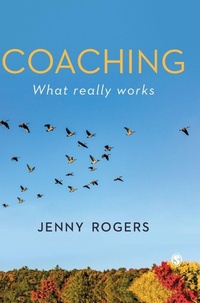
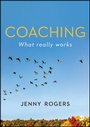
Coaching - What Really Works
1st Edition
Published on 25. March 2021
Book
Hardback
192 pages
978-1-5297-4473-6 (ISBN)
Description
This is your essential companion to being a coach. Author Jenny Rogers distills her decades of experience to guide you through the challenges and pitfalls, joys and rewards, and dos and don'ts of coaching. Whether you are a qualified coach many years into practice, or a trainee moving into your first placement, the book provides a treasure trove of practical strategies and skills, theories and concepts that will enhance your practice. It captures what it takes to be a successful coach, and will support and inspire you to become a more confident, self-reflective practitioner.
Reviews / Votes
An apparently simple text, this one by Jenny Rogers is in reality not only full of considerations and reflections but numerous and effective, bibliographic references, as well as advice and suggestions that arise from professional experience. -- Andrea Castiello d'AntonioMore details
Language
English
Place of publication
London
United Kingdom
Target group
Professional and scholarly
Dimensions
Height: 250 mm
Width: 175 mm
Thickness: 15 mm
Weight
520 gr
ISBN-13
978-1-5297-4473-6 (9781529744736)
Copyright in bibliographic data and cover images is held by Nielsen Book Services Limited or by the publishers or by their respective licensors: all rights reserved.
Schweitzer Classification
Other editions
Additional editions
Jenny Rogers
Coaching - What Really Works
Book
03/2021
1st Edition
SAGE Publications Ltd
€62.10
Shipment within 15-20 days
Jenny Rogers
Coaching - What Really Works
E-Book
02/2021
1st Edition
SAGE Publications Ltd
€54.99
Available for download
Jenny Rogers
Coaching - What Really Works
E-Book
02/2021
1st Edition
SAGE Publications Ltd
€54.99
Available for download
Jenny Rogers
Coaching - What Really Works
E-Book
02/2021
1st Edition
SAGE Publications Ltd
€54.99
Available for download
Person
Jenny Rogers was an early entrant to the world of coaching, beginning when she ran the BBC's management development department after earlier careers in teaching, television production and publishing. She left the BBC to start her own coaching company and has been a coach ever since, specializing in the world of senior executives. As well as working with her own coaching clients, she trains and supervises other coaches.
Her books range from a 4th edition of Coaching Skills: The Definitive Guide to Being a Coach, a book used around the world as the 'Bible' on how to be a coach, to her four best-selling books on the psychometric instruments, the MBTI and the FIRO-B. She has also written books about how to start a coaching business, how to navigate career crises and how to get through a job interview successfully.
Jenny was married for many years to the former BBC Editor and journalist Alan Rogers. He died in 2010. She lives in central London and is close to her two sons and three grandchildren. She is a keen cook, cat lover, filmgoer and walker.
Website: www.JennyRogersCoaching.com
Her books range from a 4th edition of Coaching Skills: The Definitive Guide to Being a Coach, a book used around the world as the 'Bible' on how to be a coach, to her four best-selling books on the psychometric instruments, the MBTI and the FIRO-B. She has also written books about how to start a coaching business, how to navigate career crises and how to get through a job interview successfully.
Jenny was married for many years to the former BBC Editor and journalist Alan Rogers. He died in 2010. She lives in central London and is close to her two sons and three grandchildren. She is a keen cook, cat lover, filmgoer and walker.
Website: www.JennyRogersCoaching.com
Content
Introduction
1. Making sure that you have a real client
2. Drawing those boundaries
3. Negotiating the confidentiality maze
4. Listening for the client's boundaries
5. Staying within your areas of competence
6. Breaking the boundaries
7. Faking it is not making it
8. Switching off judgement
9. Looking openly at the coach-client relationship
10. Being authentic
11. Exploring the backstory
12. Understanding attachment
13. Becoming trauma-aware
14. Avoiding the lure of rescuing
15. Working with rescuers
16. Coaching the perfectionist
17. Getting away from endless intellectualizing
18. Using psychometrics wisely
19. Giving feedback - carefully
20. Collecting bespoke feedback for clients
21. Understanding that change isn't as easy as it may look
22. Working with Loss
23. Coaching through crisis
24. Working on life purpose
25. Putting away the toolbox
26. Understanding the challenges of becoming a coach
27. Continuing to learn, staying connected
28. Remembering that you are vulnerable too
29. Getting a supervisor
Conclusion
Further Reading
1. Making sure that you have a real client
2. Drawing those boundaries
3. Negotiating the confidentiality maze
4. Listening for the client's boundaries
5. Staying within your areas of competence
6. Breaking the boundaries
7. Faking it is not making it
8. Switching off judgement
9. Looking openly at the coach-client relationship
10. Being authentic
11. Exploring the backstory
12. Understanding attachment
13. Becoming trauma-aware
14. Avoiding the lure of rescuing
15. Working with rescuers
16. Coaching the perfectionist
17. Getting away from endless intellectualizing
18. Using psychometrics wisely
19. Giving feedback - carefully
20. Collecting bespoke feedback for clients
21. Understanding that change isn't as easy as it may look
22. Working with Loss
23. Coaching through crisis
24. Working on life purpose
25. Putting away the toolbox
26. Understanding the challenges of becoming a coach
27. Continuing to learn, staying connected
28. Remembering that you are vulnerable too
29. Getting a supervisor
Conclusion
Further Reading