

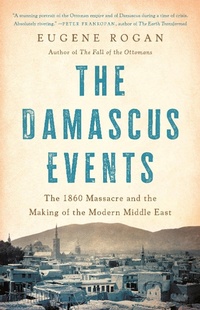
The Damascus Events
The 1860 Massacre and the Making of the Modern Middle East
Published on 7. May 2024
Book
Hardback
400 pages
978-1-5416-0427-8 (ISBN)
Description
A Financial Times Best History Book of the Year
An award-winning scholar’s account of an ancient city’s descent into unprecedented communal violence—an event that would mark the end of the old Ottoman order and the beginning of the modern Middle East.
“A stunning portrait of the Ottoman empire and of Damascus during a time of crisis. Absolutely riveting.” —Peter Frankopan, author of The Silk Roads
On July 9, 1860, a violent mob swept through the Christian quarters of Damascus. For eight days, violence raged, leaving five thousand Christians dead, thousands of shops looted, and churches, houses, and monasteries razed. The sudden and ferocious outbreak shocked the world, leaving Syrian Christians vulnerable and fearing renewed violence.
Drawn from never-before-seen eyewitness accounts of the Damascus Events, eminent Middle East historian Eugene Rogan tells the story of how a peaceful multicultural city came to be engulfed in slaughter. He traces how rising tensions between Muslim and Christian communities led some to regard extermination as a reasonable solution. Rogan also narrates the wake of this disaster, and how the Ottoman government moved quickly to retake control of the city, end the violence, and reintegrate Christians into the community. These efforts to rebuild Damascus proved successful, preserving peace for the next 150 years until 2011.
The Damascus Events offers a vivid history, one that masterfully uncovers the outbreak of violence that unmade a great city and examines the possibility, even after searing conflict and unimaginable tragedy, of repair.
An award-winning scholar’s account of an ancient city’s descent into unprecedented communal violence—an event that would mark the end of the old Ottoman order and the beginning of the modern Middle East.
“A stunning portrait of the Ottoman empire and of Damascus during a time of crisis. Absolutely riveting.” —Peter Frankopan, author of The Silk Roads
On July 9, 1860, a violent mob swept through the Christian quarters of Damascus. For eight days, violence raged, leaving five thousand Christians dead, thousands of shops looted, and churches, houses, and monasteries razed. The sudden and ferocious outbreak shocked the world, leaving Syrian Christians vulnerable and fearing renewed violence.
Drawn from never-before-seen eyewitness accounts of the Damascus Events, eminent Middle East historian Eugene Rogan tells the story of how a peaceful multicultural city came to be engulfed in slaughter. He traces how rising tensions between Muslim and Christian communities led some to regard extermination as a reasonable solution. Rogan also narrates the wake of this disaster, and how the Ottoman government moved quickly to retake control of the city, end the violence, and reintegrate Christians into the community. These efforts to rebuild Damascus proved successful, preserving peace for the next 150 years until 2011.
The Damascus Events offers a vivid history, one that masterfully uncovers the outbreak of violence that unmade a great city and examines the possibility, even after searing conflict and unimaginable tragedy, of repair.
More details
Language
English
Product notice
sewn/stitched
Cloth over boards
Illustrations
Illustrations
Dimensions
Height: 236 mm
Width: 155 mm
Thickness: 38 mm
Weight
612 gr
ISBN-13
978-1-5416-0427-8 (9781541604278)
Copyright in bibliographic data and cover images is held by Nielsen Book Services Limited or by the publishers or by their respective licensors: all rights reserved.
Schweitzer Classification
Person
Eugene Rogan is professor of modern Middle Eastern history at the University of Oxford and the director of the Middle East Centre at St. Antony's College, Oxford. The author of numerous books, including the international bestsellers The Arabs and The Fall of the Ottomans, Rogan is the recipient of the Albert Hourani Prize. He lives in Oxford, England.