

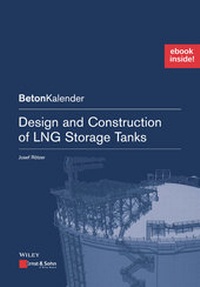
Design and Construction of LNG Storage Tanks
(Package: Print + ePDF)
1st Edition
Published on 18. September 2019
Book
Mixed media product
IX, 121 pages
978-3-433-30000-8 (ISBN)
Description
Worldwide, the use of natural gas as a primary energy source will remain indispensable for decades to come. This applies to industrialized and emerging countries as well as developing countries. Due to the low level of impurities, natural gas is considered to be a climate-friendly fossil fuel because of low CO2 emissions, and to be at the same time an affordable source of energy.
In order to enable transport over long distances as well as over oceans the gas is liquefied along with a considerable volume reduction and then transported by ship. Thus, at international ports many LNG tanks are required for temporary storage and further use. The trend towards smaller liquefaction and evaporation plants with associated storage tanks for use as marine fuel has created new entrants who often do not yet have the necessary experience and technical expertise. It is not sufficient to refer all existing technical standards when defining consistent state of the art specifications and requirements.
The switch to European standardization made the revision and adaptation of existing national standards to a European standard unavoidable. Technical committees at national and international level have begun their work to update and complete the EN 14620 series.
Also, the US regulations are updated. The revision of the American Concrete Institute standard ACI 376 "Requirements for Design and Construction of Concrete Structures for the Containment of Refrigerated Liquefied Gases", which was first published in 2011, will be completed in the spring of 2019 and the final version will be published in autumn 2019.
This book provides an overview of the state of the art in design and construction of liquefied natural gas (LNG) tanks. Since the topic is very extensive and complex, here an introduction to all areas is given, e. g. requirements and design for operating conditions, thermal design, liquid and gas pressure test, soil analysis and permitted settlement, modeling and calculation of the concrete structure, and the special effects from fire, explosion and impact. Furthermore, the dynamic analysis and the theory of the sloshing liquid is presented.
(Package: Print + ePDF)
In order to enable transport over long distances as well as over oceans the gas is liquefied along with a considerable volume reduction and then transported by ship. Thus, at international ports many LNG tanks are required for temporary storage and further use. The trend towards smaller liquefaction and evaporation plants with associated storage tanks for use as marine fuel has created new entrants who often do not yet have the necessary experience and technical expertise. It is not sufficient to refer all existing technical standards when defining consistent state of the art specifications and requirements.
The switch to European standardization made the revision and adaptation of existing national standards to a European standard unavoidable. Technical committees at national and international level have begun their work to update and complete the EN 14620 series.
Also, the US regulations are updated. The revision of the American Concrete Institute standard ACI 376 "Requirements for Design and Construction of Concrete Structures for the Containment of Refrigerated Liquefied Gases", which was first published in 2011, will be completed in the spring of 2019 and the final version will be published in autumn 2019.
This book provides an overview of the state of the art in design and construction of liquefied natural gas (LNG) tanks. Since the topic is very extensive and complex, here an introduction to all areas is given, e. g. requirements and design for operating conditions, thermal design, liquid and gas pressure test, soil analysis and permitted settlement, modeling and calculation of the concrete structure, and the special effects from fire, explosion and impact. Furthermore, the dynamic analysis and the theory of the sloshing liquid is presented.
(Package: Print + ePDF)
More details
Series
Edition
1. Auflage
Language
English
Place of publication
Berlin
Germany
Target group
Professional and scholarly
Illustrations
17
70 s/w Abbildungen, 17 s/w Tabellen
Dimensions
Height: 24.4 cm
Width: 17 cm
Thickness: 1.5 cm
Weight
524 gr
ISBN-13
978-3-433-30000-8 (9783433300008)
Schweitzer Classification
Other editions
Complete work / Part of the work
Josef Rötzer
Design and Construction of LNG Storage Tanks
E-Book
08/2019
1st Edition
Ernst & Sohn
€52.99
Available for download
Persons
Dr.-Ing. Josef Rötzer (born 1959) studied civil engineering at the Technical University of Munich and later got his Ph.D. at the Bundeswehr University Munich. From 1995 on he worked in the technical head office of Dyckerhoff & Widmann (DYWIDAG) AG in Munich. His area of responsibility included engineering design of industrial and power plant structures. The DYWIDAG LNG Technology competence area with focus on the planning and worldwide construction of liquefied gas tanks was integrated into STRABAG International in 2005. Josef Rötzer is a member of the working group for tanks for cryogenic liquefied gases of the German Standards Committee and of the American committee ACI 376.
Content
1 Introduction
2 History of natural gas liquefaction
2.1 Industrialisation and energy demand
2.2 The beginnings of gas liquefaction
2.3 The first steps towards transport in ship
2.4 Algeria becomes the first exporter
2.5 Further development with peak-shaving plants
2.6 The first German LNG tank in Stuttgart
2.7 Wilhelmshaven - the attempt to establish a German receiving terminal
2.8 The liquefaction of gas in Australia
2.9 Pollutant emissions limits in the EU
3 Regulations and their scope of applicability
3.1 History of the regulations
3.2 EEMUA publication No. 147 and BS 7777
3.3 LNG installations and equipment - EN 1473
3.4 Design and construction of LNG tanks - EN 14620
3.5 API 620 - the American standard for steel tanks
3.6 API 625 - combining concrete and steel
3.7 ACI 376 - the American standard for concrete tanks
4 Definition of different tank types
4.1 Definition and development of the different types of tank
4.2 Single containment tank system
4.3 Double containment tank system
4.4 Full containment tank system
4.5 Membrane tank system
5 Performance requirements and design
5.1 Performance requirements for normal operation
5.2 Thermal design
5.3 Hydrostatic and pneumatic tests
5.4 Soil survey, soil parameters and permissible settlement
5.5 Susceptibility to soil liquefaction
6 Tank analysis
6.1 Requirements for the analysis of the concrete structure
6.2 Requirements for the model of the concrete structure
6.3 Strut-and-tie models for discontinuity regions
6.4 Liquid Spill
6.5 Fire load cases
6.6 Explosion and Impact
7 Dynamic analysis
7.1 Theory of the sloshing fluid
7.2 Housner`s method
7.3 Veletsos` method
7.4 Provisions in EN 1998-4, annex A
7.5 Seismic design of LNG tanks
8 Construction
8.1 Construction phases and procedure
8.2 Wall formwork
8.3 Reinforcement
8.4 Prestressing
8.5 5 Tank equipment (inclinometers, heating)
8.6 Construction joints
8.7 Curing of concrete surfaces
9 Summary
References
2 History of natural gas liquefaction
2.1 Industrialisation and energy demand
2.2 The beginnings of gas liquefaction
2.3 The first steps towards transport in ship
2.4 Algeria becomes the first exporter
2.5 Further development with peak-shaving plants
2.6 The first German LNG tank in Stuttgart
2.7 Wilhelmshaven - the attempt to establish a German receiving terminal
2.8 The liquefaction of gas in Australia
2.9 Pollutant emissions limits in the EU
3 Regulations and their scope of applicability
3.1 History of the regulations
3.2 EEMUA publication No. 147 and BS 7777
3.3 LNG installations and equipment - EN 1473
3.4 Design and construction of LNG tanks - EN 14620
3.5 API 620 - the American standard for steel tanks
3.6 API 625 - combining concrete and steel
3.7 ACI 376 - the American standard for concrete tanks
4 Definition of different tank types
4.1 Definition and development of the different types of tank
4.2 Single containment tank system
4.3 Double containment tank system
4.4 Full containment tank system
4.5 Membrane tank system
5 Performance requirements and design
5.1 Performance requirements for normal operation
5.2 Thermal design
5.3 Hydrostatic and pneumatic tests
5.4 Soil survey, soil parameters and permissible settlement
5.5 Susceptibility to soil liquefaction
6 Tank analysis
6.1 Requirements for the analysis of the concrete structure
6.2 Requirements for the model of the concrete structure
6.3 Strut-and-tie models for discontinuity regions
6.4 Liquid Spill
6.5 Fire load cases
6.6 Explosion and Impact
7 Dynamic analysis
7.1 Theory of the sloshing fluid
7.2 Housner`s method
7.3 Veletsos` method
7.4 Provisions in EN 1998-4, annex A
7.5 Seismic design of LNG tanks
8 Construction
8.1 Construction phases and procedure
8.2 Wall formwork
8.3 Reinforcement
8.4 Prestressing
8.5 5 Tank equipment (inclinometers, heating)
8.6 Construction joints
8.7 Curing of concrete surfaces
9 Summary
References