


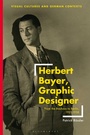
Herbert Bayer, Graphic Designer
From the Bauhaus to Berlin, 1921-1938
Published on 18. May 2023
Book
Hardback
336 pages
978-1-350-22967-9 (ISBN)
Description
Herbert Bayer was one of the most extraordinary artists associated with the Bauhaus school. A true multimedia artist, he united graphic design, art, and architecture in a unique style that came to represent the bold aesthetic approach of the movement. A teacher with the school until 1928, Bayer went on to become a highly successful graphic designer in Germany, and later one of the most prominent figures in the 20th-century art scene of the United States.
This broad biographical account, which presents previously unseen archival photographs and episodes from the life of Bayer and other influential Bauhaus artists such as Walter Gropius, Marcel Breuer and Laszlo Moholy-Nagy, follows Bayer through the Weimar Republic, Nazi Germany and finally to his exile in the United States. Specifically, Patrick Roessler reveals for the first time Bayer's unique experience of 1930s Germany, where, with his commercial and artistic life shattered by terror and censorship, he distracted himself with leading a hedonistic life. Shining a light on Bayer's time in Berlin during the Weimar Republic, and his route out of the Nazi state, Roessler provides rich new insights into how Bauhaus artists navigated a protracted period of social upheaval and dictatorship, where commercial success was fraught with a deep hostility towards the regime and the temptations of emigration.
Revealing the tensions of an avant-garde artist struggling to practice during a period of repression, Herbert Bayer, Graphic Designer speaks to both the memory of those who left Nazi Germany, but also the perseverance of artists and intellectuals throughout history who have worked under authoritarian regimes. Drawing on never before interpreted documents, letters and archival material, Roessler tells Bayer's compelling story - documenting the life of a unique artist and offering a valuable contribution to research in emigre experiences.
This broad biographical account, which presents previously unseen archival photographs and episodes from the life of Bayer and other influential Bauhaus artists such as Walter Gropius, Marcel Breuer and Laszlo Moholy-Nagy, follows Bayer through the Weimar Republic, Nazi Germany and finally to his exile in the United States. Specifically, Patrick Roessler reveals for the first time Bayer's unique experience of 1930s Germany, where, with his commercial and artistic life shattered by terror and censorship, he distracted himself with leading a hedonistic life. Shining a light on Bayer's time in Berlin during the Weimar Republic, and his route out of the Nazi state, Roessler provides rich new insights into how Bauhaus artists navigated a protracted period of social upheaval and dictatorship, where commercial success was fraught with a deep hostility towards the regime and the temptations of emigration.
Revealing the tensions of an avant-garde artist struggling to practice during a period of repression, Herbert Bayer, Graphic Designer speaks to both the memory of those who left Nazi Germany, but also the perseverance of artists and intellectuals throughout history who have worked under authoritarian regimes. Drawing on never before interpreted documents, letters and archival material, Roessler tells Bayer's compelling story - documenting the life of a unique artist and offering a valuable contribution to research in emigre experiences.
Reviews / Votes
With access to never-before-seen materials, Roessler includes documents, diaries and intimate letters from both Bayer's first wife, Irene Bayer-Hecht, and his lover, Ise Gropius [...] Rather than a sweeping indictment of Bayer's pragmatism, Roessler takes a nuanced approach to an artist's dilemma and the choices made for survival in a turbulent political landscape. * Communication Arts * Shining a new light on the life and work of Herbert Bayer, this insightful book makes a vital contribution to our understanding of modernism and the 20th century events that shaped its practitioners, and how this extraordinary designer navigated those complex times. * Robin Schuldenfrei, Reader in 20th Century Modernism, The Courtauld Institute of Art, University of London, UK * Extensively researched, Roessler's lively text analyzes Bayer's artistic, personal, and political journey from the Bauhaus to the US and hits issues head on-addressing difficult questions regarding history, emigration, politics, and biography * Gwen F. Chanzit, Curator Emerita, Denver Art Museum, and Professor Emerita, University of Denver, USA * Gorgeously illustrated and rigorously researched, this book lays bare the crucial missing decade in the life and work of this innovative, influential, and often misunderstood artist. Patrick Roessler's engaging and unflinching account is a must read for anyone interested in design history and the contradictions of creative life in Nazi Berlin. * Elizabeth Otto, Professor of Modern & Contemporary Art History, the University at Buffalo (SUNY), USA *More details
Series
Language
English
Place of publication
London
United Kingdom
Publishing group
Bloomsbury Publishing PLC
Target group
College/higher education
Product notice
Laminated cover
Illustrations
32 colour and 100 bw illus
Dimensions
Height: 238 mm
Width: 166 mm
Thickness: 25 mm
Weight
889 gr
ISBN-13
978-1-350-22967-9 (9781350229679)
Copyright in bibliographic data and cover images is held by Nielsen Book Services Limited or by the publishers or by their respective licensors: all rights reserved.
Schweitzer Classification
Other editions
Additional editions
E-Book
05/2023
1st Edition
Bloomsbury Visual Arts
€27.49
Available for download
E-Book
05/2023
1st Edition
Bloomsbury Visual Arts
€27.49
Available for download
Person
Patrick Roessler is Professor of Empirical Communication Research and Methods at the University of Erfurt, Germany. He is author of The Bauhaus and Public Relations (2014), and with Elizabeth Otto, he co-edited Bauhaus Bodies: Gender, Sexuality, and Body Culture in Modernism's Legendary Art School (2019).
Content
List of Plates
List of Figures
Introduction
1. Biographical fragments: Family, friends and companions
2. Commercial artist under National Socialism: "my advertising purgatory"
3. Shifting networks: "I'm here for love"
4. Road to emigration: "when the Nazis came to steal the land"
5. New beginnings among old friends: "i don't risk starting here without any money"
6. Progress in the USA and a look back: "I am personally struck by their success"
Conclusion: "a useful and effective member of our society"
Bibliography
Index
List of Figures
Introduction
1. Biographical fragments: Family, friends and companions
2. Commercial artist under National Socialism: "my advertising purgatory"
3. Shifting networks: "I'm here for love"
4. Road to emigration: "when the Nazis came to steal the land"
5. New beginnings among old friends: "i don't risk starting here without any money"
6. Progress in the USA and a look back: "I am personally struck by their success"
Conclusion: "a useful and effective member of our society"
Bibliography
Index