

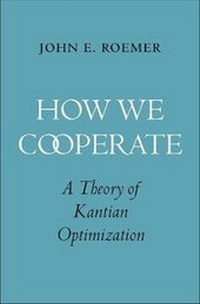
How We Cooperate
A Theory of Kantian Optimization
Published on 11. June 2019
Book
Hardback
248 pages
978-0-300-23333-9 (ISBN)
Description
A new theory of how and why we cooperate, drawing from economics, political theory, and philosophy to challenge the conventional wisdom of game theory
Game theory explains competitive behavior by working from the premise that people are self-interested. People don't just compete, however; they also cooperate. John Roemer argues that attempts by orthodox game theorists to account for cooperation leave much to be desired. Unlike competing players, cooperating players take those actions that they would like others to take-which Roemer calls "Kantian optimization." Through rigorous reasoning and modeling, Roemer demonstrates a simpler theory of cooperative behavior than the standard model provides.
Game theory explains competitive behavior by working from the premise that people are self-interested. People don't just compete, however; they also cooperate. John Roemer argues that attempts by orthodox game theorists to account for cooperation leave much to be desired. Unlike competing players, cooperating players take those actions that they would like others to take-which Roemer calls "Kantian optimization." Through rigorous reasoning and modeling, Roemer demonstrates a simpler theory of cooperative behavior than the standard model provides.
More details
Language
English
Place of publication
United States
Target group
Professional and scholarly
Product notice
Cloth over boards
Illustrations
4 b-w illus.
Dimensions
Height: 235 mm
Width: 156 mm
Thickness: 19 mm
ISBN-13
978-0-300-23333-9 (9780300233339)
Copyright in bibliographic data and cover images is held by Nielsen Book Services Limited or by the publishers or by their respective licensors: all rights reserved.
Schweitzer Classification
Person
John E. Roemer is the Elizabeth S. and A. Varick Stout Professor of Political Science and Economics at Yale University. He is the author of several books, including Sustainability for a Warmer Planet; Democracy, Education, and Equality;Political Competition: Theory and Applications; and Equality of Opportunity.