

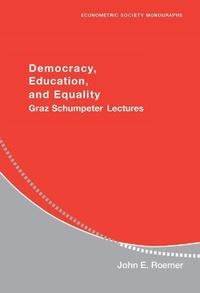
Democracy, Education, and Equality
Graz-Schumpeter Lectures
Published on 9. January 2006
Book
Hardback
186 pages
978-0-521-84665-3 (ISBN)
Description
Many believe that equality of opportunity will be achieved when the prospects of children no longer depend upon the wealth and education of their parents. The institution through which the link between child and parental prospects may be weakened is public education. Many also believe that democracy is the political institution that will bring about justice. This study, first published in 2006, asks whether democracy, modeled as competition between political parties that represent different interests in the polity, will result in educational funding policies that will, at least eventually, produce citizens who have equal capacities (human capital), thus breaking the link between family background and child prospects. In other words, will democracy engender, through the educational finance policies it produces, a state of equal opportunity in the long run?
More details
Series
Language
English
Place of publication
Cambridge
United Kingdom
Target group
Professional and scholarly
Illustrations
23 Tables, unspecified
Dimensions
Height: 235 mm
Width: 157 mm
Thickness: 15 mm
Weight
429 gr
ISBN-13
978-0-521-84665-3 (9780521846653)
Copyright in bibliographic data and cover images is held by Nielsen Book Services Limited or by the publishers or by their respective licensors: all rights reserved.
Schweitzer Classification
Other editions
Additional editions
Book
01/2006
Cambridge University Press
€48.50
Shipment within 15-20 days
Person
John E. Roemer is Elizabeth S. and A. Varick Stout Professor of Political Science at Yale University. He has published extensively in economics, political philosophy, and political science. His recent books include Political Competition (2001), Equality of Opportunity (1998), Theories of Distributive Justice (1996), and A Future for Socialism (Cambridge University Press, 1994). He was named a Felow of the Econometric Society in 1986.
Content
1. A brief overview; 2. Models of democratic party competition; 3. Democratic competition over educational investment; 4. The dynamics of human capital with endogenous growth; 5. Estimation of technological parameters; 6. Conclusion.