

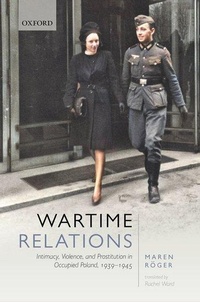
Wartime Relations
Intimacy, Violence, and Prostitution in Occupied Poland, 1939-1945
Published on 3. December 2020
Book
Hardback
224 pages
978-0-19-881722-2 (ISBN)
Description
During the Second World War, all contact between German soldiers and Polish women - considered an 'inferior race' - was officially banned. Sexual encounters frequently took place, however. Some were consensual, while others were characterised by brutal violence, and women often sold their bodies as a means of survival. The army and SS constructed purpose-built brothels for their soldiers, but also banned and frequently punished loving relationships. In Wartime Relations, Historian Maren Roeger gives a powerful account of these encounters and describes the actions of the army and the SS in regulating relations between soldiers and civilian women. Roeger provides new and important insights into everyday life during the occupation, Nazi racial policy, and the fates of the women involved.
Reviews / Votes
Providing new insights into the everyday life of the German occupation, Maren Roeger's monograph makes an important contribution to modern Polish history. * Aleksandra Jakubczak, Columbia University *More details
Language
English
Place of publication
Oxford
United Kingdom
Target group
Professional and scholarly
Product notice
sewn/stitched
Cloth over boards
Dimensions
Height: 236 mm
Width: 157 mm
Thickness: 20 mm
Weight
517 gr
ISBN-13
978-0-19-881722-2 (9780198817222)
Copyright in bibliographic data and cover images is held by Nielsen Book Services Limited or by the publishers or by their respective licensors: all rights reserved.
Schweitzer Classification
Other editions
Additional editions
E-Book
12/2020
1st Edition
OUP eBook
€67.49
Available for download
Persons
Maren Roeger is Associate Professor for German and Central European History at the University of Augsburg and Head of the Bucovina-Institute there. From 2010 to 2015, she was a research fellow at the German Historical Institute (Poland). In 2014, she won the highly-regarded Fraenkel Prize in Contemporary History for the German edition of Wartime Relations: Intimacy, Violence, and Prostitution in Occupied Poland, 1939-1945, followed in 2016 by the Geisteswissenschaften International Sonderpreis. She has published several books as well as articles in renowned academic journals, including Contemporary European History, European Review of History, Historische Zeitschrift, and Gender & History.
Content
Introduction
PART I: Prostitution in Occupied Poland
1: Establishing and Organizing Occupier Brothels
2: Policy and Politics of (Forced)Prostitution
3: Unsupervised sex work and prostitution as a means of survival
PART II: Relationships in Everyday Life Under Occupation
4: Interactive spaces in times of racial segregation
5: Types and Trajectories of Relationships
6: Fraternizing Women and Men
PART III: Occupation Relationships and the Power of the State
7: Disciplinary Measures: Polish Patriotism and Nazi Authorities
8: (Attempts at) Legalizing Relationships
PART IV: Sexual Violence and its Consequences
9: Patterns of Sexual Violence in Occupied Poland
10: Sexual Violence Before the Police and in Court
Epilogue
Conclusion
Appendix
PART I: Prostitution in Occupied Poland
1: Establishing and Organizing Occupier Brothels
2: Policy and Politics of (Forced)Prostitution
3: Unsupervised sex work and prostitution as a means of survival
PART II: Relationships in Everyday Life Under Occupation
4: Interactive spaces in times of racial segregation
5: Types and Trajectories of Relationships
6: Fraternizing Women and Men
PART III: Occupation Relationships and the Power of the State
7: Disciplinary Measures: Polish Patriotism and Nazi Authorities
8: (Attempts at) Legalizing Relationships
PART IV: Sexual Violence and its Consequences
9: Patterns of Sexual Violence in Occupied Poland
10: Sexual Violence Before the Police and in Court
Epilogue
Conclusion
Appendix