

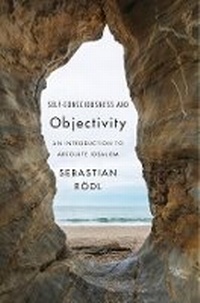
Self-Consciousness and Objectivity
An Introduction to Absolute Idealism
Published on 26. February 2018
Book
Hardback
208 pages
978-0-674-97651-1 (ISBN)
Description
Self-Consciousness and Objectivity undermines a foundational dogma of contemporary philosophy: that knowledge, in order to be objective, must be knowledge of something that is as it is, independent of being known to be so. Sebastian Roedl revives the thought-as ancient as philosophy but largely forgotten today-that knowledge, precisely on account of being objective, is self-knowledge: knowledge knowing itself. Thus he intervenes in a discussion that runs through the work of Bernard Williams, Thomas Nagel, Adrian Moore, and others, who seek to comprehend the claim to objectivity we raise in making judgments. While these authors think that the quest for objectivity demands that we transcend the first person, Roedl argues that it is through the first-person thought contained in every judgment that our judgments possess the objectivity that defines knowledge.
Self-Consciousness and Objectivity can be read as an introduction to absolute idealism, for it dismantles a stubborn obstacle to absolute idealism's reception: the notion that it is a species of idealism, which is understood to be the assertion that the world depends upon the mind. As Roedl brings out, absolute idealism is the resolute rejection of that idea.
The implications of this work are profound. It undercuts a number of contemporary presumptions, such as that judgment is a propositional attitude, that inference is a mental process, and that there is an empirical science of the capacity for objective knowledge. All of these presumptions flow from the erroneous notion that the objectivity of knowledge stands opposed to its first-person character.
Self-Consciousness and Objectivity can be read as an introduction to absolute idealism, for it dismantles a stubborn obstacle to absolute idealism's reception: the notion that it is a species of idealism, which is understood to be the assertion that the world depends upon the mind. As Roedl brings out, absolute idealism is the resolute rejection of that idea.
The implications of this work are profound. It undercuts a number of contemporary presumptions, such as that judgment is a propositional attitude, that inference is a mental process, and that there is an empirical science of the capacity for objective knowledge. All of these presumptions flow from the erroneous notion that the objectivity of knowledge stands opposed to its first-person character.
Reviews / Votes
Self-Consciousness and Objectivity is a terrific book! It addresses the most essential questions about self-consciousness and its place in the world in an original and compelling way. Sebastian Roedl challenges central doctrines in semantics, epistemology, and philosophy of mind, providing a new perspective on entrenched lines of thought in contemporary philosophy. This book ought to be read widely. -- Berislav Marusic, Brandeis University It is an ancient idea that philosophy seeks self-understanding. In this splendid book, Sebastian Roedl thinks through exactly what this idea comes to, and shows it to have truly revolutionary consequences. On every page, the most fundamental issues are pursued at a remarkable level of insight and depth. The result is a transformative work of philosophy, which succeeds in opening up the vista of absolute idealism for a contemporary audience. -- Adrian Haddock, University of StirlingMore details
Language
English
Place of publication
Cambridge, Mass
United States
Target group
Professional and scholarly
Dimensions
Height: 235 mm
Width: 156 mm
Thickness: 20 mm
Weight
454 gr
ISBN-13
978-0-674-97651-1 (9780674976511)
Copyright in bibliographic data and cover images is held by Nielsen Book Services Limited or by the publishers or by their respective licensors: all rights reserved.
Schweitzer Classification
Person
Sebastian Roedl, University Professor of Philosophy at Leipzig University,?is the author of Self-Consciousness and Objectivity, Categories of the Temporal, and Self-Consciousness.