

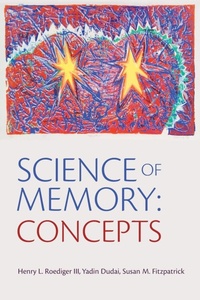
Science of Memory
Concepts
Published on 10. May 2007
Book
Paperback/Softback
464 pages
978-0-19-531044-3 (ISBN)
Description
The study of learning and memory occurs in several scientific traditions: neurobiology, neurogenetics, neurochemistry; animal learning and behaviour; behavioural neuroscience; ethological and evolutionary approaches; cognitive psychology; neuropsychology, computational modelling, and artifical intelligence all contribute. However, researchers using one approach typically work in relative isolation from those using other approaches. The aim of the volume is to bring together leading researchers in the various fields of learning and memory to discuss the field's core concepts, across disciplinary boundaries, with the hope that such discussion will enhance and reorient the field and lead to a more unified science of memory. Science of Memory: Concepts is not to be simply another edited volume that reports research by contributors, but rather a searching examination of 16 fundamental concepts in the field. For each, three position papers describe how the concept is viewed in the author's particular tradition. There is an integrator for each concept, who will pull together the main themes from the various contributions and elucidates key points of agreement and disagreement. The volume will begin with an introductory chapter by Yadin Dudai, Roddy Roediger, and Endel Tulving, and will end with a concluding chapter by Susan Fitzpatrick. Science of Memory is essential reading for professional researchers and students in all the various fields of learning and memory.
Reviews / Votes
a fascinating book that I would definitely recommend to all interested in memory phenomena. * Applied Cognitive Psychology * Rallied under the banner of 'concepts,' these chapters are a treasure trove of theories, controversies, methodologies, and findings. * PsycCRITIQUES * ...our understanding of memory systems has advanced considerably and will continue to do so...[this book] can break down conceptual barriers and push the field into new directions...and inspires us to think more generally about the relationship between various learning and memory traditions; it will have broad academic appeal. * PsycCRITIQUES *More details
Language
English
Place of publication
New York
United States
Target group
College/higher education
Professional and scholarly
Illustrations
26 black & white photographs and 26 line illustrations
Dimensions
Height: 234 mm
Width: 156 mm
Thickness: 25 mm
Weight
702 gr
ISBN-13
978-0-19-531044-3 (9780195310443)
Copyright in bibliographic data and cover images is held by Nielsen Book Services Limited or by the publishers or by their respective licensors: all rights reserved.
Schweitzer Classification
Other editions
Additional editions
E-Book
04/2007
1st Edition
OUP eBook
€35.49
Available for download
E-Book
04/2007
1st Edition
OUP eBook
€35.49
Available for download
Persons
Henry L. Roediger III is the James S. McDonnell Distinguished University Professor at Washington University in St. Louis.
Yadin Dudai is the Sela Professor of Neurobiology at the Weizmann Institute of Science, Rehovot, Israel.
Susan M. Fitzpatrick is Vice President of the James S. McDonnell Foundation.
Yadin Dudai is the Sela Professor of Neurobiology at the Weizmann Institute of Science, Rehovot, Israel.
Susan M. Fitzpatrick is Vice President of the James S. McDonnell Foundation.
Editor
James S. McDonnell Distinguished University Professor and Chair, Psychology DepartmentJames S. McDonnell Distinguished University Professor and Chair, Psychology Department, Washington University, USA
The Sara and Michael Sela Professor of NeurobiologyThe Sara and Michael Sela Professor of Neurobiology, Weizmann Institute, Israel
Vice PresidentVice President, James S. McDonnell Foundation, USA
Content
1. Memory Concepts ; Section 1: Memory ; 2. It's all about representations ; 3. Why the engram is elusive ; 4. Delineating the core ; 5. Integrative comments: Distinctions and dilemmas ; Section 2: Learning ; 6. A pre-theoretical concept ; 7. The need for a hybrid theory ; 8. Challenges in the merging of levels ; 9. Integrative comments: Multiplicity of mechanisms ; Section 3: Coding and representation ; 10. Time, space, history and beyond ; 11. The importance of mesoscale dynamics ; 12. Searching for a home in the brain ; 13. Integrative comments: On appealing beliefs and paucity of data ; Section 4: Plasticity ; 14. New concepts, new challenges ; 15. A pragmatic compromise ; 16. On the level ; 17. Integrative comments: More than memory ; Section 5: Context ; 18. What's so special about it? ; 19. Mood, memory, and the concept of context ; 20. A reference for focal experience ; 21. Integrative comments: The concept in the human and animal memory domains ; Section 6: Encoding ; 22. Models linking neural mechanisms to behavior ; 23. A cognitive perspective ; 24. Integrative comments: The proof is still required ; Section 7: Working memory ; 25. Signals in the brain ; 26. Multiple models, multiple mechanisms ; 27. What it is, and what it is not ; 28. Integrative comments: The mind is richer than the models ; Section 8: Consolidation ; 29. Molecular restlessness ; 30. Challenging the traditional view ; 31. The demise of the fixed trace ; 32. Integrative comments: From hypothesis to paradigm to concept ; Section 9: Persistence ; 33. Necessary, but not sufficient ; 34. Discrepancies between behaviors and brains ; 35. Integrative comments: In search of molecular persistance ; Section 10: Retrieval ; 36. Molecular mechanisms ; 37. Properties and effects ; 38. On its essence and related concepts ; 39. Integrative comments: Varieties and puzzles ; Section 11: Remembering ; 40. Defining and measuring ; 41. A process and a state ; 42. Metacognitive monitoring and control processes ; 43. Integrative comments: A controversy and a challenge ; Section 12: Transfer ; 44. Its transfer into neurobiology ; 45. Analysis in rats and other species ; 46. Rediscovering a central concept ; 47. Specificity and generality ; 48. Integrative comments: The ubiquitous concept ; Section 13: Inhibition ; 49. Diversity of cortical function ; 50. Attentional regulation of cognition ; 51. Manifestations in long-term memory ; 52. Elusive or illusion? ; 53. Integrative comments: An essential and contentious concept ; Section 14: Forgetting ; 54. Once again, its all about representations ; 55. The fate of once learned, but 'forgotten', material ; 56. Its role in the science of memory ; 57. Integrative comments: It's not just the opposite of remembering ; Section 15: Memory systems ; 58. A biological concept ; 59. Multiple systems in the brain and their interactions ; 60. A cognitive construct for analysis and synthesis ; 61. Integrative comments: An incentive, not an endpoint ; Section 16: Phylogeny and evolution ; 62. It takes two to tango ; 63. On comparing species at multiple levels ; 64. Implications for understanding the nature of a memory system ; Epilogue ; 66. Remember the future