

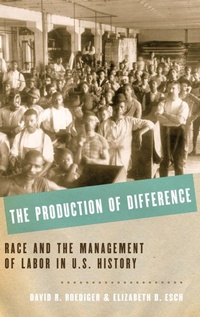
The Production of Difference
Race and the Management of Labor in U.S. History
1st Edition
Published on 31. May 2012
Book
Hardback
296 pages
978-0-19-973975-2 (ISBN)
Description
In 1907, pioneering labor historian and economist John Commons argued that US management had shown just one "symptom of originality," namely "playing one race against the other."
In this eye-opening book, David Roediger and Elizabeth Esch offer a radically new way of understanding the history of management in the United States, placing race, migration, and empire at the center of what has sometimes been narrowly seen as a search for efficiency and economy. Ranging from the antebellum period to the coming of the Great Depression, the book examines the extensive literature slave masters produced on how to manage and "develop" slaves; explores what was perhaps the greatest managerial feat in U.S. history, the building of the transcontinental railroad, which pitted Chinese and Irish work gangs against each other; and concludes by looking at how these strategies survive today in the management of hard, low-paying, dangerous jobs in agriculture, military support, and meatpacking. Roediger and Esch let us see afresh what slaves, immigrants, and all working people were up against as the objects of managerial control. Managers explicitly ranked racial groups, both in terms of which labor they were best suited for and their relative value compared to others. The authors show how whites relied on such alleged racial knowledge to manage and believed that the "lesser races" could only benefit from their tutelage. These views wove together managerial strategies and white supremacy not only ideologically but practically, every day at workplaces. Even in factories governed by scientific management, the impulse to play races against each other, and to slot workers into jobs categorized by race, constituted powerful management tools used to enforce discipline, lower wages, keep workers on dangerous jobs, and undermine solidarity.
Painstakingly researched and brilliantly argued, The Production of Difference will revolutionize the history of labor and race in the United States.
In this eye-opening book, David Roediger and Elizabeth Esch offer a radically new way of understanding the history of management in the United States, placing race, migration, and empire at the center of what has sometimes been narrowly seen as a search for efficiency and economy. Ranging from the antebellum period to the coming of the Great Depression, the book examines the extensive literature slave masters produced on how to manage and "develop" slaves; explores what was perhaps the greatest managerial feat in U.S. history, the building of the transcontinental railroad, which pitted Chinese and Irish work gangs against each other; and concludes by looking at how these strategies survive today in the management of hard, low-paying, dangerous jobs in agriculture, military support, and meatpacking. Roediger and Esch let us see afresh what slaves, immigrants, and all working people were up against as the objects of managerial control. Managers explicitly ranked racial groups, both in terms of which labor they were best suited for and their relative value compared to others. The authors show how whites relied on such alleged racial knowledge to manage and believed that the "lesser races" could only benefit from their tutelage. These views wove together managerial strategies and white supremacy not only ideologically but practically, every day at workplaces. Even in factories governed by scientific management, the impulse to play races against each other, and to slot workers into jobs categorized by race, constituted powerful management tools used to enforce discipline, lower wages, keep workers on dangerous jobs, and undermine solidarity.
Painstakingly researched and brilliantly argued, The Production of Difference will revolutionize the history of labor and race in the United States.
Reviews / Votes
detailed and well researched. * Martin Upchurch, International Socialism *More details
Language
English
Place of publication
New York
United States
Target group
College/higher education
Professional and scholarly
Those interested in the history of race, labor, management, and transnational history
Illustrations
3 halftones
Dimensions
Height: 240 mm
Width: 161 mm
Thickness: 22 mm
Weight
668 gr
ISBN-13
978-0-19-973975-2 (9780199739752)
Copyright in bibliographic data and cover images is held by Nielsen Book Services Limited or by the publishers or by their respective licensors: all rights reserved.
Schweitzer Classification
Other editions
Additional editions

David R. Roediger | Elizabeth D. Esch
The Production of Difference
Race and the Management of Labor in U.S. History
Book
05/2014
Oxford University Press Inc
€55.90
Shipment within 15-20 days
David R. Roediger | Elizabeth D. Esch
The Production of Difference
Race and the Management of Labor in U.S. History
E-Book
06/2012
1st Edition
OUP eBook
€25.49
Available for download
David R. Roediger | Elizabeth D. Esch
Production of Difference
Race and the Management of Labor in U.S. History
E-Book
05/2012
1st Edition
Oxford University Press, USA
€8.39
Available for download
Persons
David R. Roediger is Babcock Professor of History, University of Illinois, Champagne-Urbana, and the author of How Race Survived U.S. History and The Wages of Whiteness, among other titles.
Elizabeth D. Esch is Assistant Professor of History at Barnard College.
Elizabeth D. Esch is Assistant Professor of History at Barnard College.
Content
Acknowledgments ; Introduction Race in the History of U.S. Management: An Introduction ; Part I Facing South ; Ch 1 Settling on Slavery: The Antebellum South and the Origins of U.S. Race Management ; Ch 2 Managing Contradictions and Managing a Race: The Slave as Asset and Animal ; Part II Facing West ; Ch 3 Infrastructure, Internal Expansion, and Race Management ; Ch 4 The Worlds of U.S. Race Management ; Part III Changing the Whole Story ; Ch 5 Scientific Management, Racial Science, and the Studied Unstudiedness of Race Management ; Ch 6 The Crisis and Concentration of Race Management: Immigrant Rebellion, Immigrant Restruction, and Turns to Black and Mexican Labor ; Notes ; Index