

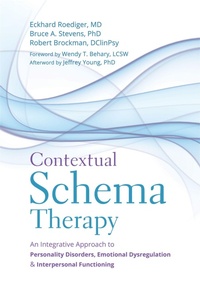
Contextual Schema Therapy
An Integrative Approach to Personality Disorders, Emotional Dysregulation, and Interpersonal Functioning
Published on 26. July 2018
Book
Paperback/Softback
272 pages
978-1-68403-095-8 (ISBN)
Description
In this groundbreaking book, three internationally recognized psychologists present a step-by-step guide outlining the most up-to-date innovations in schema therapy (ST). This important book offers a clear and practical road map for putting the schema mode model into practice, improving clients' interpersonal functioning, and integrates the latest advances in contextual behavioral psychology.
ST is a powerful, integrative treatment model that combines aspects of cognitive, behavioral, and psychodynamic therapies. It has proven highly effective in treating a number of mental health issues, including difficult-to-treat personality disorders. ST's main premise is that mental health issues arise as a result of unmet emotional needs in childhood, leading to the development of early maladaptive schemas (EMS). But, more and more, ST has shifted away from EMS to focus on schema content-that is, changing the way clients relate to their experiences and to others.
This book incorporates the latest findings in contextual behavioral science with a focus on clients' coping styles - or schema modes - and improving interpersonal functioning. The book includes exercises from compassion-focused therapies, acceptance and commitment therapy (ACT), and even functional analytic psychotherapy (FAP) to help your clients become more aware of their own unhealthy coping patterns and behaviors. You'll also discover a range of emotion-focused and experiential techniques to use in therapy with your client.
ST is a powerful, integrative treatment model that combines aspects of cognitive, behavioral, and psychodynamic therapies. It has proven highly effective in treating a number of mental health issues, including difficult-to-treat personality disorders. ST's main premise is that mental health issues arise as a result of unmet emotional needs in childhood, leading to the development of early maladaptive schemas (EMS). But, more and more, ST has shifted away from EMS to focus on schema content-that is, changing the way clients relate to their experiences and to others.
This book incorporates the latest findings in contextual behavioral science with a focus on clients' coping styles - or schema modes - and improving interpersonal functioning. The book includes exercises from compassion-focused therapies, acceptance and commitment therapy (ACT), and even functional analytic psychotherapy (FAP) to help your clients become more aware of their own unhealthy coping patterns and behaviors. You'll also discover a range of emotion-focused and experiential techniques to use in therapy with your client.
More details
Language
English
Place of publication
Oakland, CA
United States
Target group
College/higher education
Professional and scholarly
Product notice
Paperback (UK-trade)
Dimensions
Height: 257 mm
Width: 180 mm
Thickness: 20 mm
Weight
550 gr
ISBN-13
978-1-68403-095-8 (9781684030958)
Copyright in bibliographic data and cover images is held by Nielsen Book Services Limited or by the publishers or by their respective licensors: all rights reserved.
Schweitzer Classification
Other editions
Additional editions
Eckhard Roediger
Contextual Schema Therapy
An Integrative Approach to Personality Disorders, Emotional Dysregulation, and Interpersonal Functioning
E-Book
05/2018
Context Press
€58.99
Available for download
Persons
Eckhard Roediger (Author)
Eckhard Roediger, MD, is director of the Frankfurt Schema Therapy Institute, which was established in Germany. He is former president of the International Society of Schema Therapy (ISST) and board a member since its foundation in 2008. He has been a schema therapy trainer and supervisor since 2008, and is author of numerous books, book chapters, and articles about schema therapy in German.
Bruce A. Stevens (Author)
Bruce A. Stevens, PhD, is the current Wicking Chair of Aging and Practical Theology at Charles Sturt University, Canberra, Australia. He is a clinical and forensic psychologist with over twenty years of private practice experience. He has written several books-including two other books on schema therapy-and he has advanced accreditation in schema therapy for both individuals and couples.
Robert Brockman (Author)
Robert Brockman, DClinPsy, is a lecturer and psychology clinic supervisor on the Clinical Psychology Masters program at the University of Technology, Sydney, Australia (UTS). He is accredited by the International Society for Schema Therapy (ISST) as a schema therapist, supervisor, and trainer, and regularly runs schema therapy trainings nationally and internationally. Brockman has a major clinical and research interests in the formulation and treatment of complex presentations that prove difficult to treat via standard evidence-based protocols. He is currently engaged in clinical research focused on extending the schema model into novel populations (e.g., generalized anxiety disorder, eating disorders, psychosis, HIV sufferers, problem gamblers, and forensic patients).
Eckhard Roediger, MD, is director of the Frankfurt Schema Therapy Institute, which was established in Germany. He is former president of the International Society of Schema Therapy (ISST) and board a member since its foundation in 2008. He has been a schema therapy trainer and supervisor since 2008, and is author of numerous books, book chapters, and articles about schema therapy in German.
Bruce A. Stevens (Author)
Bruce A. Stevens, PhD, is the current Wicking Chair of Aging and Practical Theology at Charles Sturt University, Canberra, Australia. He is a clinical and forensic psychologist with over twenty years of private practice experience. He has written several books-including two other books on schema therapy-and he has advanced accreditation in schema therapy for both individuals and couples.
Robert Brockman (Author)
Robert Brockman, DClinPsy, is a lecturer and psychology clinic supervisor on the Clinical Psychology Masters program at the University of Technology, Sydney, Australia (UTS). He is accredited by the International Society for Schema Therapy (ISST) as a schema therapist, supervisor, and trainer, and regularly runs schema therapy trainings nationally and internationally. Brockman has a major clinical and research interests in the formulation and treatment of complex presentations that prove difficult to treat via standard evidence-based protocols. He is currently engaged in clinical research focused on extending the schema model into novel populations (e.g., generalized anxiety disorder, eating disorders, psychosis, HIV sufferers, problem gamblers, and forensic patients).