

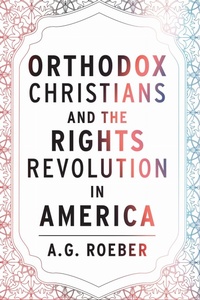
Orthodox Christians and the Rights Revolution in America
Published on 2. January 2024
Book
Paperback/Softback
336 pages
978-1-5315-0504-2 (ISBN)
Description
A distinctive and unrivaled examination of North American Eastern Orthodox Christians and their encounter with the rights revolution in a pluralistic American society.
From the civil rights movement of the 1950s to the "culture wars" of North America, commentators have identified the partisans bent on pursuing different "rights" claims. When religious identity surfaces as a key determinant in how the pursuit of rights occurs, both "the religious right" and "liberal" believers remain the focus of how each contributes to making rights demands. How Orthodox Christians in North America have navigated the "rights revolution," however, remains largely unknown. From the disagreements over the rights of the First Peoples of Alaska to arguments about the rights of transgender persons, Orthodox Christians have engaged an anglo-American legal and constitutional rights tradition. But they see rights claims through the lens of an inherited focus on the dignity of the human person.
In a pluralistic society and culture, Orthodox Christians, both converts and those with family roots in Orthodox countries, share with non-Orthodox fellow citizens the challenge of reconciling conflicting rights claims. Those claims do pit "religious liberty" rights claims against perceived dangers from outside the Orthodox Church. But internal disagreements about the rights of clergy and people within the Church accompany the Orthodox Christian engagement with debates over gender, sex, and marriage as well as expanding political, legal, and human rights claims. Despite their small numbers, North American Orthodox remain highly visible and their struggles influential among the more than 280 million Orthodox worldwide. Orthodox Christians and the Rights Revolution in America offers an historical analysis of this unfolding story.
From the civil rights movement of the 1950s to the "culture wars" of North America, commentators have identified the partisans bent on pursuing different "rights" claims. When religious identity surfaces as a key determinant in how the pursuit of rights occurs, both "the religious right" and "liberal" believers remain the focus of how each contributes to making rights demands. How Orthodox Christians in North America have navigated the "rights revolution," however, remains largely unknown. From the disagreements over the rights of the First Peoples of Alaska to arguments about the rights of transgender persons, Orthodox Christians have engaged an anglo-American legal and constitutional rights tradition. But they see rights claims through the lens of an inherited focus on the dignity of the human person.
In a pluralistic society and culture, Orthodox Christians, both converts and those with family roots in Orthodox countries, share with non-Orthodox fellow citizens the challenge of reconciling conflicting rights claims. Those claims do pit "religious liberty" rights claims against perceived dangers from outside the Orthodox Church. But internal disagreements about the rights of clergy and people within the Church accompany the Orthodox Christian engagement with debates over gender, sex, and marriage as well as expanding political, legal, and human rights claims. Despite their small numbers, North American Orthodox remain highly visible and their struggles influential among the more than 280 million Orthodox worldwide. Orthodox Christians and the Rights Revolution in America offers an historical analysis of this unfolding story.
More details
Series
Edition
New edition
Language
English
Place of publication
New York
United States
Target group
Professional and scholarly
Edition type
New edition
Product notice
Paperback (trade)
Dimensions
Height: 229 mm
Width: 152 mm
Thickness: 22 mm
Weight
567 gr
ISBN-13
978-1-5315-0504-2 (9781531505042)
Copyright in bibliographic data and cover images is held by Nielsen Book Services Limited or by the publishers or by their respective licensors: all rights reserved.
Schweitzer Classification
Person
The Rev. Dr. A. G. Roeber is Emeritus Professor of Early Modern History and Religious Studies at Penn State University, and Professor of Church History at St. Vladimir's Orthodox Theological Seminary. Author of many books, his Palatines, Liberty, and Property: German Lutherans in Colonial British America was the 1983 co-winner of the American Historical Association's John H. Dunning Prize. A past president of the Orthodox Theological Society in America, he is also co-author of Changing Churches: An Orthodox, Catholic, and Lutheran Theological Conversation (2012), author of Mixed Marriages: An Orthodox History (2018), and editor of Human v. Religious Rights?: German and U.S. Exchanges and Their Global Implications (2020).
Content
Prologue: A Rights Primer 1
Introduction 21
1 Deferential Society and Church? Protestant to Orthodox Social Ethos 34
2 The Nineteenth-Century Orthodox Confrontation with Rights 67
3 Pluralism and the Rights of Freedom of Speech and Expression 89
4 Rights of and for a Self-Governed American Orthodox Church 116
5 "Greek" North American Orthodox Rights 146
6 The Orthodox, Sex, and Marriage before the Rights Revolution 173
7 The Orthodox, Gender, and Sexuality and the Rights Revolution 205
8 Human Rights Claims and the Orthodox in America 239
Conclusion 287
Bibliography 313
Index 357
Introduction 21
1 Deferential Society and Church? Protestant to Orthodox Social Ethos 34
2 The Nineteenth-Century Orthodox Confrontation with Rights 67
3 Pluralism and the Rights of Freedom of Speech and Expression 89
4 Rights of and for a Self-Governed American Orthodox Church 116
5 "Greek" North American Orthodox Rights 146
6 The Orthodox, Sex, and Marriage before the Rights Revolution 173
7 The Orthodox, Gender, and Sexuality and the Rights Revolution 205
8 Human Rights Claims and the Orthodox in America 239
Conclusion 287
Bibliography 313
Index 357