

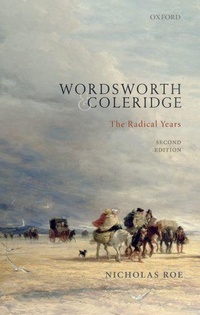
Wordsworth and Coleridge
The Radical Years
2nd Edition
Published on 29. November 2018
Book
Hardback
346 pages
978-0-19-881811-3 (ISBN)
Description
This volume offers a reappraisal of Wordsworth's and Coleridge's radical careers before their emergence as major poets. Updated, revised, and with new manuscript material, this expanded new edition responds to the most significant critical work on Wordsworth's and Coleridge's radical careers in the three decades since the book first appeared. Fresh material is drawn from newspapers and printed sources; the poetry of 1798 is given more detailed attention, and the critical debate surrounding new historicism is freshly appraised. A new introduction reflects on how the book was originally researched, offers new insights into the notorious Leonard Bourdon killings of 1793, and revisits John Thelwall's predicament in 1798.
University politics, radical dissent, and first-hand experiences of Revolutionary France form the substance of the opening chapters. Wordsworth's and Coleridge's relations with William Godwin and John Thelwall are tracked in detail, and both poets are shown to have been closely connected with the London Corresponding Society. Godwin's diaries, now accessible in electronic form, have been drawn upon extensively to supplement the narrative of his intellectual influence.
Offering a comparative perspective on the poets and their contemporaries, the book investigates the ways in which 1790s radicals coped with personal crisis, arrests, trumped-up charges, and prosecutions. Some fled the country, becoming refugees; others went underground, hiding away as inner emigres. Against that backdrop, Wordsworth and Coleridge opted for a different revolution: they wrote poems that would change the way people thought.
University politics, radical dissent, and first-hand experiences of Revolutionary France form the substance of the opening chapters. Wordsworth's and Coleridge's relations with William Godwin and John Thelwall are tracked in detail, and both poets are shown to have been closely connected with the London Corresponding Society. Godwin's diaries, now accessible in electronic form, have been drawn upon extensively to supplement the narrative of his intellectual influence.
Offering a comparative perspective on the poets and their contemporaries, the book investigates the ways in which 1790s radicals coped with personal crisis, arrests, trumped-up charges, and prosecutions. Some fled the country, becoming refugees; others went underground, hiding away as inner emigres. Against that backdrop, Wordsworth and Coleridge opted for a different revolution: they wrote poems that would change the way people thought.
Reviews / Votes
Roe captures the "unity and revolutionary idealism" that was brimming over during the 1790s with a scholarly gift for bringing together evidence drawn from a wide range of sources. His research is so exacting that his study would be enlightening to a political historian as well as a literary critic. It was a momentous period, one that did indeed unite disparate groups for a while, as Wordsworth writes: "How bright a face is worn when joy of one / is joy of tens of millions". Feelings would change, but, as Roe demonstrates, that radical ardour left a hugely significant impact on English poetry. * Maria Taylor, Time Literary Supplement * Review from previous edition Brings together in one place much scattered information and a few new details from Godwin's papers . . . Roe's research has been strenuous, his attention to detail earnest, and his book will be useful. * E.P. Thompson, London Review of Books * The London revolutionary circles in which both men moved are brilliantly described and analysed. The roles played by John Thelwall and William Godwin are investigated with a new insight. * Michael Foot, The Guardian * The quality of Roe's research is without doubt impeccable. New manuscript sources have been discovered . . . the book fills a conspicuous gap. * Joseph Bristow, Times Higher Education Supplement * A close and sophisticated study . . . Roe's account is outstanding . . . a major contribution to scholarly studies of the period. * J.D. Gutteridge, Notes and Queries *More details
Edition
2nd Revised edition
Language
English
Place of publication
Oxford
United Kingdom
Target group
Professional and scholarly
Edition type
Revised edition
Product notice
sewn/stitched
Cloth over boards
Illustrations
9 Illustrations
Dimensions
Height: 218 mm
Width: 142 mm
Thickness: 28 mm
Weight
567 gr
ISBN-13
978-0-19-881811-3 (9780198818113)
Copyright in bibliographic data and cover images is held by Nielsen Book Services Limited or by the publishers or by their respective licensors: all rights reserved.
Schweitzer Classification
Other editions
Additional editions
E-Book
11/2018
2nd Edition
OUP eBook
€19.49
Available for download
E-Book
11/2018
2nd Edition
OUP eBook
€19.49
Available for download
Book
04/1990
Clarendon Press
€64.38
Article exhausted; check different version
Person
Nicholas Roe is Wardlaw Professor of English Literature, University of St Andrews.
Content
A note on texts
New Introduction
1: Voices from the Common Grave of Liberty
2: 'Europe was Rejoiced': Responses to Revolution, 1789-1791
3: Pretty Hot in It': Wordsworth and France, 1791-1792
4: 'Mr. Frend's Company': Cambridge, Dissent, and Coleridge
5: 'War is Again Broken Out': Protest and Poetry, 1793-1798
6: 'A Light Bequeathed': Coleridge, Thelwall, Wordsworth, Godwin
7: 'A Sympathy with Power': Imagining Robespierre
8: Inner Emigrants: Kindly Interchange, Rash Disdain
Epilogue: Daring to Hope
Appendix 1: Wordsworth and Daniel Isaac Eaton's Philanthropist
Appendix 2: Wordsworth's Lost Satire
Bibliography
New Introduction
1: Voices from the Common Grave of Liberty
2: 'Europe was Rejoiced': Responses to Revolution, 1789-1791
3: Pretty Hot in It': Wordsworth and France, 1791-1792
4: 'Mr. Frend's Company': Cambridge, Dissent, and Coleridge
5: 'War is Again Broken Out': Protest and Poetry, 1793-1798
6: 'A Light Bequeathed': Coleridge, Thelwall, Wordsworth, Godwin
7: 'A Sympathy with Power': Imagining Robespierre
8: Inner Emigrants: Kindly Interchange, Rash Disdain
Epilogue: Daring to Hope
Appendix 1: Wordsworth and Daniel Isaac Eaton's Philanthropist
Appendix 2: Wordsworth's Lost Satire
Bibliography