


Optimizing Supply Chain Performance
Information Sharing and Coordinated Management
Published on 14. January 2014
Book
Paperback/Softback
214 pages
978-1-349-56817-8 (ISBN)
Description
Optimizing Supply Chain Performance takes industrial case studies from SMEs in China to examine the importance of information sharing and coordinated management as essential mechanisms to improve supply chain performance.
More details
Edition
2015 ed.
Language
English
Place of publication
London
United Kingdom
Product notice
Paperback (trade)
Unsewn / adhesive bound
Illustrations
Bibliography
Dimensions
Height: 216 mm
Width: 140 mm
ISBN-13
978-1-349-56817-8 (9781349568178)
Copyright in bibliographic data is held by Nielsen Book Services Limited or its licensors: all rights reserved.
Schweitzer Classification
Other editions
Additional editions
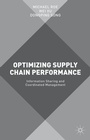
Michael Roe | Wei Xu | Dongping Song
Optimizing Supply Chain Performance
Information Sharing and Coordinated Management
Book
07/2015
Palgrave Macmillan
€106.99
Shipment within 10-20 days
Persons
Content
1. Introduction
2. Literature Review
3. A Methodology for the Exploration of Supply Chain Management
4. The Case Company Supply Chains
5. A Generalised Domestic and International Supply Chain Model
6. Mathematical Modelling for the Supply Chain System
7. Single Objective and Multiple Objective Genetic Algorithms
8. The Impact of Information Sharing
9. Evaluating the Single Objective Genetic Algorithm (SOGA)
10. Evaluating the Single Objective Genetic Algorithm (MOGA)
11. Conclusions
2. Literature Review
3. A Methodology for the Exploration of Supply Chain Management
4. The Case Company Supply Chains
5. A Generalised Domestic and International Supply Chain Model
6. Mathematical Modelling for the Supply Chain System
7. Single Objective and Multiple Objective Genetic Algorithms
8. The Impact of Information Sharing
9. Evaluating the Single Objective Genetic Algorithm (SOGA)
10. Evaluating the Single Objective Genetic Algorithm (MOGA)
11. Conclusions