

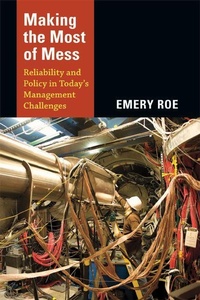
Making the Most of Mess
Reliability and Policy in Today's Management Challenges
Will be published approx. on 27. March 2013
Book
Hardback
224 pages
978-0-8223-5307-2 (ISBN)
Description
In Making the Most of Mess, Emery Roe emphasizes that policy messes cannot be avoided or cleaned up; they need to be managed. He shows how policymakers and other professionals can learn these necessary skills from control operators who manage large critical infrastructures such as water supplies, telecommunications systems, and electricity grids. The ways in which they prevent major accidents and failures offer models for policymakers and other professionals to manage the messes they face. Throughout, Roe focuses on the global financial mess of 2008 and its ongoing aftermath, showing how mismanagement has allowed it to morph into other national and international messes. More effective management is still possible for this and many other policy messes but that requires better recognition of patterns and formulation of scenarios, as well as the ability to translate pattern and scenario into reliability. Developing networks of professionals who respond to messes is particularly important. Roe describes how these networks enable the avoidance of bad or worse messes, take advantage of opportunities resulting from messes, and address societal and professional challenges. In addition to finance, he draws from a wide range of case material in other policy arenas. Roe demonstrates that knowing how to manage policy messes is the best approach to preventing crises.
Reviews / Votes
"Roe's deep and disciplined discussion in this book is a 'coherent frame of reasoning' that dimensionalizes messes . . . It provides a coherent, inclusive language and vocabulary that enables people to sort conditions of mess into meaningful dimensions." - Karl Weick (Public Administration) "Overall, Roe highlights the critical problem of managing complex, adaptive systems in real-time and underscores the importance of training policy and management professionals to function in these difficult operational contexts more effectively. The book makes a substantive contribution to the policy and management literature, especially in reference to complex adaptive systems." - Louise K. Comfort (Journal of Comparative Policy Analysis) "The great merit of Roe's book is that one of the core questions in public administration and policy science - how to unravel decisions (thinking and speaking) and actions (practice, doings) in tackling messes created by policy and administration (rather than by external sources and forces) - gets clear-headed and persuasive answers." - Robert Hoppe (Critical Policy Studies)More details
Person
Emery Roe is a practicing policy analyst and Associate at University of California Berkeley's Center for Catastrophic Risk Management. He is the author of Narrative Policy Analysis: Theory and Practice, also published by Duke University Press.
Content
Acknowledgments ix
1. Introducing Policy Messes, Management, and Their Managers 1
2. When Reliability Is Mess Management 16
3. The Wider Framework for Managing Mess Reliably: Hubs, Skills, and the Domain of Competence 32
4. Bad Mess Management 56
5. Good Mess Management 78
6. Societal Challenges 106
7. Professional Challenges 128
8. How We Know That the Policy Mess Is Managed Better 144
Notes 155
Bibliography 175
Index 201
1. Introducing Policy Messes, Management, and Their Managers 1
2. When Reliability Is Mess Management 16
3. The Wider Framework for Managing Mess Reliably: Hubs, Skills, and the Domain of Competence 32
4. Bad Mess Management 56
5. Good Mess Management 78
6. Societal Challenges 106
7. Professional Challenges 128
8. How We Know That the Policy Mess Is Managed Better 144
Notes 155
Bibliography 175
Index 201