

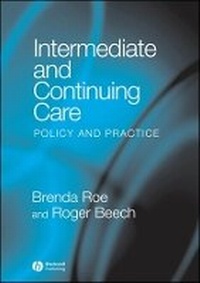
Intermediate and Continuing Care
Policy and Practice
Published on 18. October 2005
Book
Paperback/Softback
296 pages
978-1-4051-2033-3 (ISBN)
Description
Intermediate care comprises strategies which allow early discharge from acute care, prevent admission or re-admission to acute care and avoid bed-blocking in both acute and long-term residential care. It encompasses a range of short-term options including rapid response, hospital at home, residential rehabilitation, supported discharge and day rehabilitation. Continuing Care is delivered on a long-term basis in a variety of settings and often includes an element of rehabilitation.
Although these two types of care have distinct objectives, they are interrelated as changes in the supply of one type of care may affect demands for the other. In addition, from a patient perspective, intermediate and continuing care might be seen as part of the continuum of care options that are supplied to meet their needs. This book argues for consideration of intermediate and continuing care as part of the care continuum that provides integrated care adopting whole system approaches.
This edited volume explores policy, practice and current issues in intermediate and continuing care. It will be of interest to allhealth and social care professionals involved in the provision and planning of care for older people. It falls in three parts: intermediate care, continuing care, and a shorter section on patient and public involvement and future directions.
Although these two types of care have distinct objectives, they are interrelated as changes in the supply of one type of care may affect demands for the other. In addition, from a patient perspective, intermediate and continuing care might be seen as part of the continuum of care options that are supplied to meet their needs. This book argues for consideration of intermediate and continuing care as part of the care continuum that provides integrated care adopting whole system approaches.
This edited volume explores policy, practice and current issues in intermediate and continuing care. It will be of interest to allhealth and social care professionals involved in the provision and planning of care for older people. It falls in three parts: intermediate care, continuing care, and a shorter section on patient and public involvement and future directions.
Reviews / Votes
'a comprehensive review of the often neglected and under-researched areas of intermediate and continuing care. It uses a whole-system approach and draws on the existing evidence base and the authors' personal experiences.'Nursing Standard
More details
Language
English
Place of publication
Hoboken
United Kingdom
Publishing group
John Wiley and Sons Ltd
Target group
Professional and scholarly
Dimensions
Height: 243 mm
Width: 173 mm
Thickness: 15 mm
Weight
635 gr
ISBN-13
978-1-4051-2033-3 (9781405120333)
Copyright in bibliographic data and cover images is held by Nielsen Book Services Limited or by the publishers or by their respective licensors: all rights reserved.
Schweitzer Classification
Other editions
Additional editions
E-Book
05/2008
Wiley-Blackwell
€64.99
Available for download
Persons
Brenda Roe is on the Editorial board of JAN. She is Senior lecturer in Social Gerontology , Centre for Geriatric Medicine, Keele University and Non-executive Director, North Cheshire Hospitals NHS Trust. Roger Beech is Senior Lecturer in Health Operational Research, Centre for Health Planning and Management, Keele University and Academic Lead for Research, Central Cheshire Primary Care Trust
Content
PART 1: INTERMEDIATE CARE. Chapter 1. Intermediate Care: Policy and Context.
Chapter 2. Identifying Need and Scope for Intermediate Care.
Chapter 3. Management and Planning of Services.
Chapter 4. Coordinating Intermediate Care.
Chapter 5. Service Development and Evaluation.
in Intermediate Care.
Chapter 6. Interdisciplinary Working in Intermediate Care - Generic Working or the Key to a Person Centred Approach?.
Chapter 7: Interdisciplinary Training and Development.
Chapter 8: Evidence on Effectiveness of Intermediate Care.
Chapter 9: Economic Evaluation of Intermediate Care.
PART 2: CONTINUING CARE.
Chapter 10. Continuing Care: Policy and Context.
Chapter 11. Community Care: Service Delivery, Development and Evaluation.
Chapter 12. Alternative Housing and Care Arrangements: The Evidence.
Chapter 13. Care Homes and Continuing Care.
Chapter 14. Interdisciplinary Working and Education in Continuing Care.
PART 3 INVOLVEMENT OF CARERS AND CONSUMERS.
Chapter 15: Carers and Caregiving in the Context of Intermediate and Continuing Care.
Chapter 16: Patient and Public Involvement in Service Design and Evaluation.
Chapter 17. Implications for Policy and Practice: The Future
Chapter 2. Identifying Need and Scope for Intermediate Care.
Chapter 3. Management and Planning of Services.
Chapter 4. Coordinating Intermediate Care.
Chapter 5. Service Development and Evaluation.
in Intermediate Care.
Chapter 6. Interdisciplinary Working in Intermediate Care - Generic Working or the Key to a Person Centred Approach?.
Chapter 7: Interdisciplinary Training and Development.
Chapter 8: Evidence on Effectiveness of Intermediate Care.
Chapter 9: Economic Evaluation of Intermediate Care.
PART 2: CONTINUING CARE.
Chapter 10. Continuing Care: Policy and Context.
Chapter 11. Community Care: Service Delivery, Development and Evaluation.
Chapter 12. Alternative Housing and Care Arrangements: The Evidence.
Chapter 13. Care Homes and Continuing Care.
Chapter 14. Interdisciplinary Working and Education in Continuing Care.
PART 3 INVOLVEMENT OF CARERS AND CONSUMERS.
Chapter 15: Carers and Caregiving in the Context of Intermediate and Continuing Care.
Chapter 16: Patient and Public Involvement in Service Design and Evaluation.
Chapter 17. Implications for Policy and Practice: The Future