

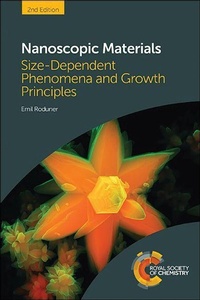
Nanoscopic Materials
Size-Dependent Phenomena and Growth Principles
2nd Edition
Published on 31. July 2014
Book
Hardback
439 pages
978-1-84973-907-8 (ISBN)
Description
In recent years there have been great advances in the development of new nanomaterials. To facilitate the progress of new materials it is essential to understand the underlying principles at the nanoscale.
Nanoscopic Materials provides an accessible overview of the physico-chemical and physical principles of nanomaterials including electronic structure, magnetic properties, thermodynamics of size dependence and phase transitions and dynamics of clusters and two-dimensional systems. This new edition has been fully revised and updated to reflect recent developments in new nanomaterials including graphene and core-shell structures, properties of nano-structured and intelligent surfaces as well as applications in catalysis and energy. Additional chapters cover the development of nucleation and crystal shape engineering; self-assembly and biomimetics for fabricating nanostructures.
With helpful illustrations and summaries of key points in every chapter, this advanced textbook is ideal for graduate students of chemistry and materials science and researchers new to the field of nanoscience and nanotechnology.
Nanoscopic Materials provides an accessible overview of the physico-chemical and physical principles of nanomaterials including electronic structure, magnetic properties, thermodynamics of size dependence and phase transitions and dynamics of clusters and two-dimensional systems. This new edition has been fully revised and updated to reflect recent developments in new nanomaterials including graphene and core-shell structures, properties of nano-structured and intelligent surfaces as well as applications in catalysis and energy. Additional chapters cover the development of nucleation and crystal shape engineering; self-assembly and biomimetics for fabricating nanostructures.
With helpful illustrations and summaries of key points in every chapter, this advanced textbook is ideal for graduate students of chemistry and materials science and researchers new to the field of nanoscience and nanotechnology.
Reviews / Votes
Lots of helpful illustrations and some of them in full colour....each of the eleven chapters includes a summary box at the end where the 'key points' are reiterated in clear and concise language, complete with bullet points.A timely reminder of how much every-thing we think we know about matter can change when the packaging unit of that matter becomes very small. This book provides an overview of the size-related changes that underlie much of the current interest in nanoscience. Excellent as an introductory text to inorganic nanoscopic materials.......a very useful primer on inorganic nanoscopic materials.More details
Edition
2nd edition
Language
English
Place of publication
Cambridge
United Kingdom
Target group
Professional and scholarly
Edition type
New edition
Product notice
Unsewn / adhesive bound
Dimensions
Height: 236 mm
Width: 165 mm
Thickness: 31 mm
Weight
835 gr
ISBN-13
978-1-84973-907-8 (9781849739078)
DOI
10.1039/9781839168970
Copyright in bibliographic data and cover images is held by Nielsen Book Services Limited or by the publishers or by their respective licensors: all rights reserved.
Schweitzer Classification
Other editions
Additional editions
E-Book
10/2015
2nd Edition
Royal Society of Chemistry
€129.99
Available for download
Person
Content
Introduction;
Bulk and Interface;
Geometric Structure, Magic Numbers, and Coordination Numbers of Small Clusters;
Electronic Structure;
Magnetic Properties;
Thermodynamics of Finite Size Systems;
Adsorption, Phase Behaviour and Dynamics of Surface Layers and in Pores;
Phase Transitions and Dynamics of Clusters;
Phase Transitions of Two-Dimensional Systems;
Nucleation and Crystal Shape Engineering;
Self-assembly and Biomimetics;
Selected Applications of Nanomaterials;
Bulk and Interface;
Geometric Structure, Magic Numbers, and Coordination Numbers of Small Clusters;
Electronic Structure;
Magnetic Properties;
Thermodynamics of Finite Size Systems;
Adsorption, Phase Behaviour and Dynamics of Surface Layers and in Pores;
Phase Transitions and Dynamics of Clusters;
Phase Transitions of Two-Dimensional Systems;
Nucleation and Crystal Shape Engineering;
Self-assembly and Biomimetics;
Selected Applications of Nanomaterials;