

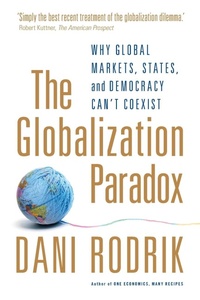
The Globalization Paradox
Why Global Markets, States, and Democracy Can't Coexist
Published on 17. May 2012
Book
Paperback/Softback
370 pages
978-0-19-965252-5 (ISBN)
Description
For a century, economists have driven forward the cause of globalization in financial institutions, labour markets, and trade. Yet there have been consistent warning signs that a global economy and free trade might not always be advantageous. Where are the pressure points? What could be done about them?
Dani Rodrik examines the back-story from its seventeenth-century origins through the milestones of the gold standard, the Bretton Woods Agreement, and the Washington Consensus, to the present day. Although economic globalization has enabled unprecedented levels of prosperity in advanced countries and has been a boon to hundreds of millions of poor workers in China and elsewhere in Asia, it is a concept that rests on shaky pillars, he contends. Its long-term sustainability is not a given.
The heart of Rodrik's argument is a fundamental 'trilemma': that we cannot simultaneously pursue democracy, national self-determination, and economic globalization. Give too much power to governments, and you have protectionism. Give markets too much freedom, and you have an unstable world economy with little social and political support from those it is supposed to help. Rodrik argues for smart globalization, not maximum globalization.
Dani Rodrik examines the back-story from its seventeenth-century origins through the milestones of the gold standard, the Bretton Woods Agreement, and the Washington Consensus, to the present day. Although economic globalization has enabled unprecedented levels of prosperity in advanced countries and has been a boon to hundreds of millions of poor workers in China and elsewhere in Asia, it is a concept that rests on shaky pillars, he contends. Its long-term sustainability is not a given.
The heart of Rodrik's argument is a fundamental 'trilemma': that we cannot simultaneously pursue democracy, national self-determination, and economic globalization. Give too much power to governments, and you have protectionism. Give markets too much freedom, and you have an unstable world economy with little social and political support from those it is supposed to help. Rodrik argues for smart globalization, not maximum globalization.
Reviews / Votes
Review from previous edition This book takes on the biggest issue of our time - globalization - and eloquently enlarges the debate about the extent and limits of global cooperation * Gordon Brown, MP * In this powerfully argued book, Dani Rodrik makes the case for country-specific paths to economic development and saner, more sustainable forms of growth. A provocative look at the excesses of hyper-globalization, The Globalization Paradox should be required reading for those who seek to prevent the financial crises and unfair trade practices that feed the backlash against open markets * Nouriel Roubini, co-author of Crisis Economics: A Crash Course in the Future of Finance * Dani Rodrik may be globalization's most prominent - and most thoughtful - gadfly. In The Globalization Paradox, he wonders aloud whether extreme globalization undermines democracy - and vice-versa. Read it and you'll wonder, too * Alan S. Blinder, former Vice Chairman of the Board of Governors of the U.S. Federal Reserve * His excellent new book is a sequel to an earlier book about the often disruptive impact of international trade on national labor markets and social policies. The new book develops and extends this theme to include financial globalization... Rodrik concludes by considering how the world economy might be reformed * Robert Rowthorn, Finance and Development * His message is nuanced and rigorous, drawing on history, logic and the latest economic data, he manages to convey it in simple, powerful prose tht any reader can follow * Steven Pearlstein, The Washington Post * Simply the best recent treatment of the globalization dilemma. . . he gives us nothing less than a general theory of globalization, development, democracy, and the state. The book provides the pleasure of following a thoughtful, critical mind working through a complex puzzle. Rodrik writes in highly friendly and nontechnical prose, blending a wide-ranging knowledge of economic history and politics and a gentle, occasionally incredulous, skepticism about the narrow and distorting lens of his fellow economists * Robert Kuttner, The American Prospect *More details
Language
English
Place of publication
Oxford
United Kingdom
Target group
College/higher education
Professional and scholarly
Dimensions
Height: 233 mm
Width: 151 mm
Thickness: 22 mm
Weight
544 gr
ISBN-13
978-0-19-965252-5 (9780199652525)
Copyright in bibliographic data and cover images is held by Nielsen Book Services Limited or by the publishers or by their respective licensors: all rights reserved.
Schweitzer Classification
Other editions
Additional editions
E-Book
05/2012
1st Edition
OUP eBook
€12.99
Available for download
E-Book
05/2012
1st Edition
OUP eBook
€12.99
Available for download
Book
03/2011
Oxford University Press
€21.03
Article exhausted; check different version
Person
Dani Rodrik is one of the world's top economists, well known for his original and prescient analyses of globalization and economic development. His ideas on improving national and global economic policies-in the fields of trade, industry, finance, and growth-have been highly influential among economists and policy makers alike. His 1997 book Has Globalization Gone Too Far? was called one of the decade's best economics books in Business Week. Rodrik's syndicated monthly columns for the Project Syndicate network are published in scores of newspapers around the world. His blog, "Unconventional thoughts on economic development and globalization" is widely read and frequently cited in newspapers and magazines such as The New York Times and The Economist. In 2007, he was recognized as the first recipient of the prestigious Albert O. Hirschman award of the Social Science Research Council (New York).
Content
Introduction: Recasting Globalization's Narrative ; 1. Of States and Markets: Globalization in History's Mirror ; 2. The Rise and Fall of the First Great Globalization ; 3. Why Doesn't Everyone Get the Case for Free Trade? ; 4. Bretton Woods, GATT, and the WTO: Trade in a Politicized World ; 5. Financial Globalization Follies ; 6. The Foxes and Hedgehogs of Finance ; 7. Poor Countries in a Rich World ; 8. Trade Fundamentalism in the Tropics ; 9. The Political Trilemma of the World Economy ; 10. Is Global Governance Feasible? Is It Desirable? ; 11. Designing Capitalism ; 12. A Sane Globalization ; Afterword: A Bedtime Story for Grown-ups