

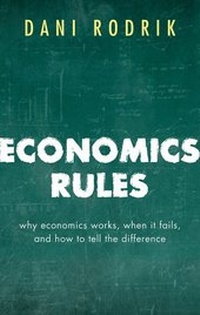
Economics Rules
Why Economics Works, When It Fails, and How To Tell The Difference
Published on 8. October 2015
Book
Hardback
268 pages
978-0-19-873689-9 (ISBN)
Description
The economics profession has become a favourite punching bag in the aftermath of the global financial crisis. Economists are widely reviled and their influence derided by the general public. Yet their services have never been in greater demand. To unravel the paradox, we need to understand both the strengths and weaknesses of economics.
Dani Rodrik argues that the multiplicity of theoretical frameworks - what economists call 'models' that exist side by side is economics' great strength. Economists are trained to hold diverse, possibly contradictory models of the world in their minds. This is what allows them, when they do their job right, to comprehend the world, make useful suggestions for improving it, and to advance their stock of knowledge over time. In short, it is what makes economics a 'science' a different kind of
science from physics or some other natural sciences, but a science nonetheless.
But syncretism is not a comfortable state of mind, and economists often jettison it for misplaced confidence and arrogance, especially when they confront questions of public policy. Economists are prone to fads and fashions, and behave too often as if their discipline is about the search for the model that works always and everywhere, rather than a portfolio of models. Their training lets them down when it comes to navigating among diverse models and figuring out which one applies
where. Ideology and political preferences frequently substitute for analysis in choosing among models.
So the book offers both a defence and critique of economics. Economists' way of thinking about social phenomena has great advantages. But the flexible, contextual nature of economics is also its Achilles' heel in the hands of clumsy practitioners.
Dani Rodrik argues that the multiplicity of theoretical frameworks - what economists call 'models' that exist side by side is economics' great strength. Economists are trained to hold diverse, possibly contradictory models of the world in their minds. This is what allows them, when they do their job right, to comprehend the world, make useful suggestions for improving it, and to advance their stock of knowledge over time. In short, it is what makes economics a 'science' a different kind of
science from physics or some other natural sciences, but a science nonetheless.
But syncretism is not a comfortable state of mind, and economists often jettison it for misplaced confidence and arrogance, especially when they confront questions of public policy. Economists are prone to fads and fashions, and behave too often as if their discipline is about the search for the model that works always and everywhere, rather than a portfolio of models. Their training lets them down when it comes to navigating among diverse models and figuring out which one applies
where. Ideology and political preferences frequently substitute for analysis in choosing among models.
So the book offers both a defence and critique of economics. Economists' way of thinking about social phenomena has great advantages. But the flexible, contextual nature of economics is also its Achilles' heel in the hands of clumsy practitioners.
Reviews / Votes
Dani Rodrik ... provides an edifying discussion of these basic tools, of the economist's trade [economic models] * Ben Chu, Books of the Year 2015, Independent * one of the world's most perceptive policy analysts * Martin Wolf, Books of the Year 2015: Best Books 2015 Economics, Financial Times * Rodriks central message is that economics is a collection of models with which to see the world ... The challenge is to choose which model applies to the situation at hand. This choice requires theoretical open-mindedness and empirical investigation and is, as Rodrik succinctly puts it, a craft not a science. That idea that good economics is about good craftsmanship as much as anything else is a hugely valuable contribution. Rodrik is well placed to make thesearguments because he is himself a master craftsman. * Martin Sandbu, The Financial Times * I hope open-minded critics of economics will read Economics Rules to learn how the best of economists approach the subject, and how important their work is * The Enlightened Economist, Diane Coyle * terrific * The Enlightened Economist, Diane Coyle *
More details
Language
English
Place of publication
Oxford
United Kingdom
Target group
College/higher education
Professional and scholarly
Dimensions
Height: 223 mm
Width: 144 mm
Thickness: 26 mm
Weight
444 gr
ISBN-13
978-0-19-873689-9 (9780198736899)
Copyright in bibliographic data and cover images is held by Nielsen Book Services Limited or by the publishers or by their respective licensors: all rights reserved.
Schweitzer Classification
Other editions
New editions
Book
01/2017
Oxford University Press
€17.00
Available immediately
Additional editions
Book
01/2017
Oxford University Press
€17.00
Available immediately
E-Book
10/2015
1st Edition
OUP eBook
€12.99
Available for download
E-Book
10/2015
1st Edition
OUP eBook
€12.99
Available for download
Person
Dani Rodrik is the Ford Foundation Professor of International Political Economy at the John F. Kennedy School of Government, Harvard University. Previously he held professorships at Princeton and Columbia Universities. He is the author, among other works, of The Globalization Paradox (2011) and One Economics, Many Recipes (2007). He has published widely in economic development and growth, globalization, and political economy.
Content
Introduction: The Use and Misuse of Economic Ideas ; 1. What Models Do ; 2. The Science of Economic Modeling ; 3. Navigating among Models ; 4. Models and Theories ; 5. When Economists Go Wrong ; 6. Economics and Its Critics ; Epilogue: The Twenty Commandments