

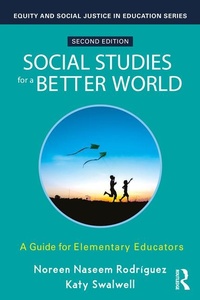
Social Studies for a Better World
A Guide for Elementary Educators
2nd Edition
Published on 12. March 2025
Book
Paperback/Softback
250 pages
978-1-032-71057-0 (ISBN)
Description
Giving young people opportunities to grapple with injustices and complex social problems can inspire them to build a better world. In this bestselling book, two experienced social studies educators lay out their vision for an elementary social studies education that will help young people find value in learning about the world as they consider how to make their communities more just, equitable, and healthy.
Rodriguez and Swalwell unpack the problems that so often characterize the elementary curriculum-normalization, idealization, heroification, and dramatization-and show how common pitfalls can be replaced with creative solutions. This timely second edition discusses increasingly important topics like book bans and the rise of AI, provides updated research and resources, and includes strategies for teaching anti-oppressive social studies even when circumstances are less than ideal.
Whether you're a classroom teacher, methods student, or curriculum coordinator, this is a book that can transform your understanding of the social studies disciplines and their power to disrupt the narratives that maintain current inequities.
Rodriguez and Swalwell unpack the problems that so often characterize the elementary curriculum-normalization, idealization, heroification, and dramatization-and show how common pitfalls can be replaced with creative solutions. This timely second edition discusses increasingly important topics like book bans and the rise of AI, provides updated research and resources, and includes strategies for teaching anti-oppressive social studies even when circumstances are less than ideal.
Whether you're a classroom teacher, methods student, or curriculum coordinator, this is a book that can transform your understanding of the social studies disciplines and their power to disrupt the narratives that maintain current inequities.
Reviews / Votes
"This preeminent guide on teaching for justice in the elementary classroom is a rare and invaluable gift to those of us working- too often in isolation- to invite young children to struggle mightily alongside us for a better world. Speaking as scholars, educators, mothers, and human beings, the authors offer the support and inspiration we need to skillfully practice anti-oppression in our classrooms and to prepare children to carry that practice into their lives outside of school."Carla Shalaby, Author of Troublemakers: Lessons in Freedom from Young Children at School
"An immediately applicable and essential text for anyone teaching humanity from the perspectives of those it is denied. Practical, thought-provoking and timeless, this text offers a breadth of teachable possibilities and insightful unlearning that every critical educator in community with young children should have."
Ki Gross, Founder, Woke Kindergarten
"Brilliantly conceptualized, Social Studies for a Better World offers essential insights for understanding the ability of social studies to help students decipher the past and make sense of the present. Equally important, it provides an easy to follow blueprint for classroom implementation. This is essential reading for anyone who believes in the power of social studies to transform society."
Hasan Kwame Jeffries, host of the podcast "Teaching Hard History," and Associate Professor of History, The Ohio State University
"No one should step into a classroom without first reading Social Studies for a Better World. The book sings with possibility about creating classrooms of justice and kindness. It is utopian in the absolute best sense of the term. So many teaching books are dry as dust, and pedagogically unhelpful. But Noreen Naseem Rodriguez and Katy Swalwell, former classroom teachers, know what they are talking about. Inviting, warm, and deeply humane, Social Studies for a Better World is the book that all teachers need in these hard times."
Bill Bigelow, Curriculum Editor, Rethinking Schools
"With the increased scrutiny on educators who aim to teach from an anti-oppressive stance, precise tools and strategies for liberatory education are needed now more than ever. Enter Social Studies for a Better World. By critiquing social studies as it is while sharing a vision for what it could be, Rodriguez and Swalwell provide elementary educators with creative solutions for transforming the discipline. This book is a must-have resource for current and aspiring teachers."
Bree Picower, Author of Reading, Writing and Racism: Disrupting Whiteness in Teacher Education and the Classroom
More details
Series
Edition
2nd edition
Language
English
Place of publication
London
United Kingdom
Publishing group
Taylor & Francis Ltd
Target group
Professional and scholarly
Professional Practice & Development
Product notice
Paperback (trade)
Unsewn / adhesive bound
Illustrations
1 s/w Zeichnung, 11 s/w Tabellen, 4 s/w Abbildungen, 3 s/w Photographien bzw. Rasterbilder
11 Tables, black and white; 1 Line drawings, black and white; 3 Halftones, black and white; 4 Illustrations, black and white
Dimensions
Height: 228 mm
Width: 152 mm
Thickness: 16 mm
Weight
522 gr
ISBN-13
978-1-032-71057-0 (9781032710570)
Copyright in bibliographic data and cover images is held by Nielsen Book Services Limited or by the publishers or by their respective licensors: all rights reserved.
Schweitzer Classification
Other editions
Additional editions
Noreen Naseem Rodriguez | Katy Swalwell
Social Studies for a Better World
A Guide for Elementary Educators
E-Book
03/2025
2nd Edition
Routledge
€29.99
Available for download
Noreen Naseem Rodriguez | Katy Swalwell
Social Studies for a Better World
A Guide for Elementary Educators
E-Book
03/2025
2nd Edition
Routledge
€29.99
Available for download
Previous edition
Noreen Naseem Rodriguez | Katy Swalwell
Social Studies for a Better World
An Anti-Oppressive Approach for Elementary Educators
Book
09/2023
1st Edition
Routledge
€50.94
Article exhausted; check for reprint
Persons
Noreen Naseem Rodriguez (she/her) is the daughter of Asian immigrants and was a bilingual elementary educator in Austin, Texas, before becoming a teacher educator. She is currently an assistant professor of elementary education and educational justice in the College of Education and core faculty in Asian Pacific American Studies and Muslim Studies at Michigan State University. Noreen engages in tsundoku-the art of collecting books but not reading them-and enjoys art projects, baking, and cooking.
Katy Swalwell (she/her) is the descendent of European settlers in Iowa and was a middle and high school social studies teacher before becoming a professor in elementary education programs at universities in the Midwest and Mid-Atlantic. She is now a consultant with the Equity Literacy Institute and Past Present Future Consulting & Media. She enjoys road trips with her family, co-hosts a history podcast called "Our Dirty Laundry," and co-founded a children's book company called Past Present Future Publishing. Noreen and Katy bonded over their love of escape rooms, theme parties, and dessert. When together, they are bound to burst into song and gesticulate wildly.
Katy Swalwell (she/her) is the descendent of European settlers in Iowa and was a middle and high school social studies teacher before becoming a professor in elementary education programs at universities in the Midwest and Mid-Atlantic. She is now a consultant with the Equity Literacy Institute and Past Present Future Consulting & Media. She enjoys road trips with her family, co-hosts a history podcast called "Our Dirty Laundry," and co-founded a children's book company called Past Present Future Publishing. Noreen and Katy bonded over their love of escape rooms, theme parties, and dessert. When together, they are bound to burst into song and gesticulate wildly.
Content
Part I: Why Social Studies Can Change the World 1. The Social Studies 2. The Transformative Potential of Social Studies 3. Sustaining Anti-Oppressive Social Studies Part II: Common Pitfalls and Creative Solutions 4. Normalization: Families and Holidays 5. Idealization: Rules, Communities, and Community Helpers 6. Heroification: The "Founding Fathers," Suffragists, and Civil Rights Movement Leaders 7. Dramatization and Gamification: Immigration, "Westward Expansion," and Slavery Part III: Teaching Anti-Oppressive Social Studies 8. Building Better Curriculum 9. Frequently Asked Questions about Teaching Anti-Oppressive Social Studies 10. Epilogue Appendix A: Recommended Resources: The Tip of the Iceberg Appendix B: Educator Tools and Guides