

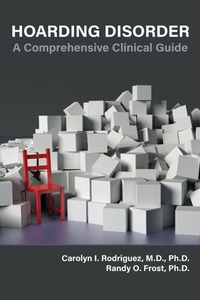
Hoarding Disorder
A Comprehensive Clinical Guide
Published on 29. July 2022
Book
Paperback/Softback
318 pages
978-1-61537-336-9 (ISBN)
Description
Accounts of hoarding behaviors have appeared in literature, as far back as 319 B.C.E. in the writings of Aristotle's student Theophrastus; in the news, like New York's infamous Collyer brothers in the 1940s; and more recently in popular reality television series.
But it wasn't until the publication of DSM-5 in 2013 that hoarding was classified as a disorder in its own right rather than as a symptom of obsessive-compulsive disorder or obsessive-compulsive personality disorder. In this single source, readers can access the most up-to-date comprehensive information on what is known about the disorder.
Drawing on the authors' own clinical experiences as well as the latest published research, Hoarding Disorder: A Comprehensive Clinical Guide examines key features of the disorder and treatment approaches, such as:
Phenomenology, including diagnosis, comorbidities, and assessment
Etiology, from both a cognitive-behavioral and a neurobiological perspective
Psychotherapeutic and pharmacological treatments, from cognitive-behavioral therapy, harm reduction strategies, and community approaches to the efficacy of specific drugs
Challenges, including working with elderly patients, managing cases of animal hoarding, and distinguishing and addressing squalor
Key points for each chapter and numerous case studies will help readers easily reference and retain information, and the appendixes feature useful symptom rating scales that can be applied to practice.
For psychiatrists, psychologists, human service and other mental health professionals, peer support counselors, community advocates, and professionals in training, this invaluable book will improve the reader's knowledge and skill in treating patients with hoarding disorder, both those with straightforward presentations and those with complicated ones.
But it wasn't until the publication of DSM-5 in 2013 that hoarding was classified as a disorder in its own right rather than as a symptom of obsessive-compulsive disorder or obsessive-compulsive personality disorder. In this single source, readers can access the most up-to-date comprehensive information on what is known about the disorder.
Drawing on the authors' own clinical experiences as well as the latest published research, Hoarding Disorder: A Comprehensive Clinical Guide examines key features of the disorder and treatment approaches, such as:
Phenomenology, including diagnosis, comorbidities, and assessment
Etiology, from both a cognitive-behavioral and a neurobiological perspective
Psychotherapeutic and pharmacological treatments, from cognitive-behavioral therapy, harm reduction strategies, and community approaches to the efficacy of specific drugs
Challenges, including working with elderly patients, managing cases of animal hoarding, and distinguishing and addressing squalor
Key points for each chapter and numerous case studies will help readers easily reference and retain information, and the appendixes feature useful symptom rating scales that can be applied to practice.
For psychiatrists, psychologists, human service and other mental health professionals, peer support counselors, community advocates, and professionals in training, this invaluable book will improve the reader's knowledge and skill in treating patients with hoarding disorder, both those with straightforward presentations and those with complicated ones.
Reviews / Votes
I found the diagnostic questionnaires and other measuresfascinating as they provided insight into when hoarding becomes a disorder.
The 'clutter image rating scale', a series of images showing rooms in
various states, was particularly interesting as a visualisation of what some
professionals deem to be normal or disordered. I learnt a lot from this
book, and the authors are evidently experts in their field and skilled in
synthesising and communicating a great deal of up-to-date knowledge and
research. The book feels practical and informative and would be of interest
to agencies and institutions working with people who hoard. But personally,
although it was touched on briefly, I would have loved to learn more about
the emotional and psychological causes of hoarding. -- Emmanuelle Smith * Therapy Today *
More details
Language
English
Place of publication
VA
United States
Target group
Professional and scholarly
US School Grade: College Graduate Student and over
Product notice
Paperback (trade)
Illustrations
1 chart, 1 figure, 9 tables
Dimensions
Height: 229 mm
Width: 152 mm
Thickness: 17 mm
Weight
431 gr
ISBN-13
978-1-61537-336-9 (9781615373369)
Copyright in bibliographic data and cover images is held by Nielsen Book Services Limited or by the publishers or by their respective licensors: all rights reserved.
Schweitzer Classification
Other editions
Additional editions
E-Book
07/2022
American Psychiatric Association Publishing
€37.99
Available for download
Persons
Carolyn I. Rodriguez, M.D., Ph.D., is Associate Chair and Associate Professor and Director of the
Translational Therapeutics Lab in the Department of Psychiatry and
Behavioral Sciences at Stanford University School of Medicine in Stanford,
California.
Randy O. Frost, Ph.D., is Harold Edward and Elsa
Siipola Israel Professor Emeritus of Psychology at Smith College in
Northampton, Massachusetts.
Translational Therapeutics Lab in the Department of Psychiatry and
Behavioral Sciences at Stanford University School of Medicine in Stanford,
California.
Randy O. Frost, Ph.D., is Harold Edward and Elsa
Siipola Israel Professor Emeritus of Psychology at Smith College in
Northampton, Massachusetts.
Content
Part I: Phenomenology
1 Introduction and History
2 Diagnosis and Comorbidity
3 Assessment
4 Insight and Motivation
Part II: Etiology
5 Cognitive Behavioral Model
6 Neurobiology
Part III: Interventions
7 Cognitive Behavioral Therapy
8 Pharmacotherapy
9 Harm Reduction
10 Community
Part IV: Challenges
11 Elders
12 Animal Hoarding
13 Squalor
14 Future Directions
1 Introduction and History
2 Diagnosis and Comorbidity
3 Assessment
4 Insight and Motivation
Part II: Etiology
5 Cognitive Behavioral Model
6 Neurobiology
Part III: Interventions
7 Cognitive Behavioral Therapy
8 Pharmacotherapy
9 Harm Reduction
10 Community
Part IV: Challenges
11 Elders
12 Animal Hoarding
13 Squalor
14 Future Directions