

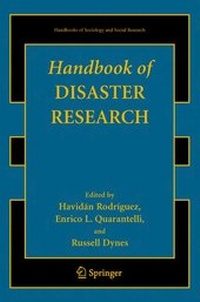
Handbook of Disaster Research
Published on 13. September 2006
Book
Hardback
XXXI, 611 pages
978-0-387-32331-2 (ISBN)
Description
This timely Handbook is based on the principle that disasters are social constructions and focuses on social science disaster research. It provides an interdisciplinary approach to disasters with theoretical, methodological, and practical applications. Attention is given to conceptual issues dealing with the concept "disaster" and to methodological issues relating to research on disasters. These include Geographic Information Systems as a useful research tool and its implications for future research. This seminal work is the first interdisciplinary collection of disaster research as it stands now while outlining how the field will continue to grow.
Reviews / Votes
From the reviews:"The Handbook of Disaster Research will, without a doubt, be the most important publication of its type during this decade. Just about everyone who is anyone in the disaster research community has shared their knowledge on the important topics of the day. The authors and the publisher are to be congratulated for completing the book that will be widely sought after by practitioners, researchers and students of disaster planning and response. Thank you for this outstanding contribution to the field."
Henry W. Fischer III, Director, Center for Disaster Research & Education, Millersville University
"The Handbook of Disaster Research will generate considerable excitement amongst international disaster research and management professionals. Finally, a volume that takes on the task of articulating and unpacking the many social complexities of modern disasters and catastrophes. By taking a multi-disciplinary perspective, the Handbook addresses the very pressing need to better understand the social dimensions of disaster. Analyses of key social-psychological concepts, such as risk and uncertainty, stand beside sociological assessments of class, community, organisation, technology and the media. It is academically weighty, boasting contributions from world-leading scholars. Yet, the Handbook offers a very balanced set of analyses that will undoubtedly appeal to not only the researcher, but the practitioner and the policy-maker alike."
Dr. Derek Bopping, Defence Science and Technology Organisation, Department of Defence, Australia
"This is an amazing handbook. An impressive array of authors, including practitioners as well as academics, provide intellectual depth and breadth on disaster, risk, and uncertainty. A "must have" for anyone who wants to know the cutting edges of disaster research. The Handbook of Disaster Research is unlike any other handbook I've seen. It covers "the field," but does a great deal more than that. For it is provocative and creative, each chapter providing much, much more than mere "coverage." By this I mean the authors present and develop new ideas, about disaster, risk, uncertainty, warning, or, more generally, social behavior. This is not surprising when you look at the list of individual authors. Luminaries in their fields, they represent some of the most creative thinkers in the social sciences today. It is surprising, however, to find so much creativity in a Handbook. The editors have done a superb job. I'm impressed, too, with the breadth of expertise that is represented. Practitioners as well as academics, the "old guard" of disaster research as well as the young, rising stars, and the refreshing appearance of scholars from places other than the United States. I need this book on my shelf."
Lee Clarke, Rutgers, The State University of New Jersey
Author of Worst Cases: Terror and Catastrophe
More details
Series
Edition
2006
Language
English
Place of publication
NY
United States
Target group
Professional and scholarly
Research
Illustrations
21
21 s/w Tabellen
21 Tables, black and white; XXXI, 611 p.
Dimensions
Height: 26 cm
Width: 19.3 cm
Weight
1488 gr
ISBN-13
978-0-387-32331-2 (9780387323312)
DOI
10.1007/978-0-387-32353-4
Schweitzer Classification
Other editions
New editions
Havidán Rodríguez | William Donner | Joseph E. Trainor
Handbook of Disaster Research
Book
12/2017
2nd Edition
Springer
€235.39
Shipment within 10-15 days
Additional editions
Havidan Rodriguez | Enrico L. Quarantelli | Russell Dynes
Handbook of Disaster Research
E-Book
11/2009
1st Edition
Springer
€96.29
Available for download
Havidan Rodriguez | Enrico L. Quarantelli | Russell Dynes
Handbook of Disaster Research
Book
07/2007
Springer
€106.99
Shipment within 7-9 days
Persons
Content
What Is a Disaster?.- A Heuristic Approach to Future Disasters and Crises: New, Old, and In-Between Types.- The Crisis Approach.- Methodological Issues.- The Role of Geographic Information Systems/Remote Sensing in Disaster Management.- Morbidity and Mortality Associated with Disasters.- Race, Class, Ethnicity, and Disaster Vulnerability.- Gender and Disaster: Foundations and Directions.- Globalization and Localization: An Economic Approach.- Local Emergency Management Organizations.- Community Processes: Warning and Evacuation.- Search and Rescue Activities in Disasters.- Community Processes: Coordination.- Sustainable Disaster Recovery: Operationalizing An Existing Agenda.- Sheltering and Housing Recovery Following Disaster*.- Businesses and Disasters: Vulnerability, Impacts, and Recovery.- Organizational Adaptation to Disaster.- Community Innovation and Disasters.- Disaster and Development Research and Practice: A Necessary Eclecticism?.- National Planning and Response: National Systems.- Disaster and Crisis Management in Transitional Societies: Commonalities and Peculiarities.- Terrorism as Disaster.- Recent Developments in U.S. Homeland Security Policies and Their Implications for the Management of Extreme Events.- Unwelcome Irritant or Useful Ally? The Mass Media in Emergencies.- The Popular Culture of Disaster: Exploring a New Dimension of Disaster Research.- Remembering: Community Commemoration After Disaster.- Research Applications in the Classroom.- From Research to Praxis: The Relevance of Disaster Research for Emergency Management.- Communicating Risk and Uncertainty: Science, Technology, and Disasters at the Crossroads.- Crisis Management in the Twenty-First Century: "Unthinkable" Events in "Inconceivable" Contexts.- New Dimensions: The Growth of a Market in Fear.- Disasters Ever More? Reducing U.S. Vulnerabilities.