

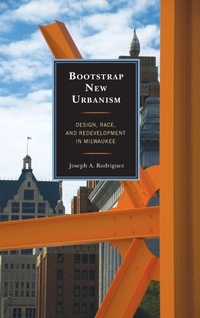
Bootstrap New Urbanism
Design, Race, and Redevelopment in Milwaukee
Published on 26. August 2014
Book
Hardback
270 pages
978-0-7391-8612-1 (ISBN)
Description
Joseph A. Rodriguez critically examines the urban design and revitalization initiatives undertaken by both the government and the people of Milwaukee, Wisconsin. In the 1990s, New Urbanists followed a city tradition of using urban design to solve problems while seeking to elevate the city's national reputation and status. While New Urbanism was not the only design element undertaken to further Milwaukee's redevelopment, the elite focus on New Urbanism reflected an attempt to fashion a self-help narrative for the revitalization of the city. This approach linked New Urbanist design to the strengthening of grassroots community organizing and volunteerism to solve urban problems. Bootstrap New Urbanism: Design, Race, and Redevelopment in Milwaukee uncovers a practice with implications for urban history, architectural history, planning history, environmental design, ethnic studies, and urban politics.
Reviews / Votes
Rodriquez does not pull punches about practices and attitudes that reinforced racial segregation and inequality. . . .Rodriguez raises important questions and avoids facile solutions. . . .I found this book refreshingly honest and fair. Rodriquez acknowledges success stories without boosterism. As the city and county grapple with diminished budgets and recurring challenges, it can be helpful to place those issues within a historical context. * The Bay View Compass * As city leaders across the country embrace various forms of new urbanism, Joseph A. Rodriguez provides a compelling historical lesson. Urban development that emphasizes self-help and ignores the structural problems of poverty, racial segregation, and growing inequality is doomed to repeat the mistakes of the nation's urban past. -- Robert Self, Brown University Bootstrap New Urbanism presents a provocative idea that revives key elements of growth machine theory and reinforces a regionalist critique of neoliberal urban policy efforts. The book shows how policymakers can avoid taking responsibility for urban issues by adopting popular design trends. Thus, community-based solutions are transformed into a "self-help" regime, which in turn comes very close to blaming the victim. Furthermore, Joseph A. Rodriguez make insightful observations about the unanticipated risks of promoting entertainment as a force for urban revitalization, particularly in relation to alcohol. -- Aaron Passell, Furman University Joseph A. Rodriquez offers an astute analysis of the limits of localized revitalization, whether based in grass-roots community activism or civic boosterism by elites. In a world dominated by the self-help discourse, this is a brave position well worth considering. -- Emily Talen, Arizona State UniversityMore details
Series
Language
English
Place of publication
United States
Publishing group
Bloomsbury Publishing Plc
Target group
Professional and scholarly
Illustrations
2 Maps
Dimensions
Height: 235 mm
Width: 157 mm
Thickness: 21 mm
Weight
596 gr
ISBN-13
978-0-7391-8612-1 (9780739186121)
Copyright in bibliographic data and cover images is held by Nielsen Book Services Limited or by the publishers or by their respective licensors: all rights reserved.
Schweitzer Classification
Other editions
Additional editions
E-Book
08/2014
1st Edition
Lexington Books
€124.99
Available for download
E-Book
08/2014
1st Edition
Lexington Books
€124.99
Available for download
Person
Joseph A. Rodriguez is associate professor of history and urban studies at the University of Wisconsin-Milwaukee.
Content
Socialists and Merchants in a Thrifty CityPraising and Blaming the Suburbs Summerfest and the Ethnic FestivalsNew Urbanism, Alcohol, and the AutomobileNew Urbanism and Community ProtestsShopping Malls, New Urbanism, and BronzevilleSelf-Help, New Urbanism, and Crime Is Milwaukee a Conservative City?