

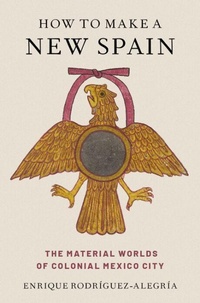
How to Make a New Spain
The Material Worlds of Colonial Mexico City
Published on 4. May 2023
Book
Hardback
344 pages
978-0-19-768229-6 (ISBN)
Description
How to Make a New Spain presents an unprecedented view of the material worlds of Mexico City in the sixteenth century, drawing from a combination of sources and methodologies. It presents the author's original analysis of over 11,000 items in the probate inventories of thirty-nine Spanish colonizers. It also synthesizes information from archaeological excavations of Spanish houses at the center of Mexico City.
The book begins with a critique of theories of materiality, in which scholars emphasize the agency of things at the expense of an investigation of social relationships. Rodriguez-Alegria argues that now that scholars have shown that the descendants of the Mexica (often known as the Aztecs) maintained social and political power in the colonial period, we should reexamine how Indigenous people, colonizers, and Black people together created the material and social worlds of colonial Mexico. The book assimilates information on architecture, money, clothing, furniture, pottery, slaves, livestock, and tools to provide a new vision of daily life in colonial Mexico City. It shows that colonialism was based on the recognition of people of similar classes across ethnic boundaries, and on the forging of relationships with powerful Indigenous people. Even colonizers who sought to display distinction from Indigenous people with their material culture depended on Indigenous products and technology to achieve that distinction. The complex history of materiality and power that emerges from this book compels us to reimagine colonial Mexico and the people who created it.
The book begins with a critique of theories of materiality, in which scholars emphasize the agency of things at the expense of an investigation of social relationships. Rodriguez-Alegria argues that now that scholars have shown that the descendants of the Mexica (often known as the Aztecs) maintained social and political power in the colonial period, we should reexamine how Indigenous people, colonizers, and Black people together created the material and social worlds of colonial Mexico. The book assimilates information on architecture, money, clothing, furniture, pottery, slaves, livestock, and tools to provide a new vision of daily life in colonial Mexico City. It shows that colonialism was based on the recognition of people of similar classes across ethnic boundaries, and on the forging of relationships with powerful Indigenous people. Even colonizers who sought to display distinction from Indigenous people with their material culture depended on Indigenous products and technology to achieve that distinction. The complex history of materiality and power that emerges from this book compels us to reimagine colonial Mexico and the people who created it.
Reviews / Votes
This book serves as an exemplary work of ethnohistory, employing both archaeological findings and records of deceased early colonizers' possessions to compose a comprehensive view of the material life of the Spanish inhabitants of New Spain.... [It] should be read by all scholars and graduate students interested in materiality, urban Latin America, or colonial New Spain. * The Americas * An innovative archaeological and historical study that examines how sixteenth-century colonizers attempted to re-create the material culture of Spain in the titular colony... Indeed, this pioneering work is certain to make any scholar of early colonial Latin America, whatever their specific discipline, hope for yet more studies of this kind. * Hispanic American Historical Review * Enrique Rodriguez-Alegria's How to Make a New Spain provides another important portal to the material worlds of colonial Mexico City. Through detailed analysis of the probate inventories of the colonizers and relevant archaeological data, Rodriguez-Alegria highlights the active role of people in creating material and social worlds. He demonstrates how the society of New Spain was materialized through the consumption of the colonizers, which involved engaging with the local materials, knowledge, and technologies of the Indigenous people. The objects in this study represent the interface where the intentionalities of and contingencies between colonizers and Indigenous peoples are intertwined. * Doyun Kim, H-Net * As with all good books, Rodriguez-Alegria's book points to questions that demand answers; as with even better books, his offers methods to answer them. * West 86th *More details
Language
English
Place of publication
New York
United States
Target group
College/higher education
Product notice
sewn/stitched
Cloth over boards
Dimensions
Height: 242 mm
Width: 162 mm
Thickness: 24 mm
Weight
798 gr
ISBN-13
978-0-19-768229-6 (9780197682296)
Copyright in bibliographic data and cover images is held by Nielsen Book Services Limited or by the publishers or by their respective licensors: all rights reserved.
Schweitzer Classification
Other editions
Additional editions
E-Book
03/2023
OUP eBook
€54.49
Available for download
E-Book
03/2023
OUP eBook
€54.49
Available for download
Person
Enrique Rodriguez-Alegria is Professor in Anthropology at the University of Texas at Austin. He is co-editor of The Oxford Handbook of the Aztecs, co-editor of The Menial Art of Cooking, and author of The Archaeology and History of Colonial Central Mexico.
Content
Preface
Acknowledgments
A Note on Terminology and Gentilics
How to enter the material and social worlds
Chapter 1: How to make money
Chapter 2: How to build houses
Chapter 3: How to furnish a house
Chapter 4: How to get pottery and food
Chapter 5: How to dress the part
Chapter 6: How to build sociotechnical systems: tools, livestock, and slaves
Chapter 7: How to link wealth and consumption, or not
Conclusion: The Material Worlds of Spanish Colonizers
Appendix 5.1: Items of clothing in the probate inventories
Appendix 6.1: Tools listed in the documents
Appendix 7.1: Prices of shirts with an indicated origin
References
Acknowledgments
A Note on Terminology and Gentilics
How to enter the material and social worlds
Chapter 1: How to make money
Chapter 2: How to build houses
Chapter 3: How to furnish a house
Chapter 4: How to get pottery and food
Chapter 5: How to dress the part
Chapter 6: How to build sociotechnical systems: tools, livestock, and slaves
Chapter 7: How to link wealth and consumption, or not
Conclusion: The Material Worlds of Spanish Colonizers
Appendix 5.1: Items of clothing in the probate inventories
Appendix 6.1: Tools listed in the documents
Appendix 7.1: Prices of shirts with an indicated origin
References