

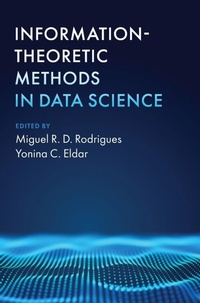
Information-Theoretic Methods in Data Science
Published on 8. April 2021
Book
Hardback
560 pages
978-1-108-42713-5 (ISBN)
Description
Learn about the state-of-the-art at the interface between information theory and data science with this first unified treatment of the subject. Written by leading experts in a clear, tutorial style, and using consistent notation and definitions throughout, it shows how information-theoretic methods are being used in data acquisition, data representation, data analysis, and statistics and machine learning. Coverage is broad, with chapters on signal acquisition, data compression, compressive sensing, data communication, representation learning, emerging topics in statistics, and much more. Each chapter includes a topic overview, definition of the key problems, emerging and open problems, and an extensive reference list, allowing readers to develop in-depth knowledge and understanding. Providing a thorough survey of the current research area and cutting-edge trends, this is essential reading for graduate students and researchers working in information theory, signal processing, machine learning, and statistics.
More details
Language
English
Place of publication
Cambridge
United Kingdom
Target group
Professional and scholarly
Illustrations
Worked examples or Exercises; 1 Halftones, black and white; 73 Line drawings, black and white
Dimensions
Height: 250 mm
Width: 175 mm
Thickness: 35 mm
Weight
1137 gr
ISBN-13
978-1-108-42713-5 (9781108427135)
Copyright in bibliographic data and cover images is held by Nielsen Book Services Limited or by the publishers or by their respective licensors: all rights reserved.
Schweitzer Classification
Other editions
Additional editions
Miguel R. D. Rodrigues | Yonina C. Eldar
Information-Theoretic Methods in Data Science
E-Book
03/2022
Cambridge University Press
€78.99
Available for download
Persons
Content
1. Introduction Miguel Rodrigues, Stark Draper, Waheed Bajwa and Yonina Eldar; 2. An information theoretic approach to analog-to-digital compression Alon Knipis, Yonina Eldar and Andrea Goldsmith; 3. Compressed sensing via compression codes Shirin Jalali and Vincent Poor; 4. Information-theoretic bounds on sketching Mert Pillanci; 5. Sample complexity bounds for dictionary learning from vector- and tensor-valued data Zahra Shakeri, Anand Sarwate and Waheed Bajwa; 6. Uncertainty relations and sparse signal recovery Erwin Riegler and Helmut Boelcskei; 7. Understanding phase transitions via mutual Information and MMSE Galen Reeves and Henry Pfister; 8. Computing choice: learning distributions over permutations Devavrat Shah; 9. Universal clustering Ravi Raman and Lav Varshney; 10. Information-theoretic stability and generalization Maxim Raginsky, Alexander Rakhlin and Aolin Xu; 11. Information bottleneck and representation learning Pablo Piantanida and Leonardo Rey Vega; 12. Fundamental limits in model selection for modern data analysis Jie Ding, Yuhong Yang and Vahid Tarokh; 13. Statistical problems with planted structures: information-theoretical and computational limits Yihong Wu and Jiaming Xu; 14. Distributed statistical inference with compressed data Wenwen Zhao and Lifeng Lai; 15. Network functional compression Soheil Feizi and Muriel Medard; 16. An introductory guide to Fano's inequality with applications in statistical estimation Jonathan Scarlett and Volkan Cevher.