

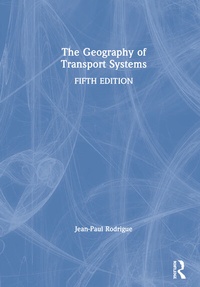
The Geography of Transport Systems
5th Edition
Published on 28. May 2020
Book
Hardback
480 pages
978-0-367-36462-5 (ISBN)
Description
This expanded and revised fifth edition of The Geography of Transport Systems provides a comprehensive and accessible introduction to the field with a broad overview of its concepts, methods and areas of application. Aimed mainly at an undergraduate audience, it provides an overview of the spatial aspects of transportation and focuses on how the mobility of passengers and freight is linked with geography.
The book is divided into ten chapters, each covering a specific conceptual dimension, including networks, modes, terminals, freight transportation, urban transportation and environmental impacts, and updated with the latest information available. The fifth edition offer new and updated material on information technologies and mobility, e-commerce, transport and the economy, mobility and society, supply chains, security, pandemics, energy and the environment and climate change. With over 140 updated figures and maps, The Geography of Transport Systems presents transportation systems at different scales ranging from global to local.
This volume is an essential resource for undergraduates studying transport geography, as well as those interested in economic and urban geography, transport planning and engineering. A companion web site, which contains additional material such as photographs, maps, figures and PowerPoint presentations, has been developed for the book and can be found here: https://transportgeography.org/
The book is divided into ten chapters, each covering a specific conceptual dimension, including networks, modes, terminals, freight transportation, urban transportation and environmental impacts, and updated with the latest information available. The fifth edition offer new and updated material on information technologies and mobility, e-commerce, transport and the economy, mobility and society, supply chains, security, pandemics, energy and the environment and climate change. With over 140 updated figures and maps, The Geography of Transport Systems presents transportation systems at different scales ranging from global to local.
This volume is an essential resource for undergraduates studying transport geography, as well as those interested in economic and urban geography, transport planning and engineering. A companion web site, which contains additional material such as photographs, maps, figures and PowerPoint presentations, has been developed for the book and can be found here: https://transportgeography.org/
More details
Edition
5th edition
Language
English
Place of publication
London
United Kingdom
Publishing group
Taylor & Francis Ltd
Target group
College/higher education
Illustrations
140 s/w Zeichnungen, 140 s/w Abbildungen
140 Line drawings, black and white; 140 Illustrations, black and white
Dimensions
Height: 246 mm
Width: 174 mm
Weight
1260 gr
ISBN-13
978-0-367-36462-5 (9780367364625)
Copyright in bibliographic data and cover images is held by Nielsen Book Services Limited or by the publishers or by their respective licensors: all rights reserved.
Schweitzer Classification
Other editions
New editions
Jean-Paul Rodrigue
The Geography of Transport Systems
Book
04/2024
6th Edition
Routledge
€193.12
Shipment within 10-20 days
Additional editions
Jean-Paul Rodrigue
The Geography of Transport Systems
Book
05/2020
5th Edition
Routledge
€68.08
Article exhausted; check for reprint
Previous edition
Jean-Paul Rodrigue
The Geography of Transport Systems
Book
11/2016
4th Edition
Routledge
€267.41
Article exhausted; check for reprint
Person
Jean-Paul Rodrigue is Professor in the Department of Geography and Global Studies at Hofstra University, New York. His research interests primarily cover issues related to freight transportation, logistics and globalization, particularly over North America, Latin American and the Caribbean and Pacific Asia. His recent work is focusing on the integration of maritime and inland freight distribution systems through the setting of gateways and corridors and the impacts of containerization on freight distribution.
Content
1. Transportation and Geography 2. Transportation and the Spatial Structure 3. Transportation, Economy and Society 4. Transport, Energy and Environment 5. Transportation Modes 6. Transportation Terminals 7. Trade, Logistics and Freight Distribution 8. Urban Transportation 9. Transport Planning and Policy 10. Methods in Transport Geography Conclusion: Challenges for Transport Geography