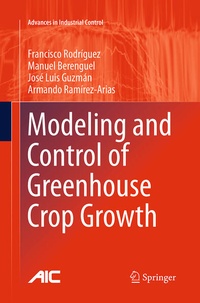
A discussion of challenges related to the modeling and control of greenhouse crop growth, this book presents state-of-the-art answers to those challenges. The authors model the subsystems involved in successful greenhouse control using different techniques and show how the models obtained can be exploited for simulation or control design; they suggest ideas for the development of physical and/or black-box models for this purpose.
Strategies for the control of climate- and irrigation-related variables are brought forward. The uses of PID control and feedforward compensators, both widely used in commercial tools, are summarized. The benefits of advanced control techniques-event-based, robust, and predictive control, for example-are used to improve on the performance of those basic methods.
A hierarchical control architecture is developed governed by a high-level multiobjective optimization approach rather than traditional constrained optimization and artificial intelligence techniques. Reference trajectories are found for diurnal and nocturnal temperatures (climate-related setpoints) and electrical conductivity (fertirrigation-related setpoints). The objectives are to maximize profit, fruit quality, and water-use efficiency, these being encouraged by current international rules. Illustrative practical results selected from those obtained in an industrial greenhouse during the last eight years are shown and described. The text of the book is complemented by the use of illustrations, tables and real examples which are helpful in understanding the material.
Modeling and Control of Greenhouse Crop Growth
will be of interest to industrial engineers, academic researchers and graduates from agricultural, chemical, and process-control backgrounds.
Series
Edition
Softcover reprint of the original 1st ed. 2015
Language
Place of publication
Publishing group
Springer International Publishing
Target group
Professional and scholarly
Illustrations
76 farbige Abbildungen, 23 s/w Abbildungen
XXIX, 250 p. 99 illus., 76 illus. in color.
Dimensions
Height: 235 mm
Width: 155 mm
Thickness: 15 mm
Weight
ISBN-13
978-3-319-34349-5 (9783319343495)
DOI
10.1007/978-3-319-11134-6
Schweitzer Classification
Maria del Mar Castilla is a researcher at the University of Almería, Spain. She received the Computer Science Engineering degree from the University of Almería, Spain in 2009. She obtains the Ph.D. degree in advanced comfort control techniques inside buildings, which was performed in a solar energy research centre: the CIESOL mixed centre, from the University of Almería in 2013. Her research interests are focused on the fields of identification, modelling and predictive control with applications to energy efficient buildings. She has participated in several R&D projects and is co-author of many papers in international journals and conferences. She is member of the "Automatic control, Robotics and Mechatronics" research group, and the Comité Español de Automática (main Spanish Association in Automatic Control).
José Domingo Álvarez is a postdoctoral researcher at the University of Seville, Spain. He received the Computer Science Engineering degree from the University of Almería, Spain in 2003. Then, in 2008, he obtained, from the same university, the Ph.D. degree in Automatic Control in Solar Plants which was performed in a leading research centre in this field: the Solar Platform of Almería. His research interests are focused on the fields of repetitive control, predictive control and classical PID control with applications to solar power plants and energy efficient buildings. He is a member of the "Automatic control, Robotics and Mechatronics" research group. He has been director of 2 Ph.D. Thesis, has participated in several R&D projects and is co-author of many papers in reputed international journals with high impact factor. He is also a member of the Comité Español de Automática (main Spanish Association in Automatic Control).
Francisco Rodríguez Diaz is Associate Professor of Systems Engineering and Automatic Control at the University of Almería (Spain). He obtained his TelecommunicationEngineering degree from Madrid Polytechnics University (Spain) and his Ph.D. degree from the University of Almería in 2002. Now he is a researcher and member of the Automatic Control, Robotic and Mechatronic research group of the University of Almería. He has participated in several Spanish and European research projects, and I+D+i tasks with many companies. He is member of IFAC Technical Committee TC 8.1, Control in Agriculture, since 2005. His current research interests are focused to the application of modeling, automatic control, and robotics techniques to dynamic systems and education.
Manuel Berenguel is professor of Systems Engineering and Automatic Control at the University of Almería, Spain. He earned an industrial engineering degree and Ph.D. from the University of Seville, Spain. His research interests are in hierarchical, predictive and robust control, with applications to solar energy systems, agriculture, and biotechnology and in control education. He has been Vice-Rector of Information and Communication Technologies at University of Almería (Spain). He is also the head of the research group "Automatic control, Robotics and Mechatronics" (http://arm.ual.es). He is co-author of the book Advanced Control of Solar Plants (Springer, 1997), Control of Solar Energy Systems (Springer, 2012) and Control Automático con Herramientas Interactivas (Pearson Education, 2012). He is co-author of 2 patents, and more than 90 papers in international journals. He has participated in IPC of several international conferences and reviewer for several journals. He has been member of the board of Governors of the Comité Español de Automática (main Spanish Association in Automatic Control) from 2003 to 2008 and 2012-now, senior member of IEEE Control System Society and member of the IFAC Technical Committees TC 8.01 Control in Agriculture, TC 6.3. Power and Energy Systems and TC 8.4 Biosystems and bioprocesses.