

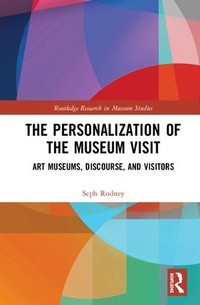
The Personalization of the Museum Visit
Art Museums, Discourse, and Visitors
1st Edition
Published on 31. May 2019
Book
Hardback
158 pages
978-1-138-04582-8 (ISBN)
Description
The Personalization of the Museum Visit examines a fundamental shift in institutional behavior in museums located in the United States and the United Kingdom. Contending that art museums have moved toward a new paradigm of public engagement, it posits that modern museum visitors are treated as self-directed "clients", with the agency to make meaning for themselves. The book then considers how this change has come about, examining factors such as the onset of a new museology, an experience economy, and a marketing revolution.
Drawing on extensive research undertaken at Britain's Tate Modern, the book examines a range of issues, including visitor engagement, curatorial practice, and museum management. A visit experience that is customizable to the individual visitor, in which curators and marketers work together with visitor-clients to create an experience of personalized meaning, is, Rodney argues, rising in prevalence in the art museum field, but it is also being stymied by certain structural impediments. This book examines such obstacles, including institutional division of labor, long-standing conceptions, or misconceptions, of the museum's mission, and the orientation of museums toward a certain conceptual model of their visitors.
The Personalization of the Museum Visit is essential reading for scholars and students engaging with issues of visitor engagement, curatorial practice, and museum management. With a particular focus on the role of business interests and public policy, the book should also be of interest to those undertaking research in fields outside of museum and visitor studies.
Drawing on extensive research undertaken at Britain's Tate Modern, the book examines a range of issues, including visitor engagement, curatorial practice, and museum management. A visit experience that is customizable to the individual visitor, in which curators and marketers work together with visitor-clients to create an experience of personalized meaning, is, Rodney argues, rising in prevalence in the art museum field, but it is also being stymied by certain structural impediments. This book examines such obstacles, including institutional division of labor, long-standing conceptions, or misconceptions, of the museum's mission, and the orientation of museums toward a certain conceptual model of their visitors.
The Personalization of the Museum Visit is essential reading for scholars and students engaging with issues of visitor engagement, curatorial practice, and museum management. With a particular focus on the role of business interests and public policy, the book should also be of interest to those undertaking research in fields outside of museum and visitor studies.
More details
Series
Language
English
Place of publication
London
United Kingdom
Publishing group
Taylor & Francis Ltd
Target group
College/higher education
Illustrations
1 s/w Tabelle
1 Tables, black and white
Dimensions
Height: 234 mm
Width: 156 mm
Weight
354 gr
ISBN-13
978-1-138-04582-8 (9781138045828)
Copyright in bibliographic data and cover images is held by Nielsen Book Services Limited or by the publishers or by their respective licensors: all rights reserved.
Schweitzer Classification
Other editions
Additional editions
Book
12/2020
1st Edition
Routledge
€66.80
Shipment within 15-20 days
E-Book
05/2019
1st Edition
Routledge
€60.49
Available for download
E-Book
05/2019
1st Edition
Routledge
€60.49
Available for download
Person
Seph Rodney is an adjunct faculty member at Parsons School of Design, USA, and an editor and writer for the Hyperallergic art and culture blog. He was born on the island of Jamaica, grew up in New York City, and obtained his PhD in Museum Studies from Birkbeck College, University of London, UK.
Content
1. Introduction 2. The New Museology 3. An Interpretive Museum 4. Marketing and the Museum 5. Tate's Audience Research 6. Appearances of the Customizable Visit 7. Conclusion