

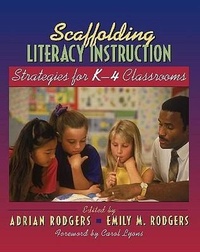
Scaffolding Literacy Instruction
Strategies for K-4 Classrooms
Published on 9. July 2004
Book
Paperback/Softback
205 pages
978-0-325-00654-3 (ISBN)
Description
Grades K-4
Helping emerging readers and writers reach their full potential requires a delicate balance between teacher assistance and student independence. With Scaffolding Literacy Instruction you can create that balance for every member of your classroom, gradually shifting the responsibility for learning to your students and creating confident learners in the process.
Editors Adrian Rodgers and Emily Rodgers frame Scaffolding Literacy Instruction, first giving you a valuable overview of guided instruction-the theory and scholarship behind it as well as its instructional goals-and then, in the final essay, anticipating its challenges and offering usable-on-Monday-morning tips for implementation. In between, wide-ranging essays from ten experts in the field, including Gay Su Pinnell and Irene C. Fountas, offer straight talk and well-researched ideas that scaffold lessons and strategies in support of:
phonics instruction
word solving
partner reading
working with special needs students
building student identity.
As Rodgers and Rodgers write, "All scaffolding is teaching, but not all teaching is scaffolding." So whether you are a preservice teacher studying scaffolding in the literacy classroom, a novice looking for step-by-step ways to support students, or a veteran who wants to consider other case studies to see what might apply to your instructional setting, Scaffolding Literacy Instruction will help you do it and help you do it better.
Helping emerging readers and writers reach their full potential requires a delicate balance between teacher assistance and student independence. With Scaffolding Literacy Instruction you can create that balance for every member of your classroom, gradually shifting the responsibility for learning to your students and creating confident learners in the process.
Editors Adrian Rodgers and Emily Rodgers frame Scaffolding Literacy Instruction, first giving you a valuable overview of guided instruction-the theory and scholarship behind it as well as its instructional goals-and then, in the final essay, anticipating its challenges and offering usable-on-Monday-morning tips for implementation. In between, wide-ranging essays from ten experts in the field, including Gay Su Pinnell and Irene C. Fountas, offer straight talk and well-researched ideas that scaffold lessons and strategies in support of:
phonics instruction
word solving
partner reading
working with special needs students
building student identity.
As Rodgers and Rodgers write, "All scaffolding is teaching, but not all teaching is scaffolding." So whether you are a preservice teacher studying scaffolding in the literacy classroom, a novice looking for step-by-step ways to support students, or a veteran who wants to consider other case studies to see what might apply to your instructional setting, Scaffolding Literacy Instruction will help you do it and help you do it better.
More details
Language
English
Place of publication
United States
Publishing group
Pearson Education (US)
Target group
College/higher education
US School Grade: From Kindergarten to Preschool, Reading Age: From 5 to 9 years, Interest Age: 0 years
Product notice
Paperback (trade)
Unsewn / adhesive bound
Dimensions
Height: 235 mm
Width: 185 mm
Thickness: 12 mm
Weight
354 gr
ISBN-13
978-0-325-00654-3 (9780325006543)
Copyright in bibliographic data and cover images is held by Nielsen Book Services Limited or by the publishers or by their respective licensors: all rights reserved.
Schweitzer Classification
Persons
Emily M. Rodgers is an assistant professor in the College of Education at The Ohio State University. Before joining OSU, Emily was a teacher for ten years in Newfoundland. Her research focuses on the professional development of teachers and the nature of effective scaffolding of literacy learning. Her paper "Language Matters: When is a Scaffold Really a Scaffold" won the National Reading Conference's Outstanding Student Research Award in 1999.