

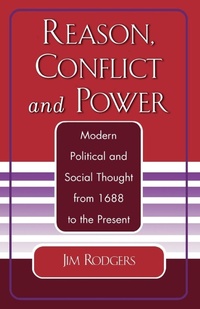
Reason, Conflict, and Power
Modern Political and Social Thought from 1688 to the Present
Published on 13. January 2004
Book
Paperback/Softback
152 pages
978-0-7618-2709-2 (ISBN)
Description
In Reason, Conflict and Power, Jim Rodgers provides an analytic, general survey of major political and social theorists of the "modern" era, from 1688 to the present. Major political belief systems are described and explained in a manner that is clearly connected to the chief writers of democratic capitalism, socialism, fascism, nationalism, feminism, and environmentalism, from a historical perspective. Patterns of social thought pertaining to large, private and public organizations, social systems, social conflict and behavior are incorporated into this concise examination of great political and social thinkers and their ideas.
More details
Language
English
Place of publication
Lanham, MD
United States
Target group
College/higher education
Dimensions
Height: 216 mm
Width: 140 mm
Thickness: 8 mm
Weight
201 gr
ISBN-13
978-0-7618-2709-2 (9780761827092)
Copyright in bibliographic data and cover images is held by Nielsen Book Services Limited or by the publishers or by their respective licensors: all rights reserved.
Schweitzer Classification
Persons
Jim Rodgers is Professor of Political Science, Saint Mary's University of Minnesota. He is co-author of Facing Terror: The Government's Response to Contemporary Extremists in America (University Press of America, 2002).
Content
Chapter 1 Preface
Chapter 2 Acknowledgments
Chapter 3 Introduction
Chapter 4 Locke, Smith and the Foundations of Democratic Capitalism
Chapter 5 Rousseau and Egalitarian Nationalism
Chapter 6 The Political Conservatives: Burke and Hume
Chapter 7 Utilitarian Reformers: Bentham and Mill
Chapter 8 The Rise of Socialism-Revolutionary Marxists and Evolutionary Social Critics
Chapter 9 Fascism, National Socialism
Chapter 10 Max Weber and the Rise of the Modern Bureaucratic State
Chapter 11 Functionalism or the Lack Thereof in Modern Society: Durkheim
Chapter 12 Modernity and Conflict Theorists
Chapter 13 Microsocial Perspectives-Viewing Daily Life
Chapter 14 Cross-cultural Theories for the 21st Century: Feminism, Fundamentalism, and Environmentalism
Chapter 15 Conclusion
Chapter 16 People and Terms to Know
Chapter 17 References
Chapter 18 Index
Chapter 2 Acknowledgments
Chapter 3 Introduction
Chapter 4 Locke, Smith and the Foundations of Democratic Capitalism
Chapter 5 Rousseau and Egalitarian Nationalism
Chapter 6 The Political Conservatives: Burke and Hume
Chapter 7 Utilitarian Reformers: Bentham and Mill
Chapter 8 The Rise of Socialism-Revolutionary Marxists and Evolutionary Social Critics
Chapter 9 Fascism, National Socialism
Chapter 10 Max Weber and the Rise of the Modern Bureaucratic State
Chapter 11 Functionalism or the Lack Thereof in Modern Society: Durkheim
Chapter 12 Modernity and Conflict Theorists
Chapter 13 Microsocial Perspectives-Viewing Daily Life
Chapter 14 Cross-cultural Theories for the 21st Century: Feminism, Fundamentalism, and Environmentalism
Chapter 15 Conclusion
Chapter 16 People and Terms to Know
Chapter 17 References
Chapter 18 Index