

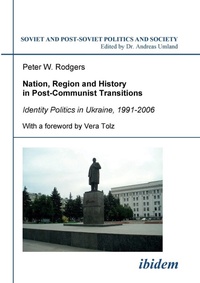
Nation, Region and History in Post-Communist Transitions
Identity Politics in Ukraine, 1991-2006
1st Edition
Published on 26. May 2008
Book
208 pages
978-3-89821-903-7 (ISBN)
Description
Since independence in 1991, issues of nation and identity have become highly debated topics in Ukraine. This monograph explores not only how national identity is being (re)constructed by the Ukrainian state, but also the processes by which it is negotiated through society. The central argument of this work is that too much attention, concerning identity in Ukraine, has focused on markers of ethnicity and language. Instead, the author advocates a regional approach, engaging with the issue of how Ukraine's regional differences affect nation-building processes.
Following the tumultuous events of the 'Orange Revolution', the view of Ukraine as a country inherently 'divided' between 'East' and 'West' has (re)emerged to become a popular explanation for political events. The study outlines the necessity for academics, policymakers and indeed politicians to veer away from this simplistic 'West versus East' divide. The book advocates an analysis of Ukraine's unique brand of regionalism not in terms of divisions, but in terms of regional differences and diversity.
The author deconstructs the concept of 'Eastern Ukraine' by focusing on three Ukrainian localities, all adjacent to the Ukrainian-Russian border. The study examines how individuals provide 'their' own understanding of the place of their region within the wider processes of nation building across Ukraine. In doing so, the book develops a 'regional' approach to the study of identity politics in Ukraine.
Following the tumultuous events of the 'Orange Revolution', the view of Ukraine as a country inherently 'divided' between 'East' and 'West' has (re)emerged to become a popular explanation for political events. The study outlines the necessity for academics, policymakers and indeed politicians to veer away from this simplistic 'West versus East' divide. The book advocates an analysis of Ukraine's unique brand of regionalism not in terms of divisions, but in terms of regional differences and diversity.
The author deconstructs the concept of 'Eastern Ukraine' by focusing on three Ukrainian localities, all adjacent to the Ukrainian-Russian border. The study examines how individuals provide 'their' own understanding of the place of their region within the wider processes of nation building across Ukraine. In doing so, the book develops a 'regional' approach to the study of identity politics in Ukraine.
More details
Other editions
Additional editions
Peter W. Rodgers
Nation, Region and History in Post-Communist Transitions
Identity Politics in Ukraine, 1991-2006
E-Book
05/2012
1st Edition
ibidem
€16.99
Available for download
Persons
The author:
Peter W. Rodgers, BA (Cambridge), MA, PhD (Birmingham), undertook post-doctoral research, funded by the Leverhulme Trust, in Ukraine in 2005-2007. He has published in, among other journals, Nationalities Papers, Nations and Nationalism and Europe-Asia Studies. Currently, he is lecturing at the Centre for Russian and East European Studies, University of Birmingham, and a Research Fellow at the Aston Business School, Aston University.
The author of the foreword:
Dr Vera Tolz is Professor of Russian Studies at the University of Manchester.
Peter W. Rodgers, BA (Cambridge), MA, PhD (Birmingham), undertook post-doctoral research, funded by the Leverhulme Trust, in Ukraine in 2005-2007. He has published in, among other journals, Nationalities Papers, Nations and Nationalism and Europe-Asia Studies. Currently, he is lecturing at the Centre for Russian and East European Studies, University of Birmingham, and a Research Fellow at the Aston Business School, Aston University.
The author of the foreword:
Dr Vera Tolz is Professor of Russian Studies at the University of Manchester.