

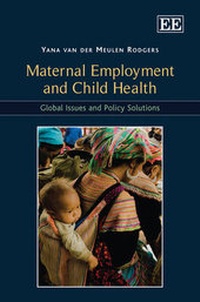
Maternal Employment and Child Health
Global Issues and Policy Solutions
Published on 31. October 2011
Book
Hardback
224 pages
978-1-84720-510-0 (ISBN)
Description
As women's labor force participation has risen around the globe, scholarly and policy discourse on the ramifications of this employment growth has intensified. This book explores the links between maternal employment and child health using an international perspective that is grounded in economic theory and rigorous empirical methods.
Women's labor-market activity affects child health largely because their paid work raises household income, which strengthens families' abilities to finance healthcare needs and nutritious food; however, time away from children could counteract some of the benefits of higher socioeconomic status that spring from maternal employment. New evidence based on data from nine South and Southeast Asian countries illuminates the potential tradeoff between the benefits and challenges families contend with in the face of women's labor-market activity. This book provides new, original evidence on links between maternal employment and children's health using data associated with three indicators of children's nutritional status: birth size, stunting, and wasting. Results support the implementation and enforcement of policy interventions that bolster women's advancement in the labor market and reduce undernutrition among children.
Scholars, students, policy makers and all those with an interest in nutritional science, gender, economics of the family, or development economies will find the methodology and original results expounded here both useful and informative.
Contents:
1. Introduction
2. Women's Employment Around the Globe
3. Conceptual Framework
4. Existing Evidence on Maternal Employment and Child Health
5. Data and Methodology
6. New Results for South and Southeast Asia
7. Conclusion and Policy Implications
Women's labor-market activity affects child health largely because their paid work raises household income, which strengthens families' abilities to finance healthcare needs and nutritious food; however, time away from children could counteract some of the benefits of higher socioeconomic status that spring from maternal employment. New evidence based on data from nine South and Southeast Asian countries illuminates the potential tradeoff between the benefits and challenges families contend with in the face of women's labor-market activity. This book provides new, original evidence on links between maternal employment and children's health using data associated with three indicators of children's nutritional status: birth size, stunting, and wasting. Results support the implementation and enforcement of policy interventions that bolster women's advancement in the labor market and reduce undernutrition among children.
Scholars, students, policy makers and all those with an interest in nutritional science, gender, economics of the family, or development economies will find the methodology and original results expounded here both useful and informative.
Contents:
1. Introduction
2. Women's Employment Around the Globe
3. Conceptual Framework
4. Existing Evidence on Maternal Employment and Child Health
5. Data and Methodology
6. New Results for South and Southeast Asia
7. Conclusion and Policy Implications
More details
Language
English
Place of publication
Cheltenham
United Kingdom
Target group
Professional and scholarly
Dimensions
Height: 234 mm
Width: 156 mm
ISBN-13
978-1-84720-510-0 (9781847205100)
Copyright in bibliographic data and cover images is held by Nielsen Book Services Limited or by the publishers or by their respective licensors: all rights reserved.
Schweitzer Classification
Person
Yana van der Meulen Rodgers, Associate Professor, Women's and Gender Studies Department, Rutgers University, New Brunswick, US
Content
Contents: 1. Introduction 2. Women's Employment Around the Globe 3. Conceptual Framework 4. Existing Evidence on Maternal Employment and Child Health 5. Data and Methodology 6. New Results for South and Southeast Asia 7. Conclusion and Policy Implications Bibliography Index