

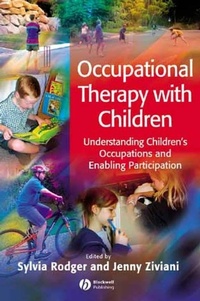
Occupational Therapy with Children
Understanding Children's Occupations and Enabling Participation
1st Edition
Published on 13. April 2006
Book
Paperback/Softback
320 pages
978-1-4051-2456-0 (ISBN)
Description
Occupational Therapy with Children draws on contemporary research to examine children's roles, their occupations and the skills which underpin their ability to participate in society. The book will develop the occupational therapist's understanding of how to optimise the participation of children in the various environments in which they are required or choose to engage. Occupational Therapy with Children maintains a developmental perspective and incorporates child-centred interventions to improve performance deficits.
Section one examines children's roles and occupations in contemporary society at a broad level. Coverage includes the child's participation in the family, at school and in the community. This section considers environmental influences on childhood activities, and highlights children's changing occupational time use and the impact this has on health and wellbeing. Section two focuses on childhood as a period of significant development and skill acquisition. This is profiled as a dynamic period for the therapist to encourage occupational mastery across the spectrum of childhood experience: in play; in self-care; as a student; and beyond the school grounds. Topical chapters evaluate participation in physical activity and consider the potential for 'healthy' leisure, along with the risk characteristics associated with certain approaches to leisure.
Occupational Therapy with Children is aimed at students and practitioners of occupational therapy. Other childhood professionals, particularly early childhood educators, will also appreciate the articulate approach this book takes towards the development of the child.
Highly illustrated with contemporary photographs, drawings and succinct tables
Includes case studies; providing worked examples of therapeutic applications
Draws on the World Health Organisation International Classification of Functioning, Disability and Health (ICF) to frame the concept of children's occupations and societal participation
Responsive to developments in occupational science
Expert contributors provide international perspectives
"[Occupational therapists] will find that this book provides a framework that makes planning effective therapy with children practical, relevant, and effective . . . [Rodger & Ziviani's] contribution to the literature has helped unleash the genie of occupation in the service of improved therapy with children."
-From the Foreword by Professor Charles Christiansen, The University of Texas Medical Branch, Galveston
Section one examines children's roles and occupations in contemporary society at a broad level. Coverage includes the child's participation in the family, at school and in the community. This section considers environmental influences on childhood activities, and highlights children's changing occupational time use and the impact this has on health and wellbeing. Section two focuses on childhood as a period of significant development and skill acquisition. This is profiled as a dynamic period for the therapist to encourage occupational mastery across the spectrum of childhood experience: in play; in self-care; as a student; and beyond the school grounds. Topical chapters evaluate participation in physical activity and consider the potential for 'healthy' leisure, along with the risk characteristics associated with certain approaches to leisure.
Occupational Therapy with Children is aimed at students and practitioners of occupational therapy. Other childhood professionals, particularly early childhood educators, will also appreciate the articulate approach this book takes towards the development of the child.
Highly illustrated with contemporary photographs, drawings and succinct tables
Includes case studies; providing worked examples of therapeutic applications
Draws on the World Health Organisation International Classification of Functioning, Disability and Health (ICF) to frame the concept of children's occupations and societal participation
Responsive to developments in occupational science
Expert contributors provide international perspectives
"[Occupational therapists] will find that this book provides a framework that makes planning effective therapy with children practical, relevant, and effective . . . [Rodger & Ziviani's] contribution to the literature has helped unleash the genie of occupation in the service of improved therapy with children."
-From the Foreword by Professor Charles Christiansen, The University of Texas Medical Branch, Galveston
Reviews / Votes
"[Occupational therapists] will find that this book provides a framework that makes planning effective therapy with children practical, relevant, and effective. . . [Rodger & Ziviani's] contribution to the literature has helped unleash the genie of occupation in the service of improved therapy with children."From the Foreword by Professor Charles Christiansen, The University of Texas Medical Branch, Galveston
"There is something new to be learned in each of the 14 well-written, nicely illustrated, co-authored chapters."
Canadian Journal of Occupational Therapy
"This is a well-written and compressive book...Certainly it can and should be used in occupational therapy educational programs."
Occupational Therapy in Healthcare
More details
Language
English
Place of publication
Hoboken
United Kingdom
Publishing group
John Wiley and Sons Ltd
Target group
Professional and scholarly
Product notice
Paperback (trade)
sewn/stitched
Dimensions
Height: 244 mm
Width: 174 mm
Thickness: 16 mm
Weight
697 gr
ISBN-13
978-1-4051-2456-0 (9781405124560)
Copyright in bibliographic data and cover images is held by Nielsen Book Services Limited or by the publishers or by their respective licensors: all rights reserved.
Schweitzer Classification
Persons
Sylvia Rodger is Head of Division, and Jenny Ziviani Associate Professor in Occupational Therapy, within the School of Health and Rehabilitation Sciences at the University of Queensland. Their clinical and academic activities are characterised by a keen focus in paediatric occupational therapy, as evidenced by extensive publications in the field.
Content
SECTION I: CHILDREN'S ROLES, OCCUPATIONS AND PARTICIPATION IN CONTEMPORARY SOCIETY. 1. Children, their environments, roles and occupations in contemporary society.
2. Families and children's occupational performance.
3. Environmental influences on children's participation.
4. Participation of children in school and community.
5. Children's occupational time use.
SECTION II: MASTERING OCCUPATIONS, ROLES, AND ENABLING CHILDREN'S PARTICIPATION.
6. Doing, being and becoming: their importance for children.
7. The occupational development of children.
8. Communication and social skills for occupational engagement.
9. Developing as a player.
10. I can do it: developing, promoting, and managing children's self-care needs.
11. The transition to school.
12. Student participation in the classroom.
13. Children's participation in physical activity at school.
14. Children's participation beyond the school grounds.
2. Families and children's occupational performance.
3. Environmental influences on children's participation.
4. Participation of children in school and community.
5. Children's occupational time use.
SECTION II: MASTERING OCCUPATIONS, ROLES, AND ENABLING CHILDREN'S PARTICIPATION.
6. Doing, being and becoming: their importance for children.
7. The occupational development of children.
8. Communication and social skills for occupational engagement.
9. Developing as a player.
10. I can do it: developing, promoting, and managing children's self-care needs.
11. The transition to school.
12. Student participation in the classroom.
13. Children's participation in physical activity at school.
14. Children's participation beyond the school grounds.