

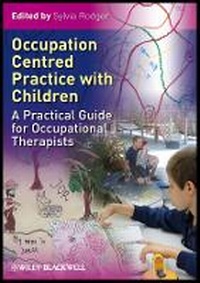
Occupation Centred Practice with Children - a Practical Guide for Occupational Therapists
Published on 9. April 2010
Book
Paperback/Softback
368 pages
978-1-4051-8427-4 (ISBN)
Description
This book draws on contemporary occupational therapy theory andresearch to provide occupational therapy students and clinicianswith a practical resource on implementing occupation centredpractice with children. Each chapter has specific objectives and uses case studies todemonstrate the clinical realities and applications of each of thetopics addressed. Best practice guidelines are provided along witha summary of recommendations drawn from the relevant theories,occupational therapy philosophy and existing research. The bookaims specifically to be practice based.
Reviews / Votes
"If you want a substantial paediatric text to support theapplication of occupation centred approaches then buy this book."(British Journal of Occupational Therapy, 1 January 2012)More details
Language
English
Place of publication
Chichester
United Kingdom
Publishing group
John Wiley and Sons Ltd
Target group
College/higher education
Professional and scholarly
Dimensions
Height: 242 mm
Width: 170 mm
Thickness: 19 mm
Weight
1 gr
ISBN-13
978-1-4051-8427-4 (9781405184274)
Copyright in bibliographic data and cover images is held by Nielsen Book Services Limited or by the publishers or by their respective licensors: all rights reserved.
Schweitzer Classification
Other editions
New editions
Sylvia Rodger | Ann Kennedy-Behr
Occupation-Centred Practice with Children
A Practical Guide for Occupational Therapists
Book
04/2017
2nd Edition
Wiley
€56.00
Shipment within 15-20 days
Additional editions
Sylvia Rodger
Occupation Centred Practice with Children
A Practical Guide for Occupational Therapists
E-Book
05/2013
Wiley-Blackwell
€48.99
Available for download
Person
Sylvia Rodger, Associate Professor and Head of Division, Division of Occupational Therapy, The University of Queensland, Brisbane, AUSTRALIA.
Content
Contributors. Foreward. Preface. Acknowledgements. 1 Introduction to Occupation-centred Practice withChildren (Sylvia Rodger). Introduction. Re-affi rming occupation: the core of occupational therapy. External infl uences impacting occupational therapypractice. The evolution of occupational therapy practice withchildren. Changing views of child development and maturation. Emerging views about occupational development. Refocusing occupational therapy with children Conclusion. References. 2 Becoming more Occupation-centred When Working withChildren(Sylvia Rodger). Introduction. Theoretical underpinnings of occupational therapy withchildren. Top-down and bottom-up approaches to occupational therapypractice with children. Characteristics of occupation-centred practice for children. Conclusion. References. 3 Child- and Family-centred Service Provision (SylviaRodger and Deb Keen). Introduction. Defi ning the client: who and how many? Client-centred practice 46Child-centred practice. Family-centred practice and service provision. Becoming a child- and/or family-centred practitioner. Developing family-centred services. The extended family and community. Conclusion. References. 4 Cultural Influences and Occupation-centred Practice withChildren and Families(Alison Nelson and MichaelIwama). Introduction. Culture and the occupations of the child. The privilege of occupational therapy. Cultural safety in occupational therapy. The Kawa Model: a tool for culturally safe practice. Culturally appropriate goal setting. Making the invisible visible. Relationship: the art of occupational therapy. Conclusion. References. 5 Enabling Children s Spirituality in OccupationalTherapy Practice(Imelda Burgman). Introduction. Spirituality and children. Why does spirituality matter in occupational therapypractice? The art of occupational therapy practice. Children s contexts and spirituality. Conclusion. References. 6 Occupational Goal Setting with Children andFamilies(Nancy Pollock, Cheryl Missiuna, and SylviaRodger). Introduction. Giving children a voice. Goal setting and motivation. Tools to facilitate goal setting with children. Goal setting contributes to outcome measurement. Conclusion. References. 7 Occupation-centred Assessment with Children (TedBrown and Chi-Wen Chien). Introduction. Bottom-up and top-down approaches to assessment. OCAC. Implementation of occupation-centred assessment with children:assessment in action. Occupation-centred assessment with children: tools. Conclusion. References. 8 Cognitive Orientation for Daily Occupational Performance(CO-OP): A Uniquely Occupation-centred. Intervention created for Children(Sylvia Rodger andHelene Polatajko). Introduction. CO-OP: a brief overview. CO-OP: an occupation-centred intervention. Conclusion. References. 9 Perceive, Recall, Plan and Perform (PRPP):Occupation-centred Task Analysis and Intervention System(Christine Chapparo). Introduction. Information processing and occupational performance. The Perceive, Recall, Plan and Perceive (PRPP) System of TaskAnalysis and Intervention. Using the PRPP System of Task Analysis and Intervention:David. Perceive : observing and prompting sensoryprocessing behaviours during task performance. Recall : observing strategies used for storage andretrieval of information during task performance. Plan : processing information for organisingandproblem solving. Perform : processing output and performancefeedback. Conclusion. References. 10 Occupational Performance Coaching: Enabling Parents and Children s Occupational Performance(Fiona Grahamand Sylvia Rodger). Introduction. Theoretical and philosophical basis. Three enabling domains. Structured problem-solving process . Conclusion. References. 11 Occupation-centred Intervention in the SchoolSetting(Elizabeth A. Hinder and Jill Ashburner). Understanding the occupations of the school student. Educationally relevant occupational therapy in schools. Ways of working in schools. Planning educational programmes for diverse learners. Occupation-centred information gathering in educationalsettings. Occupation-centred programme planning and intervention inschools. Collaboration in service delivery. Conclusion. References. 12 Enablement of Children s LeisureParticipation(Anne Poulsen and Jenny Ziviani). Introduction. Outcomes of healthy leisure engagement. EACH-Child: model of leisure coaching. Step one: creating successful engagements. Step two: coaching to promote personal growth. Conclusion. References. 13 Acute Hospitals: A Challenging Context forOccupation-centred Practice with Children(Sylvia Rodger andRebecca Banks). Introduction. Occupation-centred practice in hospital settings: lessons fromthe literature. Occupation-centred practice in hospitals: lessons from thefrontline. Challenges to occupation-centred practice in hospitals. Strategies to foster occupation-centred practice inchildren s hospitals. Examples of occupation-centred practice in children shospital settings. Conclusion. Acknowledgements. References. 14 Enabling Children s Occupations and Participationusing Assistive Technology(Desleigh de Jonge and RachelMcDonald). Introduction. What is assistive technology? What can assistive technology offer children and families? A theoretical model for understanding assistive technology. Information gathering for augmentative and assistivetechnologies. Utilising assistive technology for children as anoccupation-centred intervention. Specifi c assistive technology interventions for children. Evaluating AT outcomes. Conclusion. References. 15 Decision Making for Occupation-centred Practice withChildren(Jodie Copley, Sally Bennett, and MerrillTurpin). Introduction. Decision making and information sources. Information about clients, families and their contexts. Information about the practice context. Information from empirical research. Information from clinical experience. Integrating information despite alternatives anduncertainties. Shared decision making. Conclusion. References. Index.