

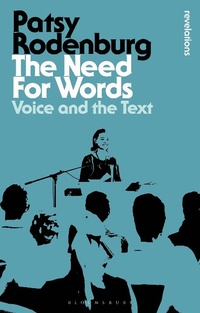
The Need for Words
Voice and the Text
2nd Edition
Published on 10. August 2023
Book
Paperback/Softback
248 pages
978-1-350-29011-2 (ISBN)
Description
As one of the world's leading voice coaches, Patsy Rodenburg describes practical ways to approach language, using Shakespeare, Romantic poetry, modern prose and a range of other texts to help each of us discover our own unique need for words.
In Part One Rodenburg attacks the myth that there is only one correct way to speak by clearing away the blocks that can make language inaccessible. Part Two, a series of language and text exercises, connects the voice to the shape and quality of individual words and phrases.
Drawing on Rodenburg's time spent coaching in the worlds of business and politics, this edition reflects on how the way we use words has changed since the book was first published. It brings a renewed focus on the language of power, spoken in the worlds of politicians and company directors. This gives readers an insight into the potency of clear, direct communication. Language and text exercises provide readers with unmediated access to this new research, allowing them to practice and master the language and words that drive the modern world.
Foreword by Antony Sher.
In Part One Rodenburg attacks the myth that there is only one correct way to speak by clearing away the blocks that can make language inaccessible. Part Two, a series of language and text exercises, connects the voice to the shape and quality of individual words and phrases.
Drawing on Rodenburg's time spent coaching in the worlds of business and politics, this edition reflects on how the way we use words has changed since the book was first published. It brings a renewed focus on the language of power, spoken in the worlds of politicians and company directors. This gives readers an insight into the potency of clear, direct communication. Language and text exercises provide readers with unmediated access to this new research, allowing them to practice and master the language and words that drive the modern world.
Foreword by Antony Sher.
Reviews / Votes
I know Patsy to be a gifted voice and speech coach. In The Need for Words she provides practical and imaginative means for getting to the heart of the text and making the necessity for the language to be strongly felt by audiences. I do recommend it to anyone who needs to use words with clarity and passion. * Trevor Nunn * Playwrights, a complacent lot, tend to think that their text says it all. Grudgingly conceding the role of the director, they still think the words speak for themselves. They don't, and in this excellent book, Patsy Rodenburg shows why. * Alan Bennett * The Need for Words is an astonishing book. It takes you on an extraordinary voyage of discovery through the worlds of language and texts. Every actor and non-actor should know it and read it. * Declan Donnellan *More details
Series
Edition
2nd edition
Language
English
Place of publication
London
United Kingdom
Publishing group
Bloomsbury Publishing PLC
Target group
Professional and scholarly
Dimensions
Height: 212 mm
Width: 136 mm
Thickness: 19 mm
Weight
322 gr
ISBN-13
978-1-350-29011-2 (9781350290112)
Copyright in bibliographic data and cover images is held by Nielsen Book Services Limited or by the publishers or by their respective licensors: all rights reserved.
Schweitzer Classification
Other editions
Additional editions
E-Book
07/2023
2nd Edition
Bloomsbury Academic
€26.49
Available for download
E-Book
07/2023
2nd Edition
Bloomsbury Academic
€26.49
Available for download
Person
Patsy Rodenburg, OBE, is Professor of Text and Poetry at Guildhall School of Music & Drama, UK, after serving as Head of Voice from 1981-2016. In 1981 she was appointed the Voice Coach for the Royal Shakespeare Company, responsible for the works of the Company in London, and in 1990 was appointed the first Head of Voice at the Royal National Theatre where she ran the department until 2006.
She has worked with theatre companies across the UK including Theatre de Complicite, Shared Experience, Cheek by Jowl and the Royal Court, having coached numerous West End and Broadway productions. Patsy has also worked at many major theatre companies all over the world, including Stratford Festival Theatre (Ontario, Canada), Kabuki Theatre (Japan), Indian National Theatre (Mumbai, Japan), Lithuania National Drama Theatre (Vilnius, Lithuania), Royal Dramatic Theatre (Stockholm, Sweden), The Market Theatre (Johannesburg, South Africa), Beijing Opera (China) and Verbier Festival (Verbier, Switzerland). She has been teaching storytelling to teachers and corporate leaders since 1976.
www.patsyrodenburg.co.uk.
She has worked with theatre companies across the UK including Theatre de Complicite, Shared Experience, Cheek by Jowl and the Royal Court, having coached numerous West End and Broadway productions. Patsy has also worked at many major theatre companies all over the world, including Stratford Festival Theatre (Ontario, Canada), Kabuki Theatre (Japan), Indian National Theatre (Mumbai, Japan), Lithuania National Drama Theatre (Vilnius, Lithuania), Royal Dramatic Theatre (Stockholm, Sweden), The Market Theatre (Johannesburg, South Africa), Beijing Opera (China) and Verbier Festival (Verbier, Switzerland). She has been teaching storytelling to teachers and corporate leaders since 1976.
www.patsyrodenburg.co.uk.
Content
About the Author
Acknowledgements
Foreword Antony Sher
Introduction 1
Let's Consider Shakespeare!
PART ONE The Need for Words
1 Connecting with Words
The Speaking Act
Distrust of Words
Returning to Words
In the Beginning was the Word
The Power of Words
The Importance of Oracy
The Deeper Need for Words
Lost Voices
Not Empty Rhetoric
Native Eloquence
Words are Physical
2 The Breakdown of Words
Family
Education
Conservation
The Written Word vs the Spoken Word
Speaking Your Way into Writing and Reading
Discussion and Debate
Training Young Actors
Guarding Against Quick Fixes
3 Cultural and Physical Barriers
The Age of Cacophony and Image Saturation
Embodiment
Role Models
Speaking in Public
The Inability to Listen
Tensions and Physical Habits as Barriers
Poetry
Profanity
Language of Gestures
Wit and Wordplay
Irony and Satire
The Tyranny of the Intellectual
Codes and Code Breaking
The Media and Tabloid Thinking
Solipsism
Advertising
Power Talk or Don't Talk Back
The Passion-Mongers
Sentimentality
Fillers and Cliches
Sexual Politics
Political Correctness
RP or Not RP
RP is a Choice
Overcoming the Speech Barrier
PART TWO Voice and the Text
4 Finding a Voice
Releasing Physical Barriers
Getting 'In Voice'
Focal Points
Simple Voice Workout
5 Voice into Words and Text
Connecting to a Text
Experimenting with Language
Sounding Real
Language Exercises
6 Working Further with Texts
The Marriage between Voice and Text
Clues from the Great Writers
The Poetry Barrier
The Structure of Verse
The Way Words Work
Starting with Shakespeare
Speaking Shakespeare's Text
Sonnets
Shakespeare's Speeches
Shakespearean Prose
The Verse Duet
Medieval Verse
Christopher Marlowe
John Milton
Jacobean Drama
A Modern Jacobean Equivalent
The Age of Pope and the Age of Reason
Restoration Dialogue
Oscar Wilde
George Bernard Shaw
Styles in Speaking Texts
Greek Tragedy
Edward Bond
William Blake
Samuel Beckett
Harold Pinter
Working with Song Lyrics
Bad Texts
Prologues and Epilogues
Copyright and Permissions Acknowledgements
Index
Acknowledgements
Foreword Antony Sher
Introduction 1
Let's Consider Shakespeare!
PART ONE The Need for Words
1 Connecting with Words
The Speaking Act
Distrust of Words
Returning to Words
In the Beginning was the Word
The Power of Words
The Importance of Oracy
The Deeper Need for Words
Lost Voices
Not Empty Rhetoric
Native Eloquence
Words are Physical
2 The Breakdown of Words
Family
Education
Conservation
The Written Word vs the Spoken Word
Speaking Your Way into Writing and Reading
Discussion and Debate
Training Young Actors
Guarding Against Quick Fixes
3 Cultural and Physical Barriers
The Age of Cacophony and Image Saturation
Embodiment
Role Models
Speaking in Public
The Inability to Listen
Tensions and Physical Habits as Barriers
Poetry
Profanity
Language of Gestures
Wit and Wordplay
Irony and Satire
The Tyranny of the Intellectual
Codes and Code Breaking
The Media and Tabloid Thinking
Solipsism
Advertising
Power Talk or Don't Talk Back
The Passion-Mongers
Sentimentality
Fillers and Cliches
Sexual Politics
Political Correctness
RP or Not RP
RP is a Choice
Overcoming the Speech Barrier
PART TWO Voice and the Text
4 Finding a Voice
Releasing Physical Barriers
Getting 'In Voice'
Focal Points
Simple Voice Workout
5 Voice into Words and Text
Connecting to a Text
Experimenting with Language
Sounding Real
Language Exercises
6 Working Further with Texts
The Marriage between Voice and Text
Clues from the Great Writers
The Poetry Barrier
The Structure of Verse
The Way Words Work
Starting with Shakespeare
Speaking Shakespeare's Text
Sonnets
Shakespeare's Speeches
Shakespearean Prose
The Verse Duet
Medieval Verse
Christopher Marlowe
John Milton
Jacobean Drama
A Modern Jacobean Equivalent
The Age of Pope and the Age of Reason
Restoration Dialogue
Oscar Wilde
George Bernard Shaw
Styles in Speaking Texts
Greek Tragedy
Edward Bond
William Blake
Samuel Beckett
Harold Pinter
Working with Song Lyrics
Bad Texts
Prologues and Epilogues
Copyright and Permissions Acknowledgements
Index