

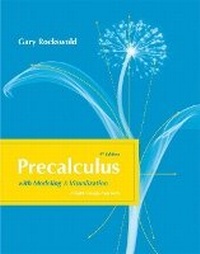
Precalculus with Modeling and Visualization
4th Edition
Published on 17. March 2009
Book
Hardback
1176 pages
978-0-321-56800-7 (ISBN)
Description
Gary Rockswold teaches algebra in context, answering the question, "Why am I learning this?" By experiencing math through applications, students see how it fits into their lives, and they become motivated to succeed. Rockswold's focus on conceptual understanding helps students make connections between the concepts and as a result, students see the bigger picture of math and are prepared for future courses.
More details
Edition
4th edition
Language
English
Place of publication
United States
Publishing group
Pearson Education (US)
Target group
College/higher education
Dimensions
Height: 256 mm
Width: 223 mm
Thickness: 42 mm
Weight
2210 gr
ISBN-13
978-0-321-56800-7 (9780321568007)
Copyright in bibliographic data and cover images is held by Nielsen Book Services Limited or by the publishers or by their respective licensors: all rights reserved.
Schweitzer Classification
Other editions
New editions

Gary K. Rockswold
Precalculus with Modeling & Visualization
Book
01/2013
5th Edition
Pearson
€200.54
Article exhausted; check for reprint
Previous edition
Gary K. Rockswold
Precalculus with Modeling and Visualization
Book
04/2005
3rd Edition
Pearson
€95.31
Article exhausted; check for reprint
Person
Dr. Gary Rockswold has been teaching mathematics for 25 years at all levels from seventh grade to graduate school, including junior high and high school students, talented youth, vocational, undergraduate and graduate students, and adult education classes. He is currently employed at Minnesota State University, Mankato, where he is a full professor of mathematics and the chair of the mathematics department. He graduated with majors in mathematics and physics from St. Olaf College in Northfield, Minnesota, where he was elected to Phi Beta Kappa. He received his Ph.D. in applied mathematics from Iowa State University. He has an interdisciplinary background and has also taught physical science, astronomy, and computer science. Outside of mathematics, he enjoys spending time with his wife and two children.
Content
1. Introduction to Functions and Graphs
1.1 Numbers, Data, and Problem Solving
1.2 Visualizing and Graphing Data
1.3 Functions and Their Representations
1.4 Types of Functions
1.5 Functions and Their Rates of Change
2. Linear Functions and Equations
2.1 Linear Functions and Models
2.2 Equations of Lines
2.3 Linear Equations
2.4 Linear Inequalities
2.5 Absolute Value Equations and Inequalities
3. Quadratic Functions and Equations
3.1 Quadratic Functions and Models
3.2 Quadratic Equations and Problem Solving
3.3 Complex Numbers
3.4 Quadratic Inequalities
3.5 Transformations of Graphs
4. More Nonlinear Functions and Equations
4.1 More Nonlinear Functions and Their Graphs
4.2 Polynomial Functions and Models
4.3 Division of Polynomials
4.4 Real Zeros of Polynomial Functions
4.5 The Fundamental Theorem of Algebra
4.6 Rational Functions and Models
4.7 More Equations and Inequalities
4.8 Radical Equations and Power Functions
5. Exponential and Logarithmic Functions
5.1 Combining Functions
5.2 Inverse Functions and Their Representations
5.3 Exponential Functions and Models
5.4 Logarithmic Functions and Models
5.5 Properties of Logarithms
5.6 Exponential and Logarithmic Equations
5.7 Constructing Nonlinear Models
6. Trigonometric Functions
6.1 Angles and Their Measure
6.2 Right Triangle Trigonometry
6.3 The Sine and Cosine Functions and Their Graphs
6.4 Other Trigonometric Functions and Their Graphs
6.5 Graphing Trigonometric Functions
6.6 Inverse Trigonometric Functions
7. Trigonometric Identities and Equations
7.1 Fundamental Identities
7.2 Verifying Identities
7.3 Trigonometric Equations
7.4 Sum and Difference Identities
7.5 Multiple-Angle Identities
8. Further Topics in Trigonometry
8.1 Law of Sines
8.2 Law of Cosines
8.3 Vectors
8.4 Parametric Equations
8.5 Polar Equations
8.6 Trigonometric Form and Roots of Complex Numbers
9. Systems of Equations and Inequalities
9.1 Functions and Systems of Equations in Two Variables
9.2 Systems of Inequalities in Two Variables
9.3 Systems of Linear Equations in Three Variables
9.4 Solutions to Linear Systems Using Matrices
9.5 Properties and Applications of Matrices
9.6 Inverses of Matrices
9.7 Determinants
10. Conic Sections
10.1 Parabolas
10.2 Ellipses
10.3 Hyperbolas
11. Further Topics in Algebra
11.1 Sequences
11.2 Series
11.3 Counting
11.4 The Binomial Theorem
11.5 Mathematical Induction
11.6 Probability
Reference: Basic Concepts from Algebra and Geometry
R.1 Formulas from Geometry
R.2 Integer Exponents
R.3 Polynomial Expressions
R.4 Factoring Polynomials
R.5 Rational Expressions
R.6 Radical Notation and Rational Exponents
R.7 Radical Expressions
Appendix A: Using the Graphing Calculator
Appendix B: A Library of Functions
Appendix C: Partial Fractions
Bibliography
Answers to Selected Exercises
Index of Applications
Index
1.1 Numbers, Data, and Problem Solving
1.2 Visualizing and Graphing Data
1.3 Functions and Their Representations
1.4 Types of Functions
1.5 Functions and Their Rates of Change
2. Linear Functions and Equations
2.1 Linear Functions and Models
2.2 Equations of Lines
2.3 Linear Equations
2.4 Linear Inequalities
2.5 Absolute Value Equations and Inequalities
3. Quadratic Functions and Equations
3.1 Quadratic Functions and Models
3.2 Quadratic Equations and Problem Solving
3.3 Complex Numbers
3.4 Quadratic Inequalities
3.5 Transformations of Graphs
4. More Nonlinear Functions and Equations
4.1 More Nonlinear Functions and Their Graphs
4.2 Polynomial Functions and Models
4.3 Division of Polynomials
4.4 Real Zeros of Polynomial Functions
4.5 The Fundamental Theorem of Algebra
4.6 Rational Functions and Models
4.7 More Equations and Inequalities
4.8 Radical Equations and Power Functions
5. Exponential and Logarithmic Functions
5.1 Combining Functions
5.2 Inverse Functions and Their Representations
5.3 Exponential Functions and Models
5.4 Logarithmic Functions and Models
5.5 Properties of Logarithms
5.6 Exponential and Logarithmic Equations
5.7 Constructing Nonlinear Models
6. Trigonometric Functions
6.1 Angles and Their Measure
6.2 Right Triangle Trigonometry
6.3 The Sine and Cosine Functions and Their Graphs
6.4 Other Trigonometric Functions and Their Graphs
6.5 Graphing Trigonometric Functions
6.6 Inverse Trigonometric Functions
7. Trigonometric Identities and Equations
7.1 Fundamental Identities
7.2 Verifying Identities
7.3 Trigonometric Equations
7.4 Sum and Difference Identities
7.5 Multiple-Angle Identities
8. Further Topics in Trigonometry
8.1 Law of Sines
8.2 Law of Cosines
8.3 Vectors
8.4 Parametric Equations
8.5 Polar Equations
8.6 Trigonometric Form and Roots of Complex Numbers
9. Systems of Equations and Inequalities
9.1 Functions and Systems of Equations in Two Variables
9.2 Systems of Inequalities in Two Variables
9.3 Systems of Linear Equations in Three Variables
9.4 Solutions to Linear Systems Using Matrices
9.5 Properties and Applications of Matrices
9.6 Inverses of Matrices
9.7 Determinants
10. Conic Sections
10.1 Parabolas
10.2 Ellipses
10.3 Hyperbolas
11. Further Topics in Algebra
11.1 Sequences
11.2 Series
11.3 Counting
11.4 The Binomial Theorem
11.5 Mathematical Induction
11.6 Probability
Reference: Basic Concepts from Algebra and Geometry
R.1 Formulas from Geometry
R.2 Integer Exponents
R.3 Polynomial Expressions
R.4 Factoring Polynomials
R.5 Rational Expressions
R.6 Radical Notation and Rational Exponents
R.7 Radical Expressions
Appendix A: Using the Graphing Calculator
Appendix B: A Library of Functions
Appendix C: Partial Fractions
Bibliography
Answers to Selected Exercises
Index of Applications
Index