

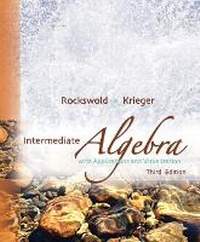
Intermediate Algebra with Applications and Visualization
3rd Edition
Published on 19. February 2008
Book
Hardback
912 pages
978-0-321-50003-8 (ISBN)
Description
Gary Rockswold and Terry Krieger focus on teaching algebra in context, giving students realistic and convincing answers to the perennial question, "When will I ever use this?" The authors' consistent use of real data, graphs, and tables throughout the examples and exercise sets gives meaning to the numbers and equations as students encounter them. This new edition further enhances Rockswold and Krieger's focus on math in the real world with new features and updated applications to engage today's students.
More details
Edition
3rd edition
Language
English
Place of publication
United States
Publishing group
Pearson Education (US)
Target group
Professional and scholarly
Dimensions
Height: 254 mm
Width: 216 mm
Weight
1785 gr
ISBN-13
978-0-321-50003-8 (9780321500038)
Copyright in bibliographic data and cover images is held by Nielsen Book Services Limited or by the publishers or by their respective licensors: all rights reserved.
Schweitzer Classification
Other editions
New editions
Gary K. Rockswold | Terry A. Krieger
Intermediate Algebra with Applications & Visualization Plus NEW MyMathLab with Pearson eText -- Access Card Package
Book
03/2012
4th Edition
Pearson
€245.40
Shipment within 10-20 days
Gary Rockswold | Terry Krieger
Intermediate Algebra with Applications & Visualization
Book
02/2012
4th Edition
Pearson
€210.45
Article exhausted; check for reprint
Previous edition

Margaret L. Lial | Diana L. Hestwood | John Hornsby
Prealgebra and Introductory Algebra, a la carte Plus
Book
12/2008
2nd Edition
Pearson
€64.36
Article exhausted; check for reprint
Persons
Gary Rockswold is a professor of mathematics at Minnesota State University-Mankato. He received his BA in mathematics and physics from St. Olaf College and his Ph.D. in applied mathematics from Iowa State. He was elected to the honor societies of Phi Beta Kappa, Phi Kappa Phi, and Sigma Xi. He has been a principal investigator at the Minnesota Supercomputer Institute and has published several research articles discussing parallel processing and numerical analysis. He is also the author or coauthor of more than 10 current textbooks. At regional and national meetings, he has given numerous presentations related to teaching mathematics. During his thirty-five-year career, Gary has taught mathematics, physical science, astronomy, and computer science at a variety of student levels, ranging from junior high to graduate. Making mathematics meaningful and relevant for students at the developmental and precalculus levels is of special interest to him. He also has a passion for professing mathematics and for communicating the amazing impact that mathematics has on our society.
Terry Krieger has taught mathematics for over fifteen years at the middle school, high school, vocational, community college, and university levels. He graduated summa cum laude from Bemidji State University in Bemidji, Minnesota with a BA in secondary mathematics education. He received his MA in mathematics from Minnesota State University-Mankato. In addition to his teaching experience in the United States, Terry has taught mathematics in Tasmania, Australia and in a rural school in Swaziland, Africa, where he served as a Peace Corps volunteer. Outside of teaching, Terry enjoys wilderness camping, trout fishing and home improvement projects. His past experiences include running two marathons, climbing Mt. Kilimanjaro, and watching the sunset from the banks of the Nile. He currently resides in Rochester, Minnesota with his wife and family. Terry has been involved with various aspects of mathematics textbook publication for more than ten years.
Terry Krieger has taught mathematics for over fifteen years at the middle school, high school, vocational, community college, and university levels. He graduated summa cum laude from Bemidji State University in Bemidji, Minnesota with a BA in secondary mathematics education. He received his MA in mathematics from Minnesota State University-Mankato. In addition to his teaching experience in the United States, Terry has taught mathematics in Tasmania, Australia and in a rural school in Swaziland, Africa, where he served as a Peace Corps volunteer. Outside of teaching, Terry enjoys wilderness camping, trout fishing and home improvement projects. His past experiences include running two marathons, climbing Mt. Kilimanjaro, and watching the sunset from the banks of the Nile. He currently resides in Rochester, Minnesota with his wife and family. Terry has been involved with various aspects of mathematics textbook publication for more than ten years.
Content
Note: There are Cumulative Review exercises after every chapter beginning with Chapter 2, and Checking Basic Concepts exercises after every other section.
1. Real Numbers and Algebra
1.1 Describing Data with Sets of Numbers
1.2 Operations on Real Numbers
1.3 Integer Exponents
1.4 Variables, Equations, and Formulas
1.5 Introduction to Graphing
2. Linear Functions and Models
2.1 Functions and Their Representations
2.2 Linear Functions
2.3 The Slope of a Line
2.4 Equations of Lines and Linear Models
3. Linear Equations and Inequalities
3.1 Linear Equations
3.2 Introduction to Problem Solving
3.3 Linear Inequalities
3.4 Compound Inequalities
3.5 Absolute Value Equations and Inequalities
4. Systems of Linear Equations
4.1 Systems of Linear Equations in Two Variables
4.2 The Substitution and Elimination Methods
4.3 Systems of Linear Inequalities
4.4 Introduction to Linear Programming
4.5 Systems of Linear Equations in Three Variables
4.6 Matrix Solutions of Linear Systems
4.7 Determinants
5. Polynomial Expressions and Functions
5.1 Polynomial Functions
5.2 Multiplication of Polynomials
5.3 Factoring Polynomials
5.4 Factoring Trinomials
5.5 Special Types of Factoring
5.6 Summary of Factoring
5.7 Polynomial Equations
6. Rational Expressions and Functions
6.1 Introduction to Rational Functions and Equations
6.2 Multiplication and Division of Rational Expressions
6.3 Addition and Subtraction of Rational Expressions
6.4 Rational Equations
6.5 Complex Fractions
6.6 Modeling with Proportions and Variation
6.7 Division of Polynomials
7. Radical Expressions and Functions
7.1 Radical Expressions and Rational Exponents
7.2 Simplifying Radical Expressions
7.3 Operations on Radical Expressions
7.4 Radical Functions
7.5 Equations Involving Radical Expressions
7.6 Complex Numbers
8. Quadratic Functions and Equations
8.1 Quadratic Functions and Their Graphs
8.2 Parabolas and Modeling
8.3 Quadratic Equations
8.4 The Quadratic Formula
8.5 Quadratic Inequalities
8.6 Equations in Quadratic Form
9. Exponential and Logarithmic Functions
9.1 Composite and Inverse Functions
9.2 Exponential Functions
9.3 Logarithmic Functions
9.4 Properties of Logarithms
9.5 Exponential and Logarithmic Equations
10. Conic Sections
10.1 Parabolas and Circles
10.2 Ellipses and Hyperbolas
10.3 Nonlinear Systems of Equations and Inequalities
11. Sequences and Series
11.1 Sequences
11.2 Arithmetic and Geometric Sequences
11.3 Series
11.4 The Binomial Theorem
Appendix: Using the Graphing Calculator
Answers to Selected Exercises
Glossary
Bibliography
Photo Credits
Index of Applications
Index
1. Real Numbers and Algebra
1.1 Describing Data with Sets of Numbers
1.2 Operations on Real Numbers
1.3 Integer Exponents
1.4 Variables, Equations, and Formulas
1.5 Introduction to Graphing
2. Linear Functions and Models
2.1 Functions and Their Representations
2.2 Linear Functions
2.3 The Slope of a Line
2.4 Equations of Lines and Linear Models
3. Linear Equations and Inequalities
3.1 Linear Equations
3.2 Introduction to Problem Solving
3.3 Linear Inequalities
3.4 Compound Inequalities
3.5 Absolute Value Equations and Inequalities
4. Systems of Linear Equations
4.1 Systems of Linear Equations in Two Variables
4.2 The Substitution and Elimination Methods
4.3 Systems of Linear Inequalities
4.4 Introduction to Linear Programming
4.5 Systems of Linear Equations in Three Variables
4.6 Matrix Solutions of Linear Systems
4.7 Determinants
5. Polynomial Expressions and Functions
5.1 Polynomial Functions
5.2 Multiplication of Polynomials
5.3 Factoring Polynomials
5.4 Factoring Trinomials
5.5 Special Types of Factoring
5.6 Summary of Factoring
5.7 Polynomial Equations
6. Rational Expressions and Functions
6.1 Introduction to Rational Functions and Equations
6.2 Multiplication and Division of Rational Expressions
6.3 Addition and Subtraction of Rational Expressions
6.4 Rational Equations
6.5 Complex Fractions
6.6 Modeling with Proportions and Variation
6.7 Division of Polynomials
7. Radical Expressions and Functions
7.1 Radical Expressions and Rational Exponents
7.2 Simplifying Radical Expressions
7.3 Operations on Radical Expressions
7.4 Radical Functions
7.5 Equations Involving Radical Expressions
7.6 Complex Numbers
8. Quadratic Functions and Equations
8.1 Quadratic Functions and Their Graphs
8.2 Parabolas and Modeling
8.3 Quadratic Equations
8.4 The Quadratic Formula
8.5 Quadratic Inequalities
8.6 Equations in Quadratic Form
9. Exponential and Logarithmic Functions
9.1 Composite and Inverse Functions
9.2 Exponential Functions
9.3 Logarithmic Functions
9.4 Properties of Logarithms
9.5 Exponential and Logarithmic Equations
10. Conic Sections
10.1 Parabolas and Circles
10.2 Ellipses and Hyperbolas
10.3 Nonlinear Systems of Equations and Inequalities
11. Sequences and Series
11.1 Sequences
11.2 Arithmetic and Geometric Sequences
11.3 Series
11.4 The Binomial Theorem
Appendix: Using the Graphing Calculator
Answers to Selected Exercises
Glossary
Bibliography
Photo Credits
Index of Applications
Index