

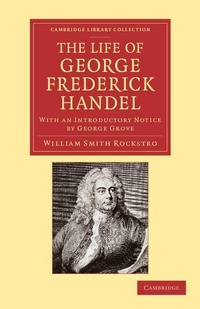
The Life of George Frederick Handel
With an Introductory Notice by George Grove
Published on 4. July 2013
Book
Paperback/Softback
476 pages
978-1-108-06481-1 (ISBN)
Description
Beloved not only in Britain, George Frideric Handel (1685-1759) is admired as a composer the world over. His inventive and sensitive melodic genius and his exuberant brilliance in depicting the spectacular are best displayed in his Messiah and Zadok the Priest. Larger than life, Handel impressed all who met him and was adept at promoting his works, arranging for their publication and even selling them from his home in London's Brook Street. His dogged determination to triumph over the many reverses of his career and the fickle enthusiasms of the Georgian public is the stuff of three-volume novels. This sympathetic and highly readable biography by the composer and author William Smith Rockstro (1823-95) was first published in 1883. Wherever possible, autograph manuscripts have been consulted and the book contains the first detailed catalogue of Handel's output. Among other works, Rockstro's biography of Mendelssohn is also reissued in this series.
More details
Series
Language
English
Place of publication
Cambridge
United Kingdom
Target group
College/higher education
Professional and scholarly
Product notice
Paperback (trade)
Dimensions
Height: 216 mm
Width: 140 mm
Thickness: 28 mm
Weight
666 gr
ISBN-13
978-1-108-06481-1 (9781108064811)
Copyright in bibliographic data and cover images is held by Nielsen Book Services Limited or by the publishers or by their respective licensors: all rights reserved.
Schweitzer Classification
Persons
Content
Notice; Author's preface; 1. The Handel family; 2. Georg Friedrich's childhood; 3. The journey to Berlin; 4. The student-organist; 5. The journey to Hamburg; 6. Almira; 7. The journey to Italy; 8. The first Italian opera; 9. The first visit to London; 10. In London and Hanover; 11. The Utrecht Te deum; 12. At Burlington House; 13. Concerning the Water Musick; 14. The second passion oratorio; 15. Concerning the duke of Chandos; 16. Concerning the Royal Academy of Music; 17. Concerning the success of the Royal Academy of Music; 18. Cuzzoni and Faustina; 19. Concerning the decline and fall of the Royal Academy of Music; 20. Handel as manager; 21. The revival of Esther, and Acis and Galatea; 22. The threatening storm; 23. The rival operas; 24. Performances without dramatic action; 25. The last Italian operas; 26. Saul, Israel in Egypt; 27. The disputed Magnificat; 28. The Messiah; 29. The technical history of the Messiah; 30. The return to London; 31. The victory of Dettingen; 32. The second bankruptcy; 33. Brighter prospects; 34. National rejoicings; 35. The last oratorio; 36. English dramatic works; 37. Pasticcios; 38. Instrumental music; 39. Eventide; 40. The closing scene; 41. The will; 42. The man; 43. The genius; 44. De reliquiis; Catalogue of works; Fac-simile of handwriting; Appendix; Genealogical tree; Index.