

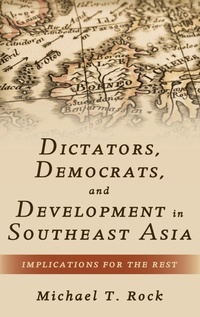
Dictators, Democrats, and Development in Southeast Asia
Implications for the Rest
Published on 3. November 2016
Book
Hardback
364 pages
978-0-19-061986-2 (ISBN)
Description
Getting growth going has been rare in the developing world-since 1960 only nine developing countries have succeeded in sustaining high growth. The aim of Dictators, Democrats and Development in Southeast Asia is to examine how dictators and democrats in three of the nine fast growers -Indonesia, Malaysia and Thailand, hereafter IMT-built and sustained pro-growth political coalitions that enabled them to adopt policies that ushered in sustained high growth.
The focus is on IMT because circa 1960 few thought the three were candidates for high growth and because the three have factor endowments, ethnic heterogeneity, and forms of governance that resemble the Rest. These similarities suggest the Rest may have much to learn from IMT. The focus is unabashedly on the politics of development in IMT because dictators and democrats in IMT built and sustained pro-growth political coalitions that enabled them to link their long term political survival with delivering development. How and why they did so should be of keen interest to the Rest.
Because dictators and democrats in IMT were committed to capitalist, industrial and open economy development strategies but deeply suspicious of a laissez faire approach to development, none of the three ever adopted a Washington Consensus style growth strategy. While all three toyed with a Northeast style capitalist developmental state approach to growth, because governments in IMT lacked the political requisites to make this strategy work, none really stuck to this approach to growth either.
Instead dictators and democrats in IMT implemented highly pragmatic growth and development strategies. When markets worked, governments used them. When interventions worked governments relied on them. When either failed to deliver expected results, governments weeded out bad investments to sustain high growth. Such a pragmatic, trial and error approach to development should also be of keen interest to the Rest.
The focus is on IMT because circa 1960 few thought the three were candidates for high growth and because the three have factor endowments, ethnic heterogeneity, and forms of governance that resemble the Rest. These similarities suggest the Rest may have much to learn from IMT. The focus is unabashedly on the politics of development in IMT because dictators and democrats in IMT built and sustained pro-growth political coalitions that enabled them to link their long term political survival with delivering development. How and why they did so should be of keen interest to the Rest.
Because dictators and democrats in IMT were committed to capitalist, industrial and open economy development strategies but deeply suspicious of a laissez faire approach to development, none of the three ever adopted a Washington Consensus style growth strategy. While all three toyed with a Northeast style capitalist developmental state approach to growth, because governments in IMT lacked the political requisites to make this strategy work, none really stuck to this approach to growth either.
Instead dictators and democrats in IMT implemented highly pragmatic growth and development strategies. When markets worked, governments used them. When interventions worked governments relied on them. When either failed to deliver expected results, governments weeded out bad investments to sustain high growth. Such a pragmatic, trial and error approach to development should also be of keen interest to the Rest.
Reviews / Votes
"Rock uses the high growth and transformation experiences of Indonesia, Malaysia, and Thailand, countries with conditions similar to other developing countries, to construct a serious strategic development alternative to prevailing conventional wisdom. Following difficult nation building processes, conservative political elites-dictators and democrats alike-became hegemonic, building center right political coalitions for development and self-preservation. Thelong run success of this capitalist, but not laissez faire, strategy is testimony to how weaker states, with high ethnic diversity and substantial corruption, can use states and markets to grow and
transform their economies."
-- Jomo Kwame Sundaram, Former United Nations Assistant Secretary General for Economic Development
"Rock's book tackles some of the biggest debates in the political economy of development and asks why both authoritarian and democratic governments in Indonesia, Malaysia, and Thailand (IMT) have consistently outperformed their peers. The focus on IMT is welcome-with their comparatively more restive and diverse civil societies and weaker states they look much more like their counterparts in the rest of the world, than do Singapore and the developmental states
of Northeast Asia. A hallmark of the book is the way in which the author lets the data speak for themselves while skillfully synthesizing disparate strands of argument and evidence."
-- Allen Hicken, Professor of Political Science, University of Michigan
"Dictators, Democrats, and Development in Southeast Asia is a powerful account of the politics of sustained economic success in Southeast Asia. Michael Rock does a masterful job of distilling fifty years of Indonesian, Thai, and Malaysian history with sharp political and economic analysis and the pragmatic eye of someone who understands the myriad practical obstacles to deliberate developmental change."
-- Andrew MacIntyre, Deputy Vice-Chancellor Global Development and Vice-President, RMIT University
More details
Language
English
Place of publication
New York
United States
Target group
College/higher education
Professional and scholarly
Dimensions
Height: 240 mm
Width: 161 mm
Thickness: 24 mm
Weight
710 gr
ISBN-13
978-0-19-061986-2 (9780190619862)
Copyright in bibliographic data and cover images is held by Nielsen Book Services Limited or by the publishers or by their respective licensors: all rights reserved.
Schweitzer Classification
Other editions
Additional editions
E-Book
08/2016
1st Edition
OUP eBook
€80.49
Available for download
E-Book
08/2016
1st Edition
OUP eBook
€80.49
Available for download
Person
Samuel and Etta Wexler Professor of Economic History, Bryn Mawr College
Content
1. Getting growth going is hard and rare
2. History as prologue
3. Dictators build and sustain pro-growth coalitions
4. Dictators incite domestic capitalists to invest
5. Selective interventions in rice agriculture
6. The state and industrial development
7. Technological upgrading
8. Democrats, democratic developmental states and growth
9. Democracy and corruption
10. Lessons from IMT for the Rest
2. History as prologue
3. Dictators build and sustain pro-growth coalitions
4. Dictators incite domestic capitalists to invest
5. Selective interventions in rice agriculture
6. The state and industrial development
7. Technological upgrading
8. Democrats, democratic developmental states and growth
9. Democracy and corruption
10. Lessons from IMT for the Rest