

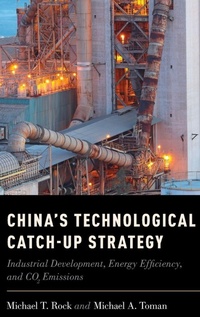
China's Technological Catch-Up Strategy
Industrial Development, Energy Efficiency, and CO2 Emissions
Published on 2. April 2015
Book
Hardback
292 pages
978-0-19-938532-4 (ISBN)
Description
Prior to 1979, China had a bifurcated and geographically-dispersed industrial structure made up of a relatively small number of large-scale, state-owned enterprises in various industries alongside numerous small-scale, energy-intensive and polluting enterprises. Economic reforms beginning in 1979 led to the rapid expansion of these small-scale manufacturing enterprises in numerous energy-intensive industries such as aluminum, cement, iron and steel, and pulp and paper. Subsequently, the government adopted a new industrial development strategy labeled "grasp the large, let go the small." The aims of this new policy were to close many of the unprofitable, small-scale manufacturing plants in these (and other) industries, create a small number of large enterprises that could compete with OECD multinationals, entice these larger enterprises to engage in high-speed technological catch-up, and save energy.
China's Technological Catch-Up Strategy traces the impact of this new industrial development strategy on technological catch-up, energy use, and CO2 emissions. In doing so, the authors explore several detailed, enterprise-level case studies of technological catch-up; develop industry-wide estimates of energy and CO2 savings from specific catch-up interventions; and present detailed econometric work on the determinants of energy intensity. The authors conclude that China's strategy has contributred to substantial energy and CO2 savings, but it has not led to either a peaking of or a decline in CO2 emissions in these industries. More work is needed to cap and reduce China's CO2 emissions.
China's Technological Catch-Up Strategy traces the impact of this new industrial development strategy on technological catch-up, energy use, and CO2 emissions. In doing so, the authors explore several detailed, enterprise-level case studies of technological catch-up; develop industry-wide estimates of energy and CO2 savings from specific catch-up interventions; and present detailed econometric work on the determinants of energy intensity. The authors conclude that China's strategy has contributred to substantial energy and CO2 savings, but it has not led to either a peaking of or a decline in CO2 emissions in these industries. More work is needed to cap and reduce China's CO2 emissions.
Reviews / Votes
Comprehensive, innovative, thought-provoking analysis of the world's largest carbon emitter. Exceptionally well-researched and accessible to specialists and generalists alike, this book should be on the desk of anyone seriously concerned about climate and energy policies. * Richard Morgenstern, Senior Fellow, Resources for the Future * China is the largest consumer and producer of energy in the world, and in China's Technological Catch-up Strategy, Michael Rock and Michael Toman give us an in-depth look at the energy policies, company strategies and their effects on pollution and technology acquisition in the Chinese industries of Cement, Iron & Steel, Aluminum and Paper. A fascinating read for those interested in peering into the black box of Chinese industrial operations. * LUsha C. V. Haley, co-author, Subsidies to Chinese Industry: State Capitalism, Business Strategy, and Trade Policy *More details
Language
English
Place of publication
New York
United States
Target group
College/higher education
Professional and scholarly
Dimensions
Height: 240 mm
Width: 161 mm
Thickness: 20 mm
Weight
605 gr
ISBN-13
978-0-19-938532-4 (9780199385324)
Copyright in bibliographic data and cover images is held by Nielsen Book Services Limited or by the publishers or by their respective licensors: all rights reserved.
Schweitzer Classification
Other editions
Additional editions
Michael T. Rock | Michael Toman
China's Technological Catch-Up Strategy
Industrial Development, Energy Efficiency, and CO2 Emissions
E-Book
02/2015
1st Edition
OUP eBook
€56.49
Available for download
Michael T. Rock | Michael Toman
China's Technological Catch-Up Strategy
Industrial Development, Energy Efficiency, and CO2 Emissions
E-Book
02/2015
1st Edition
OUP eBook
€56.49
Available for download
Persons
Michael T. Rock is the Samuel and Etta Wexler Professor of Economic History at Bryn Mawr College. He received his PhD. in economics from the University of Pittsburgh. Rock's published research focuses on East and Southeast Asia where he writes about the environment and economic development, industrial policy and development, and democracy and economic growth. His work has appeared in numerous academic journals. His research has been funded by Resources for the Future; the World Bank; the Ministry of the Economy, Trade, and Industry in Japan; the U.S. National Science Foundation; the MacArthur Foundation; the Asian Development Bank; and the United Nations Industrial Development Organization. He has taught economics and lived in both Thailand and Vietnam.
Michael A. Toman is Lead Economist in the World Bank Development Research Group and Manager of the Energy and Environment Team. Throughout his career, Mike has done extensive research on climate change economics and policy, energy markets and policy, environmental policy instruments, and approaches to achieving sustainable development. Prior to joining the World Bank in fall 2008, he held senior analytical and management positions at RAND Corporation, Inter-American Development Bank, and Resources for the Future. His teaching experience has included adjunct positions at the Johns Hopkins School of Advanced International Studies as well as the School of the Environment at University of California-Santa Barbara. He has a B.A. from Indiana University, a M.Sc. in applied mathematics from Brown University, and M.A. and Ph.D. degrees in economics from the University of Rochester.
Michael A. Toman is Lead Economist in the World Bank Development Research Group and Manager of the Energy and Environment Team. Throughout his career, Mike has done extensive research on climate change economics and policy, energy markets and policy, environmental policy instruments, and approaches to achieving sustainable development. Prior to joining the World Bank in fall 2008, he held senior analytical and management positions at RAND Corporation, Inter-American Development Bank, and Resources for the Future. His teaching experience has included adjunct positions at the Johns Hopkins School of Advanced International Studies as well as the School of the Environment at University of California-Santa Barbara. He has a B.A. from Indiana University, a M.Sc. in applied mathematics from Brown University, and M.A. and Ph.D. degrees in economics from the University of Rochester.
Content
Chapter 1: Introduction ; Chapter 2: Conceptual framework ; Chapter 3: China's Industrial and Technology Policies ; Chapter 4: Breaking the link between production and CO2 emissions in cement (with Professor Cui Yuansheng) ; Chapter 5: Saving energy and CO2 in iron and steel (with Kejun Jiang) ; Chapter 6: Modernizing the aluminum industry (with Professor Wang Yanjia) ; Chapter 7: Technological change in pulp and paper (with Yun Song) ; Chapter 8: Determinants of energy intensity (with Professor Karen Fisher-Vanden, Yong Hu, and Professor Gary Jefferson) ; Chapter 9: China's technological catch up industrial development strategy in comparative perspective ; Chapter 10: Conclusions