

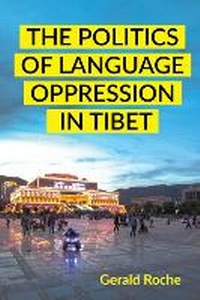
The Politics of Language Oppression in Tibet
Published on 15. November 2024
Book
Paperback/Softback
264 pages
978-1-5017-7778-3 (ISBN)
Description
In The Politics of Language Oppression in Tibet, Gerald Roche sheds light on a global crisis of linguistic diversity that will see at least half of the world's languages disappear this century.
Roche explores the erosion of linguistic diversity through a study of a community on the northeastern Tibetan Plateau in the People's Republic of China. Manegacha is but one of the sixty minority languages in Tibet and is spoken by about 8,000 people who are otherwise mostly indistinguishable from the Tibetan communities surrounding them. Recently, many in these communities have switched to speaking Tibetan, and Manegacha faces an uncertain future.
The author uses the Manegacha case to show how linguistic diversity across Tibet is collapsing under assimilatory state policies. He looks at how global advocacy networks inadequately acknowledge this issue, highlighting the complex politics of language in an inter-connected world. The Politics of Language Oppression in Tibet broadens our understanding of Tibet and China, the crisis of global linguistic diversity, and the radical changes needed to address this crisis.
Roche explores the erosion of linguistic diversity through a study of a community on the northeastern Tibetan Plateau in the People's Republic of China. Manegacha is but one of the sixty minority languages in Tibet and is spoken by about 8,000 people who are otherwise mostly indistinguishable from the Tibetan communities surrounding them. Recently, many in these communities have switched to speaking Tibetan, and Manegacha faces an uncertain future.
The author uses the Manegacha case to show how linguistic diversity across Tibet is collapsing under assimilatory state policies. He looks at how global advocacy networks inadequately acknowledge this issue, highlighting the complex politics of language in an inter-connected world. The Politics of Language Oppression in Tibet broadens our understanding of Tibet and China, the crisis of global linguistic diversity, and the radical changes needed to address this crisis.
Reviews / Votes
This is a brilliant, informative, and deeply worrying book.(State Crime Journal) The Politics of Language Oppression in Tibet provides a detailed, expansive account of Manegacha speakers and the ongoing loss of their language.
(Melbourne Asia Review)
More details
Language
English
Place of publication
Ithaca
United States
Target group
College/higher education
Product notice
Paperback (trade)
Illustrations
8 b&w halftones, 3 maps - 3 Maps - 8 Halftones, black and white
Dimensions
Height: 229 mm
Width: 152 mm
Weight
907 gr
ISBN-13
978-1-5017-7778-3 (9781501777783)
Copyright in bibliographic data and cover images is held by Nielsen Book Services Limited or by the publishers or by their respective licensors: all rights reserved.
Schweitzer Classification
Other editions
Additional editions
Gerald Roche
The Politics of Language Oppression in Tibet
E-Book
11/2024
Cornell University Press
€25.49
Available for download
Person
Gerald Roche is Associate Professor in Politics in the Department of Politics, Media, and Philosophy at La Trobe University, Melbourne, Australia. His work focuses on power, the state, colonialism, and racism.
Content
Introduction: Language Oppression
Part 1: Erasure
1. Before Language Oppression: Languages and Sovereign Power
2. Language Oppression and the State: Biopolitics and State Racism in the People's Republic of China
Part 2: Supression
3. Language Oppression and Resistance: Race War andthe Violence of Self-Defense
4. Language Oppression and Global Power Circuits
Part 3: Elimination
5. The Slow Violence of State-Building
6. Banal Violence and Biosovereign Power
Conclusion: Resisting Languag
Epilogue
Part 1: Erasure
1. Before Language Oppression: Languages and Sovereign Power
2. Language Oppression and the State: Biopolitics and State Racism in the People's Republic of China
Part 2: Supression
3. Language Oppression and Resistance: Race War andthe Violence of Self-Defense
4. Language Oppression and Global Power Circuits
Part 3: Elimination
5. The Slow Violence of State-Building
6. Banal Violence and Biosovereign Power
Conclusion: Resisting Languag
Epilogue