

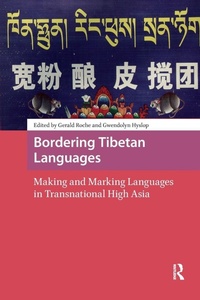
Bordering Tibetan Languages
Making and Marking Languages in Transnational High Asia
1st Edition
Will be published approx. on 1. December 2025
Book
Paperback/Softback
216 pages
978-1-041-17630-5 (ISBN)
Description
Bordering Tibetan Languages: Making and Marking Languages in Transnational High Asia examines the complex interactions between state, ethnic, and linguistic borders in the Himalayas. These case studies from Bhutan, China, India, and Nepal show how people in the Himalayas talk borders into existence, and also how those borders speak to them and their identities. These 'talking borders' exist in a world where state borders are contested, and which is being irrevocably transformed by rapid social and economic change. This book offers a new perspective on this dynamic region by centring language, and in doing so, also offers new ways of thinking about how borders and language influence each other.
More details
Series
Language
English
Place of publication
London
United Kingdom
Publishing group
Taylor & Francis Ltd
Target group
Professional and scholarly
Academic
Dimensions
Height: 234 mm
Width: 156 mm
Thickness: 12 mm
Weight
339 gr
ISBN-13
978-1-041-17630-5 (9781041176305)
Copyright in bibliographic data and cover images is held by Nielsen Book Services Limited or by the publishers or by their respective licensors: all rights reserved.
Schweitzer Classification
Other editions
Additional editions
Gerald Roche | Gwendolyn Hyslop
Bordering Tibetan Languages
Making and Marking Languages in Transnational High Asia
E-Book
10/2025
Routledge
€60.99
Available for download
Gerald Roche | Gwendolyn Hyslop
Bordering Tibetan Languages
Making and Marking Languages in Transnational High Asia
E-Book
10/2025
Routledge
€60.99
Available for download
Gerald Roche | Gwendolyn Hyslop
Bordering Tibetan Languages
Making and Marking Languages in Transnational High Asia
Book
09/2022
Amsterdam University Press
€149.60
Shipment within 10-20 days
Persons
Gerald Roche is a Senior Research Fellow in the Department of Politics, Media, and Philosophy at La Trobe University (Australia). He is an international expert in language revitalization and the politics of language in Tibet and the Himalayas. Gwendolyn Hyslop received her PhD from the University of Oregon and is a Senior Lecturer in the Department of Linguistics at the University of Sydney. She is a specialist of Tibeto Burman languages, in particular those from Bhutan. She has written a grammar of Kurtoep and also specializes in Historical Linguistics. Willem van Schendel, Professor of History, University of Amsterdam and International Institute of Social History, the Netherlands. He works with the history, anthropology and sociology of Asia. Recent works include A History of Bangladesh (2020), Embedding Agricultural Commodities (2017, ed.), The Camera as Witness (2015, with J. L. K. Pachuau). See uva.academia.edu/WillemVanSchendel. Cathryn Donohue (PhD, Stanford University) is a field linguist specializing in Sino-Tibetan, with a primary focus on Himalayan languages. Her linguistic interests center on morphosyntax, tonal phenomena, and language variation, including documentary and outreach components. She is currently a Research Assistant Professor at the Hong Kong Polytechnic University. Charisma K. Lepcha teaches anthropology at Sikkim University, India. Her research interests include religion, identity, indigeneity, and linguistic anthropology in the eastern Himalaya borderlands. She was a Fellow at the Indian Institute of Advanced Study (IIAS), Shimla (2018-2019). She was also a Visiting Scholar at the Harvard-Yenching Institute, Cambridge, MA (2021-2022). Dirk Schmidt graduated with an MA in Tibetan Studies in 2008. He then went to India to learn Tibetan. He has worked with Esukhia since 2011 on a variety of research and development projects related to Tibetan language education, children's literature, and translation technology. Dirk is currently a PhD student at the University of Wisconsin-Madison. Hiroyuki Suzuki holds a D.Litt. in linguistics from Kyoto University (2007) and is currently a part-time lecturer teaching the Chinese language at Kyoto University, Japan. His principal research interests are descriptive linguistics, geolinguistics, dialectology, and sociolinguistics of languages in the Tibetosphere. Shannon M. Ward is an Assistant Professor of Linguistic Anthropology at the University of British Columbia Okanagan, Canada. Her research examines language socialization, multilingualism, and heritage language learning, with a focus on communities from the Himalayas.
Content
Acknowledgements, About the Cover Image, 1 Introduction: Bordering Tibetan Languages: Making and Marking Languages in Transnational High Asia, by Gerald Roche, 2 Playing with Language Boundaries: Heteroglot Standard Language Ideology and Linguistic Belonging among Amdo Children, by Shannon Ward, 3 The Role of Classical Tibetan (Choke) on the Development of Kurtop, a Language of Bhutan, by Gwendolyn Hyslop, 4 Reimagining Rongring without Tibetan Buddhist Influence, by Charisma K. Lepcha, 5 Glottonyms, Identity, and Language Recognition in the Eastern Tibetosphere, by Hiroyuki Suzuki, 6 On the Yak Horns of a Dilemma: Diverging Standards in Diaspora Tibetan, by Dirk Schmidt, 7 Changing Identity and Linguistic Practices in Nubri: Veiled Language Endangerment in the Nepalese Tibetosphere, by Cathryn Donohue, 8 Borderline Dominance: Transnational Tibetan Language Politics in the Himalayas, by Gerald Roche, 9 Borders: In Conclusion, by Gwendolyn Hyslop, Tibetan Language Summaries, Index