

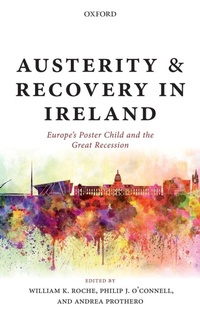
Austerity and Recovery in Ireland
Europe's Poster Child and the Great Recession
Published on 15. December 2016
Book
Hardback
370 pages
978-0-19-879237-6 (ISBN)
Description
In international commentary and debate on the effects of the Great Recession and austerity, Ireland has been hailed as the poster child for economic recovery and regeneration out of deep economic and fiscal contraction. While the genesis of Ireland's financial, economic and fiscal crisis has been covered in the literature, no systematic analysis has yet been devoted to the period of austerity, to the impact of austerity on institutions and people, or to the roots of economic recovery.
In this book a group of Ireland's leading social scientists present a multi-disciplinary analysis of recession and austerity and their effects on economic, business, political and social life. Individual chapters discuss the fiscal and economic policies implemented, the role of international, and, in particular, of EU institutions, and the effects on businesses, consumption, work, the labour market, migration, political and financial institutions, social inequality and cohesion, housing and cultural expression.
The book shows that Ireland cannot be viewed uncritically as a poster child for austerity. While fiscal contraction provided a basis for stabilizing the perilous finances of the State, economic recovery was due in the main to the long-established structure of Irish economic and business activity, to the importance of foreign direct investment and the dynamic export sector, and to recovery in the international economy. The restructuring and recovery of the financial system was aided by favourable international developments, including historically low interest rates and quantitative easing. Migration flows, nominal wage stability, the protection of social transfer payments and the involvement of trade unions in severe public sector retrenchment - long-established features of Irish political economy - were of critical importance in the maintenance of social cohesion.
In this book a group of Ireland's leading social scientists present a multi-disciplinary analysis of recession and austerity and their effects on economic, business, political and social life. Individual chapters discuss the fiscal and economic policies implemented, the role of international, and, in particular, of EU institutions, and the effects on businesses, consumption, work, the labour market, migration, political and financial institutions, social inequality and cohesion, housing and cultural expression.
The book shows that Ireland cannot be viewed uncritically as a poster child for austerity. While fiscal contraction provided a basis for stabilizing the perilous finances of the State, economic recovery was due in the main to the long-established structure of Irish economic and business activity, to the importance of foreign direct investment and the dynamic export sector, and to recovery in the international economy. The restructuring and recovery of the financial system was aided by favourable international developments, including historically low interest rates and quantitative easing. Migration flows, nominal wage stability, the protection of social transfer payments and the involvement of trade unions in severe public sector retrenchment - long-established features of Irish political economy - were of critical importance in the maintenance of social cohesion.
Reviews / Votes
The many strands of ruin and gradual but not complete recovery are dealt with in a style that is both scholarly and accessible. This richness makes it the best overall single-volume assessment of our recent political and social experience. * Paschal Donohoe, Minister for Public Expenditure and Reform, The Irish Times *More details
Language
English
Place of publication
Oxford
United Kingdom
Target group
College/higher education
Professional and scholarly
Illustrations
62 Figures, 36 Tables
Dimensions
Height: 240 mm
Width: 161 mm
Thickness: 24 mm
Weight
719 gr
ISBN-13
978-0-19-879237-6 (9780198792376)
Copyright in bibliographic data and cover images is held by Nielsen Book Services Limited or by the publishers or by their respective licensors: all rights reserved.
Schweitzer Classification
Other editions
Additional editions
William K. Roche | Philip J. O'Connell | Andrea Prothero
Austerity and Recovery in Ireland
Europe's Poster Child and the Great Recession
E-Book
12/2016
1st Edition
OUP eBook
€31.49
Available for download
William K. Roche | Philip J. O'Connell | Andrea Prothero
Austerity and Recovery in Ireland
Europe's Poster Child and the Great Recession
E-Book
12/2016
1st Edition
OUP eBook
€31.49
Available for download
Persons
William Roche is Professor of Industrial Relations & Human Resources at the School of Business, University College Dublin and Honorary Professor at the Management School, Queen's University, Belfast. He obtained his doctorate from the University of Oxford, where he was Heyworth Memorial Prize Research Fellow of Nuffield College. He has published extensively in leading international peer-reviewed journals in industrial relations and human resource management. His recent books include Managing Conflict at Work: Alternative Dispute Resolution in Ireland (with P. Teague, T. Gormley, and D. Currie, Institute of Public Administration, 2015), The Oxford Handbook of Conflict Management in Organizations (with P. Teague and A. Colvin, OUP, 2014), and Recession at Work: HRM in the Irish Crisis (with P. Teague, A. Coughlan and M. Fahy, Routledge, 2013).
Philip J. O'Connell is Director of the UCD Geary Institute and Professor of Applied Social Science at University College Dublin. Most of his work focuses on the labour market and on migration. He has an enduring interest in equality at work and in access to employment, and has published papers on wage inequality, on working conditions and workplace practices, on the transition from unemployment to work, and on the experience of migrant workers in Ireland. He has written several books on the determinants and effects of work-related education and training, and published papers on this and other labour market issues in the leading peer-reviewed journals. He has served as a consultant on human resource development and labour market issues to the European Commission and the OECD. He is a government-appointed member of the Irish Labour Market Council.
Andrea Prothero is Associate Professor of Marketing at University College Dublin. Her research focuses primarily on exploring the relationships between marketing and society, with a particular emphasis on sustainability marketing research, and she has published widely in these areas. Prior to moving to Ireland in 1999, Andrea worked at universities in the UK, and also completed a sabbatical at Arizona State University in 2002. She recently led one of UCDs contributions to the President of Ireland's Ethics Initiative, asking students across Ireland to engage in debate focusing on why 'we need to talk about ethics.'
Philip J. O'Connell is Director of the UCD Geary Institute and Professor of Applied Social Science at University College Dublin. Most of his work focuses on the labour market and on migration. He has an enduring interest in equality at work and in access to employment, and has published papers on wage inequality, on working conditions and workplace practices, on the transition from unemployment to work, and on the experience of migrant workers in Ireland. He has written several books on the determinants and effects of work-related education and training, and published papers on this and other labour market issues in the leading peer-reviewed journals. He has served as a consultant on human resource development and labour market issues to the European Commission and the OECD. He is a government-appointed member of the Irish Labour Market Council.
Andrea Prothero is Associate Professor of Marketing at University College Dublin. Her research focuses primarily on exploring the relationships between marketing and society, with a particular emphasis on sustainability marketing research, and she has published widely in these areas. Prior to moving to Ireland in 1999, Andrea worked at universities in the UK, and also completed a sabbatical at Arizona State University in 2002. She recently led one of UCDs contributions to the President of Ireland's Ethics Initiative, asking students across Ireland to engage in debate focusing on why 'we need to talk about ethics.'
Editor
Professor of Industrial Relations & Human Resources at the College of Business University College Dublin; Honorary Professor at the Management School, Queen's University, Belfast
Professor of Applied Social Science at the School of Social Policy, Social Work and Social Justice, College of Business Social Science and Law, University College Dublin; Director of the UCD Geary Institute for Public Policy
Professor of Business and Scoiety at the College of Business, University College Dublin
Content
1: William K. Roche, Philip O'connell, and Andrea Prothero: 'Poster Child' or 'Beautiful Freak': Austerity and Recovery in Ireland
2: Sean O Riain: The Road to Austerity
3: Stephen Kinsella: Economic and Fiscal Policy
4: Frank Barry and Adele Bergin: Business
5: Gregory Connor, Thomas Flavin, and Brian O'Kelly: The Financial Sector
6: Blanaid Clarke: Banking Regulation
7: Marius Claudy, Andrew Keating, and Andrea Prothero: Consumption
8: Paul Teague: Ireland and the 'GIPS' Countries
9: David M. Farrell: Political Reform
10: Brigid Laffan: International Actors and Agencies
11: William K. Roche: Workplaces
12: Richard Boyle: Public Service Reform
13: Philip J. O'Connell: Unemployment and Labour Market Policy
14: Kathleen Lynch, Sarah Cantillon, and Margaret Crean: Inequality
15: Rob Kitchin, Rory Hearne, and Cian O'Callaghan: Housing
16: Irial Glynn and Philip J. O'Connell: Migration
17: Donald Taylor Black: Culture
2: Sean O Riain: The Road to Austerity
3: Stephen Kinsella: Economic and Fiscal Policy
4: Frank Barry and Adele Bergin: Business
5: Gregory Connor, Thomas Flavin, and Brian O'Kelly: The Financial Sector
6: Blanaid Clarke: Banking Regulation
7: Marius Claudy, Andrew Keating, and Andrea Prothero: Consumption
8: Paul Teague: Ireland and the 'GIPS' Countries
9: David M. Farrell: Political Reform
10: Brigid Laffan: International Actors and Agencies
11: William K. Roche: Workplaces
12: Richard Boyle: Public Service Reform
13: Philip J. O'Connell: Unemployment and Labour Market Policy
14: Kathleen Lynch, Sarah Cantillon, and Margaret Crean: Inequality
15: Rob Kitchin, Rory Hearne, and Cian O'Callaghan: Housing
16: Irial Glynn and Philip J. O'Connell: Migration
17: Donald Taylor Black: Culture