

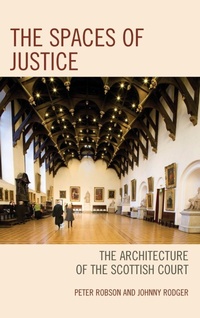
The Spaces of Justice
The Architecture of the Scottish Court
Published on 18. August 2017
Book
Hardback
238 pages
978-1-68393-088-4 (ISBN)
Description
This book looks at the architecture of the courts in Scotland and the importance of these civic spaces. Given the importance of courts to the legal experience it starts by exploring why scholars have been so reticent in examining spaces in which the administration of justice takes place. It notes the major changes already unfolding in Scotland and puts these into a historical and cultural context. The authors trace the emergence of the notion of the dedicated courtroom space in 19th century Scotland and the ways in which the courtroom setting affected the exercise of power through law. They show what factors led to the adoption of different architectural styles. They examine the changes in the legal, political and social world which drove such changes and how these changed in the 20th and 21st centuries. They also examine the symbolic functions of courts both internally and externally. They note the changes in the decision-makers and their goals in the 21st century and how this will lead to a very different kind of courtroom in the near future. They examine the wider factors affecting the process of litigation and trends in dispute resolution. They conclude that the goals of transparency and civil dignity have serious implications for the kinds of spaces which will serve as halls of justice in the future. Since these are driven, it seems, by financial imperatives it does not bode well for the retention of civic pride and community which the courts of justice might be said to embody.
Reviews / Votes
This absorbing book, an interdisciplinary collaboration between academics, is as far as I know unique in Scottish legal and architectural scholarship. . . . This book, in short, can be recommended to anyone with an interest in the past, present, or future of Scotland's court system. * The Journal of the Law Society of Scotland * The architecture of our public buildings embodies our societal values and makes manifest our priorities. This thoroughly researched work asks important and timely questions: What is our vision for Scotland's future 'spaces of justice'? Should there be wider professional, public and architectural debate? How do we ensure public investment creates buildings that are meaningful and by design enable progressive and inclusive legal process? -- Karen Anderson, architect and chair of Architecture and Design Scotland Robson and Rodger have produced a masterful and in depth study of the hitherto neglected institution that is the Scottish courthouse: as historical monument, symbol of civic pride and judicial independence. This is a fascinating survey of those spaces in which Scottish law has been crafted and developed over centuries and of a system under unprecedented pressure to respond to the very different and evolving demands of 21st century justice. -- Dame Elish Angiolini, Principal St Hugh's College Oxford ( former Lord Advocate and Solicitor General for Scotland) This is a fascinating and thought provoking piece of socio-legal scholarship - a worthwhile read for all of those with an interest in the provision of justice in Scotland, who will undoubtedly, as a result, find their engagement with the spaces in which our justice system operates to be a richer and more rewarding experience. -- Lord Clark, Court of Session Judge A marvelous and insightful book. Original, thought-provoking and timely, it makes us see the places and spaces of law and justice in a new way. Interdisciplinary work at its best, the authors raise important questions about the courts and justice. The book uses the history and development of the legal system to help better us understand contemporary debates. Highly recommended. -- Richard Collier, Professor at University of Newcastle ( former editor of Social and Legal Studies) This book is a very welcome addition to the burgeoning international literature on the architecture of justice spaces and provides a very welcome focus on the much neglected topic of Scottish courts. The gazeteer is particularly valuable and provides rich material for future research. -- Linda Mulcahy, Professor, LSE, author of Legal Architecture This is a welcome and timely study of the history, context and significance of Scotland's court buildings. In today's more culturally and socially fluid society, the stability and solidity once offered by courthouses seem less relevant to current generations. The recent programme of court closures diminishes their significance and status yet further. Professors Robson and Rodger's fascinating book charts the development of what are essentially architectural manifestations of civic-mindedness, albeit primarily bourgeois in their provenance and intent. Their story is also the story of Scottish society, as it moved from local decision-making to a more centralised bureaucracy. -- John Pelan, Director, The Scottish Civic TrustMore details
Series
Language
English
Place of publication
Cranbury
United States
Publishing group
Associated University Presses
Target group
Professional and scholarly
Illustrations
44 BW Photos, 1 Table
Dimensions
Height: 235 mm
Width: 157 mm
Thickness: 17 mm
Weight
501 gr
ISBN-13
978-1-68393-088-4 (9781683930884)
Copyright in bibliographic data and cover images is held by Nielsen Book Services Limited or by the publishers or by their respective licensors: all rights reserved.
Schweitzer Classification
Other editions
Additional editions
E-Book
08/2017
1st Edition
Fairleigh Dickinson University Press,U.S.
€94.99
Available for download
E-Book
08/2017
1st Edition
Fairleigh Dickinson University Press,U.S.
€95.99
Available for download
Persons
Peter Robson is a poverty lawyer who teaches at the University of Strathclyde in Scotland.
Johnny Rodger is professor of urban literature at the Mackintosh School of Architecture at the Glasgow School of Art.
Johnny Rodger is professor of urban literature at the Mackintosh School of Architecture at the Glasgow School of Art.
Content
Acknowledgments
Introduction
1Justice-Personnel, Procedure and Places
2The Courtroom in Context
3The Development of the Modern Scottish Court System
4The Emergence of Modern Scottish Court Buildings: The Superior Courts-The Court of Session and the High Court of Justiciary
5The Architecture of Scottish Courts
6The Iconography of Scottish Justice
7Scottish Courts Going Forward into the Future
Appendix: Courthouse Gazetteer-Sheriff Courts Followed by High Courts
Bibliography
Index
About the Authors
Introduction
1Justice-Personnel, Procedure and Places
2The Courtroom in Context
3The Development of the Modern Scottish Court System
4The Emergence of Modern Scottish Court Buildings: The Superior Courts-The Court of Session and the High Court of Justiciary
5The Architecture of Scottish Courts
6The Iconography of Scottish Justice
7Scottish Courts Going Forward into the Future
Appendix: Courthouse Gazetteer-Sheriff Courts Followed by High Courts
Bibliography
Index
About the Authors