

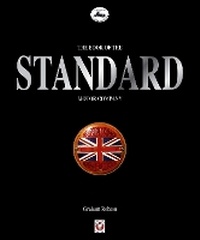
The Book of the Standard Motor Company
Published on 15. June 2011
Book
Hardback
208 pages
978-1-84584-343-4 (ISBN)
Description
For many years, Standard was one of Britain's largest car-makers. The largest motor industry employer in Coventry, Standard rescued Triumph from oblivion, produced more than 500,000 tractors on behalf of Ferguson, and was one of the biggest contributors to Britain's efforts during WWII. This book is the first to definitively tell the story of the Standard marque - a story that's not merely technical, but financial, too, and covers the personalities and the products in equal measure. Starting with the original Standard prototype of 1903, this book covers the scores of Standard models built until the brand was discontinued in 1963 (Britain) and 1987 (India). It also covers the Ferguson tractor involvement, military aero-engine manufacture, military aircraft manufacturer (including Beaufighter and Mosquito fighter-bombers), Rolls-Royce Avon turbo-jet military engine manufacture, and Triumph cars.
More details
Language
English
Place of publication
United Kingdom
Publishing group
David & Charles
Dimensions
Height: 250 mm
Width: 207 mm
Weight
1088 gr
ISBN-13
978-1-84584-343-4 (9781845843434)
Copyright in bibliographic data and cover images is held by Nielsen Book Services Limited or by the publishers or by their respective licensors: all rights reserved.
Schweitzer Classification
Other editions
Additional editions
Graham Robson
The Book of the Standard Motor Company
E-Book
03/2022
NYU Press
€18.49
Available for download
Person
After a varied career in the automotive industry Graham Robson has gained a worldwide reputation as a motoring historian, and has more than 160 books to his credit.
Born in 1936, and educated at Ermysteds Grammar School in Yorkshire, Graham then went on to study Engineering at Oxford University. He joined Jaguar Cars as a graduate trainee, becoming involved in design work on the Mk II, E-Type and Mark X. Beginning as a hobby, he became a rally co-driver, eventually joining the Sunbeam 'works' team in 1961, and took part in rallies up to International level (once with Roger Clark), but stopped rallying by 1968.
During this time he joined Standard-Triumph in Coventry, in 1961, as a Development Engineer, mainly on sports car projects. He then ran the re-opened 'works' motorsport department from 1962 to 1965, this being the period of the birth of Spitfire Le Mans cars, TR4, Vitesse, Spitfire and 2000 rally car developments.
Graham Robson's writing began with rally reports for magazines which evolved into a job with Autocar from 1965-1969. He was recruited back to industry at Rootes to run the Product Proving department, then after a brief period in 1972 as technical director of a safety belt company, became an independent motoring writer. Graham has lived 'by the pen' and 'by the voice', not only writing but commentating, presenting and organising events of all types.
Born in 1936, and educated at Ermysteds Grammar School in Yorkshire, Graham then went on to study Engineering at Oxford University. He joined Jaguar Cars as a graduate trainee, becoming involved in design work on the Mk II, E-Type and Mark X. Beginning as a hobby, he became a rally co-driver, eventually joining the Sunbeam 'works' team in 1961, and took part in rallies up to International level (once with Roger Clark), but stopped rallying by 1968.
During this time he joined Standard-Triumph in Coventry, in 1961, as a Development Engineer, mainly on sports car projects. He then ran the re-opened 'works' motorsport department from 1962 to 1965, this being the period of the birth of Spitfire Le Mans cars, TR4, Vitesse, Spitfire and 2000 rally car developments.
Graham Robson's writing began with rally reports for magazines which evolved into a job with Autocar from 1965-1969. He was recruited back to industry at Rootes to run the Product Proving department, then after a brief period in 1972 as technical director of a safety belt company, became an independent motoring writer. Graham has lived 'by the pen' and 'by the voice', not only writing but commentating, presenting and organising events of all types.
Content
Introduction Acknowledgements Timeline Chapter 1 - Raising the Standard 1903-1906 Chapter 2 - Standard and the Union Flag - building the brand 1906-1914 Interruption - World War One and aircraft 1914-1918 Chapter 3 - Vintage Standards 1919-1927 Chapter 4 - The first of the Nines 1927-1935 Chapter 5 - Flying Standards for all 1935-1940 Chapter 6 - World War Two - aero engines and aircraft 1939-1945 Chapter 7 - The takeover of Triumph, and after 1944-1946 Chapter 8 - Tractors, Banner Lane, and jet engines ... 1940-1959 Interlude - The BRM project - dabbling with Formula One Chapter 9 - Vanguards, Renowns and Mayflowers 1947-1953 Chapter 10 - Eights, Tens, Triumph sports cars - and a new Vanguard 1953-1960 Chapter 11 - Triumph takes centre stage 1959-1960s Chapter 12 - Leyland takes over - the final years 183 Appendix A - Standard and SS - an important commercial link Appendix B - 'Works' rally cars in the 1950s Appendix C - Series-production petrol engine 'family' dimensions Appendix D - Standard and Triumph model launches Appendix E - UK-produced Standard production models 1903-1963 Appendix F - Production figures - year-on-year Index