

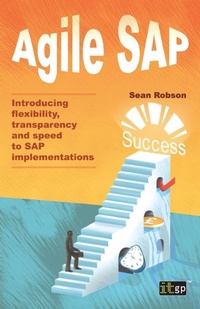
Agile SAP
Introducing flexibility, transparency and speed to SAP implementations
Published on 24. January 2013
Book
Paperback/Softback
216 pages
978-1-84928-445-5 (ISBN)
Description
Many SAP projects use waterfall methodologies, but these often run into budgeting and scheduling problems. In this unique book, Sean Robson presents ways of improving SAP implementations and offers practical advice on the most effective way to see a project through from beginning to end. Basing his strategies on the twelve principles of the Agile Manifesto, and drawing on his vast experience, he particularly focuses on the use of Scrum and Kanban and their suitability for certain types of projects, enabling you to select the most appropriate method for the task in hand.
More details
Language
English
Place of publication
Ely
United Kingdom
Target group
Professional and scholarly
Product notice
Paperback (UK-trade)
Dimensions
Height: 216 mm
Width: 140 mm
Thickness: 13 mm
Weight
281 gr
ISBN-13
978-1-84928-445-5 (9781849284455)
Copyright in bibliographic data and cover images is held by Nielsen Book Services Limited or by the publishers or by their respective licensors: all rights reserved.
Schweitzer Classification
Other editions
Additional editions
E-Book
01/2013
1st Edition
IT Governance Publishing
€37.99
Available for download
Person
Sean Robson MBA, PMP, CSM has 17 years' SAP experience in project management, portfolio management, team leadership, configuration and development. He is a project management professional and certified Scrum Master with wide consulting and industry experience, and has managed large-scale projects worth up to $5M. He has experience with a wide variety of SAP functionality including Netweaver Portal, Netweaver Mobile 7.1, Customer Relationship Management, and various ERP Central Component modules.
Content
1. Introduction to Scrum and Kanban
2. Project Conception
3. Project Preparation
4. Business Blueprint
5. Realization
6. Final Preparation
Appendix A: Development Approach
2. Project Conception
3. Project Preparation
4. Business Blueprint
5. Realization
6. Final Preparation
Appendix A: Development Approach