

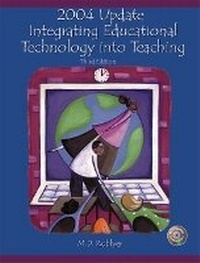
2004 Update
Integrating Educational Technology into Teaching
3rd Edition
Published on 2. June 2004
Book
Paperback/Softback
608 pages
978-0-13-118923-2 (ISBN)
Description
For courses in Computers in Education, Instructional Technology, or Instructional Media.
Integration methods should be based in both learning theory and teaching practice. Integration should match specific teaching and learning needs.
Old integration strategies are not necessarily bad; new strategies are not necessarily good.
Using these three premises as a foundation, this text presents effective theory- and research-based strategies for integrating technology resources and technology-based methods into everyday classroom practices. It is written from the teacher's perspective, making it ideal for both novice and experienced computer users.
Integration methods should be based in both learning theory and teaching practice. Integration should match specific teaching and learning needs.
Old integration strategies are not necessarily bad; new strategies are not necessarily good.
Using these three premises as a foundation, this text presents effective theory- and research-based strategies for integrating technology resources and technology-based methods into everyday classroom practices. It is written from the teacher's perspective, making it ideal for both novice and experienced computer users.
More details
Edition
3rd edition
Language
English
Place of publication
United States
Publishing group
Pearson Education (US)
Target group
Professional and scholarly
Weight
1231 gr
ISBN-13
978-0-13-118923-2 (9780131189232)
Copyright in bibliographic data and cover images is held by Nielsen Book Services Limited or by the publishers or by their respective licensors: all rights reserved.
Schweitzer Classification
Other editions
New editions
M. D. Roblyer
Integrating Educational Technology into Teaching
Book
08/2005
4th Edition
Pearson
€68.24
Article is exhausted; no reprint
Content
I. INTRODUCTION AND BACKGROUND ON INTEGRATING TECHNOLOGY IN EDUCATION.
1. Educational Technology in Context: The Big Picture.
2. Planning and Implementation for Effective Technology Integration.
3. Learning Theories and Integration Models.
II. INTEGRATING SOFTWARE AND MEDIA TUTORS AND TOOLS: PRINCIPLES AND STRATEGIES
4. Integrating Instructional Software into Teaching and Learning.
5. Integrating Word Processing, Spreadsheet, and Database Software Tools into Teaching and Learning.
6. Integrating Other Software Tools into Teaching and Learning.
7. Integrating Multimedia and Hypermedia into Teaching and Learning.
III. LINKING TO LEARN: PRINCIPLES AND STRATEGIES
8. Integrating the Internet and Other Distance Resources into the Curriculum.
9. A Link to the Future: Emerging Developments in Technology Integration.
IV. INTEGRATING TECHNOLOGY ACROSS THE CURRICULUM
10. Technology in Language Arts and Foreign Language Instruction.
11. Technology in Science and Mathematics Instruction.
12. Technology in Social Studies Instruction.
13. Technology in Art and Music Instruction.
14. Technology in Physical Education and Health Education.
15. Technology in Special Education.
Appendix: Rubrics and Checklists to Support Technology Integration and Assessment.
Glossary.
1. Educational Technology in Context: The Big Picture.
2. Planning and Implementation for Effective Technology Integration.
3. Learning Theories and Integration Models.
II. INTEGRATING SOFTWARE AND MEDIA TUTORS AND TOOLS: PRINCIPLES AND STRATEGIES
4. Integrating Instructional Software into Teaching and Learning.
5. Integrating Word Processing, Spreadsheet, and Database Software Tools into Teaching and Learning.
6. Integrating Other Software Tools into Teaching and Learning.
7. Integrating Multimedia and Hypermedia into Teaching and Learning.
III. LINKING TO LEARN: PRINCIPLES AND STRATEGIES
8. Integrating the Internet and Other Distance Resources into the Curriculum.
9. A Link to the Future: Emerging Developments in Technology Integration.
IV. INTEGRATING TECHNOLOGY ACROSS THE CURRICULUM
10. Technology in Language Arts and Foreign Language Instruction.
11. Technology in Science and Mathematics Instruction.
12. Technology in Social Studies Instruction.
13. Technology in Art and Music Instruction.
14. Technology in Physical Education and Health Education.
15. Technology in Special Education.
Appendix: Rubrics and Checklists to Support Technology Integration and Assessment.
Glossary.