

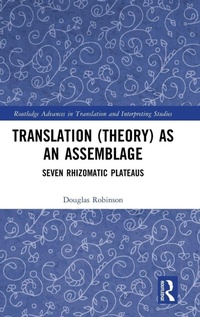
Translation (Theory) as an Assemblage
Seven Rhizomatic Plateaus
1st Edition
Will be published approx. on 24. March 2026
Book
Hardback
168 pages
978-1-041-14603-2 (ISBN)
Description
This experimental book on translation borrows its title and methodology from the introduction to Deleuze and Guattari's A Thousand Plateaus. As they theorize it, an assemblage (French agencement) works through a complex socio-material network characterized by fluidity, exchangeability, and connectivity. They contrast the assemblage with what they call the "root-tree," which is rooted in stable ontological soil and issues forth into tidy binaries: one becomes two, two becomes four, and so on.
An assemblage is not simply the kind of postmodern form of allegory or analogy where what points beyond itself to "reality" is not a fictional story or image but what Kenneth Burke called "perspectives by incongruity." Rather, whatever "pointing" an assemblage does is radically local and shifting, or what Deleuze and Guattari call rhizomatic. A rhizomatic assemblage (dis)organizes people, events, and the planes on which they occur, and the speeds at which they occur, through a nonlinear network that is constantly in motion.
Robinson reads Franz Kafka (and other authors) and their translations in kaleidoscopic snippets that work as temporary mappings rather than stable calques-tiny fleeting ways or moments of looking at or feeling one's way into or otherwise experiencing translingual address. That orientation makes this book experimental, and the types of translation (theory) that Robinson explores in it experimental as well.
It will be of interest to graduate students and professors of translation and comparative world literature, those interested in modernist, experimental or avant-garde fiction, and those who also do literary and scholarly translation.
An assemblage is not simply the kind of postmodern form of allegory or analogy where what points beyond itself to "reality" is not a fictional story or image but what Kenneth Burke called "perspectives by incongruity." Rather, whatever "pointing" an assemblage does is radically local and shifting, or what Deleuze and Guattari call rhizomatic. A rhizomatic assemblage (dis)organizes people, events, and the planes on which they occur, and the speeds at which they occur, through a nonlinear network that is constantly in motion.
Robinson reads Franz Kafka (and other authors) and their translations in kaleidoscopic snippets that work as temporary mappings rather than stable calques-tiny fleeting ways or moments of looking at or feeling one's way into or otherwise experiencing translingual address. That orientation makes this book experimental, and the types of translation (theory) that Robinson explores in it experimental as well.
It will be of interest to graduate students and professors of translation and comparative world literature, those interested in modernist, experimental or avant-garde fiction, and those who also do literary and scholarly translation.
More details
Series
Language
English
Place of publication
London
United Kingdom
Publishing group
Taylor & Francis Ltd
Target group
Professional and scholarly
Academic
Product notice
sewn/stitched
Cloth over boards
Illustrations
3 s/w Zeichnungen, 1 s/w Photographie bzw. Rasterbild, 4 s/w Abbildungen
3 Line drawings, black and white; 1 Halftones, black and white; 4 Illustrations, black and white
Dimensions
Height: 234 mm
Width: 156 mm
Thickness: 14 mm
Weight
485 gr
ISBN-13
978-1-041-14603-2 (9781041146032)
Copyright in bibliographic data and cover images is held by Nielsen Book Services Limited or by the publishers or by their respective licensors: all rights reserved.
Schweitzer Classification
Other editions
Additional editions
E-Book
03/2026
1st Edition
Routledge
€60.99
Available for download
E-Book
03/2026
1st Edition
Routledge
€60.99
Available for download
Person
Douglas Robinson is Professor of Translation Studies and Head of the Division of Intercultural Communication at the Chinese University of Hong Kong, Shenzhen, and author of three dozen monographs on translation, literature, rhetoric, and semiotics. He has been translating from Finnish since 1975, experimentally since 2020.
Content
Preface. Rhizomatizing Kafka
Acknowledgments
First Plateau. Uprooting Schleiermacher's Crabgrass
Second Plateau. The Wish (Not) to be an Interpreter: The Wasp and the Orchid
Third Plateau. The Silence of the Crabgrass
Fourth Plateau. The Shamanic Translator as Constellator
Fifth Plateau. Ants in the House and the Forming of Norms
Sixth Plateau. The Leopards (and the Wasps) of Translation
Seventh Plateau. Collections: Indirect Translations as Babelian Assemblages
Conclusion. Tough Row to Hoe
Acknowledgments
First Plateau. Uprooting Schleiermacher's Crabgrass
Second Plateau. The Wish (Not) to be an Interpreter: The Wasp and the Orchid
Third Plateau. The Silence of the Crabgrass
Fourth Plateau. The Shamanic Translator as Constellator
Fifth Plateau. Ants in the House and the Forming of Norms
Sixth Plateau. The Leopards (and the Wasps) of Translation
Seventh Plateau. Collections: Indirect Translations as Babelian Assemblages
Conclusion. Tough Row to Hoe