

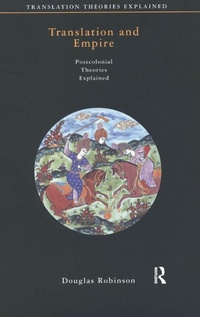
Translation and Empire
Postcolonial Theories Explained
1st Edition
Published on 11. May 2016
Book
Hardback
140 pages
978-1-138-14658-7 (ISBN)
Description
Arising from cultural anthropology in the late 1980s and early 1990s, postcolonial translation theory is based on the observation that translation has often served as an important channel of empire. Douglas Robinson begins with a general presentation of postcolonial theory, examines current theories of the power differentials that control what gets translated and how, and traces the historical development of postcolonial thought about translation. He also explores the negative and positive impact of translation in the postcolonial context, reviewing various critiques of postcolonial translation theory and providing a glossary of key words. The result is a clear and useful guide to some of the most complex and critical issues in contemporary translation studies.
More details
Series
Language
English
Place of publication
London
United Kingdom
Publishing group
Taylor & Francis Ltd
Target group
College/higher education
Dimensions
Height: 240 mm
Width: 161 mm
Thickness: 12 mm
Weight
382 gr
ISBN-13
978-1-138-14658-7 (9781138146587)
Copyright in bibliographic data and cover images is held by Nielsen Book Services Limited or by the publishers or by their respective licensors: all rights reserved.
Schweitzer Classification
Other editions
Additional editions
Douglas Robinson
Translation and Empire
E-Book
04/2014
1st Edition
Routledge
€55.49
Available for download
Douglas Robinson
Translation and Empire
E-Book
04/2014
1st Edition
Routledge
€55.49
Available for download
Book
11/1997
1st Edition
St Jerome Publishing
€62.60
Shipment within 3-4 weeks
Person
Content
1. Postcolonial Studies, Translation Studies
Translation and empire
What does postcolonial mean?
The rise of postcolonial theory
Hegemony, subjectification and interpellation
Language, place and self
Beyond nationalism: migrant and border cultures
2. Power Differentials
Translating across power differentials
Disproportionate translations
'Inscrutable' texts
Stereotypes
Writing for translation
Theorizing across power differentials
3. Translation as Empire: The Theoretical Record
Emperors and displaced populations
The sublimation of empire: Cicero and Horace
Translatio Imperii et Studii
Taking the original captive
Translation and empire
4. Translation and the Impact of Colonialism
Eric Cheyfitz and the colonization of the New World
Repression and hierarch
Projection
Eloquence and dialogue
Property
Centre and periphery
Niranjana and the British interpellation of India
Rafael and the Spanish conversion of the Tagalogs
The hierarch of languages
Confession
5. Resistance, Redirection, and Retranslation
Tejaswini Niranjana and retranslation
Vicente Rafael and mistranslation
Samia Mehrez and metisses
6. Criticisms
Translation and empire
What does postcolonial mean?
The rise of postcolonial theory
Hegemony, subjectification and interpellation
Language, place and self
Beyond nationalism: migrant and border cultures
2. Power Differentials
Translating across power differentials
Disproportionate translations
'Inscrutable' texts
Stereotypes
Writing for translation
Theorizing across power differentials
3. Translation as Empire: The Theoretical Record
Emperors and displaced populations
The sublimation of empire: Cicero and Horace
Translatio Imperii et Studii
Taking the original captive
Translation and empire
4. Translation and the Impact of Colonialism
Eric Cheyfitz and the colonization of the New World
Repression and hierarch
Projection
Eloquence and dialogue
Property
Centre and periphery
Niranjana and the British interpellation of India
Rafael and the Spanish conversion of the Tagalogs
The hierarch of languages
Confession
5. Resistance, Redirection, and Retranslation
Tejaswini Niranjana and retranslation
Vicente Rafael and mistranslation
Samia Mehrez and metisses
6. Criticisms