

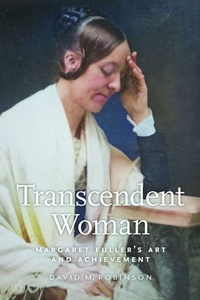
Transcendent Woman
Margaret Fuller's Art and Achievement
Published on 18. July 2025
Book
Paperback/Softback
163 pages
978-1-62534-878-4 (ISBN)
Description
Journalist, editor, critic, translator, and women's rights advocate, Margaret Fuller was America's first major female intellectual. Throughout much of the late-19th and 20th centuries, however, critics and scholars largely saw her as a minor figure in the transcendentalist movement with which she is associated, and her work was considered secondary to that of male figures like Emerson and Hawthorne. While her biography-including her marriage to an Italian noble and her dramatic death in a shipwreck-was often the focus, her skill as a writer was generally overlooked, and her intellectual development largely ignored.
In the early 1980s, David M. Robinson was one of the first scholars to publish an article that focused on Fuller's mind and art. Now Transcendent Woman completes and extends this early work. Outlining the development of her philosophy, which Robinson defines as a "purpose-oriented form of thinking, tailored to the commitment and assets of each individual," he traces Fuller's intellectual journey, first in relation to her family and the people around her in New England and later in her travels in the midwestern United States and, more importantly, through Europe and her residency in Italy. He focuses first and foremost on what Fuller was reading (Goethe was key), what she was thinking as revealed in her letters and journals, and what she was writing, including seminal works such as Summer on the Lakes and Woman in the Nineteenth Century as well as lesser-known essays, translations, and short stories. Drawing extensively on primary sources, Robinson charts Fuller's development and achievement as an original thinker and fearless advocate of democracy.
In the early 1980s, David M. Robinson was one of the first scholars to publish an article that focused on Fuller's mind and art. Now Transcendent Woman completes and extends this early work. Outlining the development of her philosophy, which Robinson defines as a "purpose-oriented form of thinking, tailored to the commitment and assets of each individual," he traces Fuller's intellectual journey, first in relation to her family and the people around her in New England and later in her travels in the midwestern United States and, more importantly, through Europe and her residency in Italy. He focuses first and foremost on what Fuller was reading (Goethe was key), what she was thinking as revealed in her letters and journals, and what she was writing, including seminal works such as Summer on the Lakes and Woman in the Nineteenth Century as well as lesser-known essays, translations, and short stories. Drawing extensively on primary sources, Robinson charts Fuller's development and achievement as an original thinker and fearless advocate of democracy.
Reviews / Votes
"A well-written, well-documented account of Fuller's intellectual achievements by a first-rate scholar, Transcendent Woman makes a significant contribution to the field of American literature." - Susan Belasco, editor of Summer on the Lakes, in 1843 "Robinson does an impressive job of focusing on the origins and growth of Fuller's major ideas and on the artfulness with which she expressed them. Although some 10 or more major biographies have appeared in the last 20 or so years, this account of her art and its import offers something fresh and illuminating." - Larry J. Reynolds, editor of Woman in the Nineteenth Century: A Norton Critical EditionMore details
Language
English
Place of publication
Massachusetts
United States
Target group
College/higher education
Dimensions
Height: 227 mm
Width: 147 mm
Thickness: 11 mm
Weight
250 gr
ISBN-13
978-1-62534-878-4 (9781625348784)
Copyright in bibliographic data and cover images is held by Nielsen Book Services Limited or by the publishers or by their respective licensors: all rights reserved.
Schweitzer Classification
Person
David M. Robinson is Distinguished Professor Emeritus of American Literature at Oregon State University. He has written several books on the Transcendentalists and American literature, including Emerson and the Conduct of Life; World of Relations: The Achievement of Peter Taylor; and Natural Life: Thoreau's Worldly Transcendentalism, and has published widely in numerous edited volumes and journals, including Reviews in American History, American Literary Scholarship, and New England Quarterly.